My sister walked into my dining room last month, stopped dead in the doorway, and said, “Isla. Since when do you own a sideboard that doesn’t wobble.” Which, fair. For about six years, every sideboard I owned had a shim of folded cardboard under one leg and a personality disorder about which side of the room was actually level. She wasn’t being mean. She was genuinely stunned. And that reaction, more than anything a magazine could tell you, is what got me thinking properly about sideboards, about what they’re for beyond just being a long flat surface you dump mail on until Sunday.
A sideboard is doing more work in a room than almost anything else you own.

It’s storage, it’s a display shelf, it’s the thing that anchors a dining room or a living room wall the way a rug anchors a floor. And because it sits low and long, at a height your eye naturally drifts to, every choice you make on top of it and around it gets noticed in a way a tall bookshelf never has to answer for. Get the proportions wrong, and the whole wall feels off even if you can’t say why. Get them right, and it looks like the room was built around the piece, even when the piece showed up eight years after the walls did.
I’ve hunted these things at every yard sale and salvage barn between here and the coast, and I’ve made every mistake there is to make with them, wrong height, wrong depth, one memorable teak disaster with a veneer that had basically given up on life. But I’ve also found the ones that made me actually gasp out loud in a parking lot, which is a specific and slightly embarrassing sound to make over furniture. What I want to walk through here isn’t a rigid style guide. It’s more the handful of sideboard types that keep earning their spot in my house and other people’s, why each one behaves differently when it comes to styling, and the quick rules for balance and height that I wish someone had handed me a decade ago instead of letting me learn them the hard way, one wonky cardboard shim at a time.
[Sideboard Ideas]
Mid-Century Teak Sideboards
Nearly walked straight past the one that changed everything. It was at a barn sale outside Guyton, shoved behind a wall of stacked bed frames, and from the doorway it looked like nothing, just another dark rectangle under a tarp. I almost didn’t bother. Pulled the tarp back anyway, mostly out of habit, and there it was, a long teak sideboard with tambour doors that still rolled smooth as anything, sculpted brass pulls, and a maker’s mark stamped inside the drawer that told me exactly what decade I was dealing with instead of some vague “vintage” sticker slapped on for a markup.
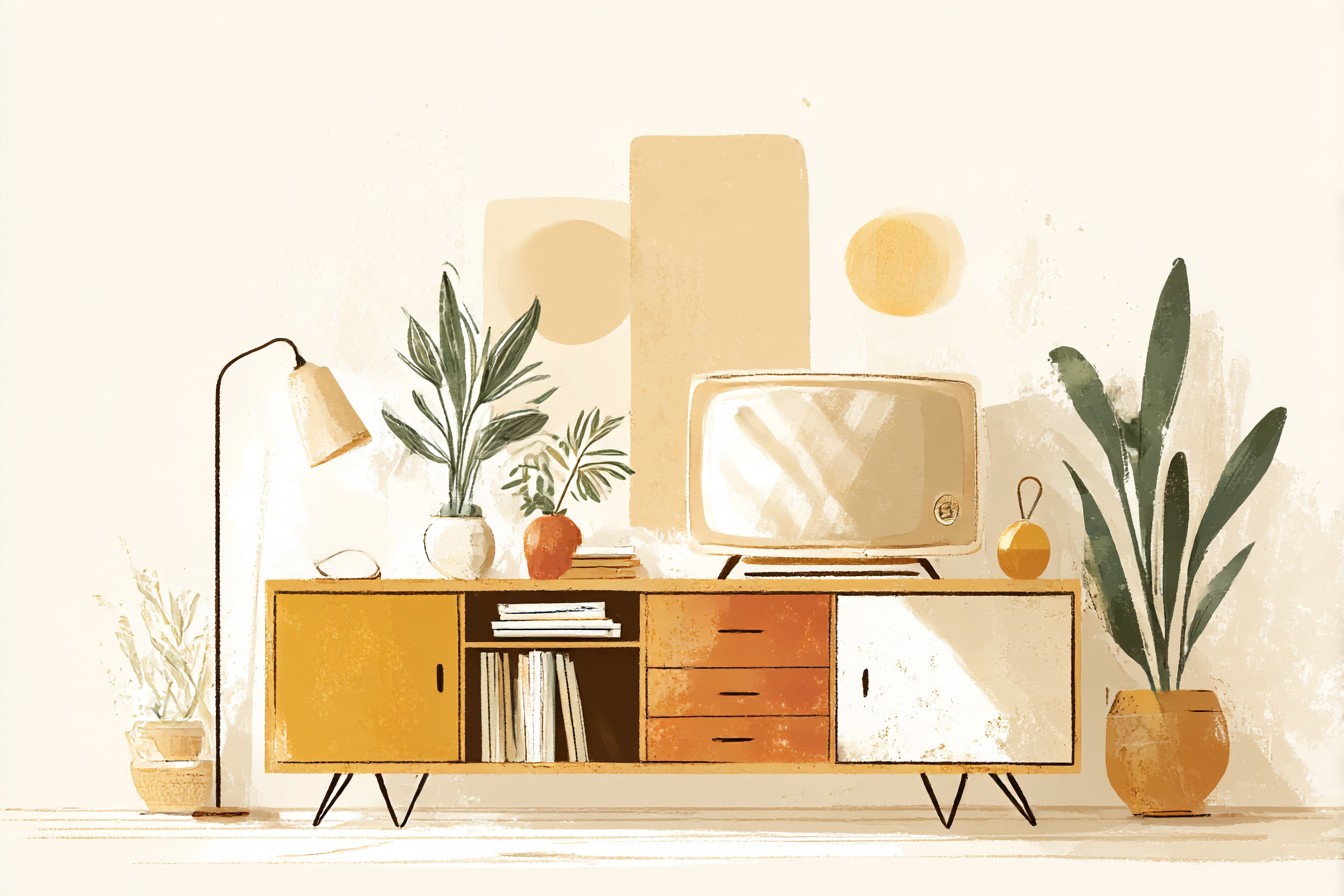
Teak sideboards like that one are low, usually somewhere between twenty six and thirty one inches, and long, often six feet or better, which means the rule of thumb I use every single time is this: nothing goes on top taller than a third of the piece’s own height, unless it’s a single anchor object, in which case it can go up to about half. So on mine, that’s a lamp around fourteen inches, flanked by lower things, never two tall pieces side by side fighting for the same visual space. Balance isn’t matching. It’s weight. A heavy ceramic vase on one end needs something with real presence on the other, not necessarily the same size, just the same gravity.
The woodworm confession, since I owe you one. Fell in love with a teak piece at a different yard entirely, got it home, and found the telltale little exit holes along the back panel that I’d somehow missed under bad lighting and my own excitement. Happens more than I’d like to admit. Now I bring a flashlight and actually check the joints before I hand over cash, no matter how good the light looked at the yard.
[Mid-Century Teak Sideboards]
Painted Vintage Cabinets
There’s a dealer at the Sunday yard who knows exactly what I’m looking for before I’ve said a word, and a few months back he had a low painted cabinet set aside behind the register, didn’t even mention it until I was walking out. Original robin’s egg blue paint, chipped in the honest places, a farmhouse piece that had clearly lived in someone’s kitchen for decades before it landed anywhere near a dining room.
Painted sideboards carry color into a room in a way wood pieces simply can’t, and that’s both the gift and the trap. I avoided anything blue for years after one bad buy, a piece painted a flat, chalky navy that made my whole room feel like a shadow. Turns out the issue wasn’t the color, it was the finish, matte and light absorbing instead of the slightly worn, layered look this newer one has. When the paint has some history in it, some unevenness, it reads as warm instead of heavy.
Height rule with these tends to differ from teak, because painted farmhouse cabinets often run a touch taller, sometimes closer to thirty four inches, so your tallest styled object should sit lower relative to the piece, more like a quarter of its height, or the whole thing tips top heavy. And because the color is already doing so much talking, keep what’s on top quieter. A single stack of plain stoneware, a small dried arrangement, one framed piece leaned rather than hung. Let the cabinet be the loud one in the room. Everything on its surface should be there to support that, not compete with it.
[Painted Vintage Cabinets]
Marble Top Sideboards for Dining Rooms
I’ll admit something. I spent years dismissing marble top sideboards as a bit much, a bit showroom, until I found one at an estate sale with a top so worn and etched from decades of actual dinners that it stopped looking precious and started looking lived in. That’s the whole difference for me now. New marble reads as a statement. Old marble, with its water rings and its faint yellowing near one corner, reads as a record.
You Might Also Like

These pieces are almost always for dining rooms, and they carry weight, literally, so the styling rule shifts entirely toward restraint. Marble already has visual movement in the veining, so anything on top competing for attention just muddies the read. My rule of thumb here is odd numbers and negative space. Three objects, never four, with real gaps between them, so the marble itself gets room to breathe. Height wise, aim low and let one thing rise, a single taller vase or a stack of two serving bowls, no more than about forty percent of the sideboard’s own height, since these tend to sit around thirty two to thirty six inches already and you don’t want to fight the ceiling line above a dining table.
The other thing nobody tells you is that marble tops chip if you’re careless setting hot dishes straight from oven to surface, and I found that out the hard way with a hairline crack near one edge that I now just consider character. Bless it. It’s earned that crack honestly.
[Marble Top Sideboards]
Campaign Chests and Brass Hardware Pieces
The campaign chest I own now came from a yard I’d visited a dozen times without ever finding anything, and I’d nearly stopped bothering with it entirely. Then on visit thirteen, tucked behind three identical flat pack shelving units someone had clearly given up trying to sell, there it was, a proper brass cornered campaign chest, the kind built to be strapped shut and hauled onto a ship, with recessed brass handles worn down to a soft, dull gold from actual hands over actual decades.
Campaign pieces run smaller and boxier than a lot of sideboards, often closer to a chest of drawers in proportion, which changes the balance math completely. Because the piece itself already has strong horizontal lines from the brass corner straps, you want to resist adding more hard lines on top. I keep mine simple, a single lamp with a soft fabric shade, nothing metallic that competes with the existing brass, and one low stack of books turned spine in rather than out, which sounds fussy but genuinely changes how busy the top looks.
Height rule here is the tightest of any piece I own. Because campaign chests sit lower and read visually dense already, nothing on top should exceed about a quarter of the chest’s height unless it’s a single lamp doing the work alone. Two smaller objects will always look cluttered on a campaign piece in a way they wouldn’t on a longer teak sideboard, purely because the chest itself is already so visually busy from the hardware.
[Campaign Chests and Brass Hardware Pieces]
Long Low Console Sideboards for Hallways
These are the pieces I actually go looking for on purpose now, rather than stumbling into, because a good long low console solves a hallway problem almost nothing else can. I found mine at a salvage warehouse an hour outside Savannah, an oak piece that had clearly started life as something else entirely, a stripped down cabinet base maybe, with legs added later by someone handy. Not fancy. Just right for the space.
Hallway consoles get judged on a different rule than dining or living room sideboards, because you walk past them rather than sit in front of them. The eye takes in the whole thing in a glance, which means asymmetry actually reads better than a perfectly centered arrangement. My rule of thumb, one taller anchor object, a lamp or a tall vase, pushed to about a third of the way in from one end, then everything else stepping down in height moving toward the opposite side. It creates a kind of visual walk across the surface instead of a static, centered display that stops your eye dead.
Depth matters more here than height, honestly. A console deeper than about sixteen inches starts eating into hallway space that people actually need to move through, and I learned that lesson bruising my hip on one for a solid month before finally swapping it for something four inches shallower. Small change, completely different hallway.
[Long Low Console Sideboards]
Final Thoughts
If there’s one thing ten years of yard hunting has taught me about sideboards, it’s that the piece itself only does half the job. The other half is what you let yourself put on top of it, and how honest you are about height and weight instead of just reaching for whatever looks nice in the moment. Teak wants restraint and a single tall anchor.

Painted cabinets want quiet company for all that color. Marble wants space around fewer things. Campaign chests want almost nothing at all. Console tables want asymmetry more than balance.
None of that is complicated once you’ve actually lived with a few of these and watched what works. What I’d tell anyone starting out is the same thing I’d tell myself walking into that Guyton barn all those years ago. Check the joints before you fall in love. Bring a flashlight. And trust that the piece that looks like nothing from the doorway is sometimes the one you’ll still be styling a decade later, cardboard shim long since retired.