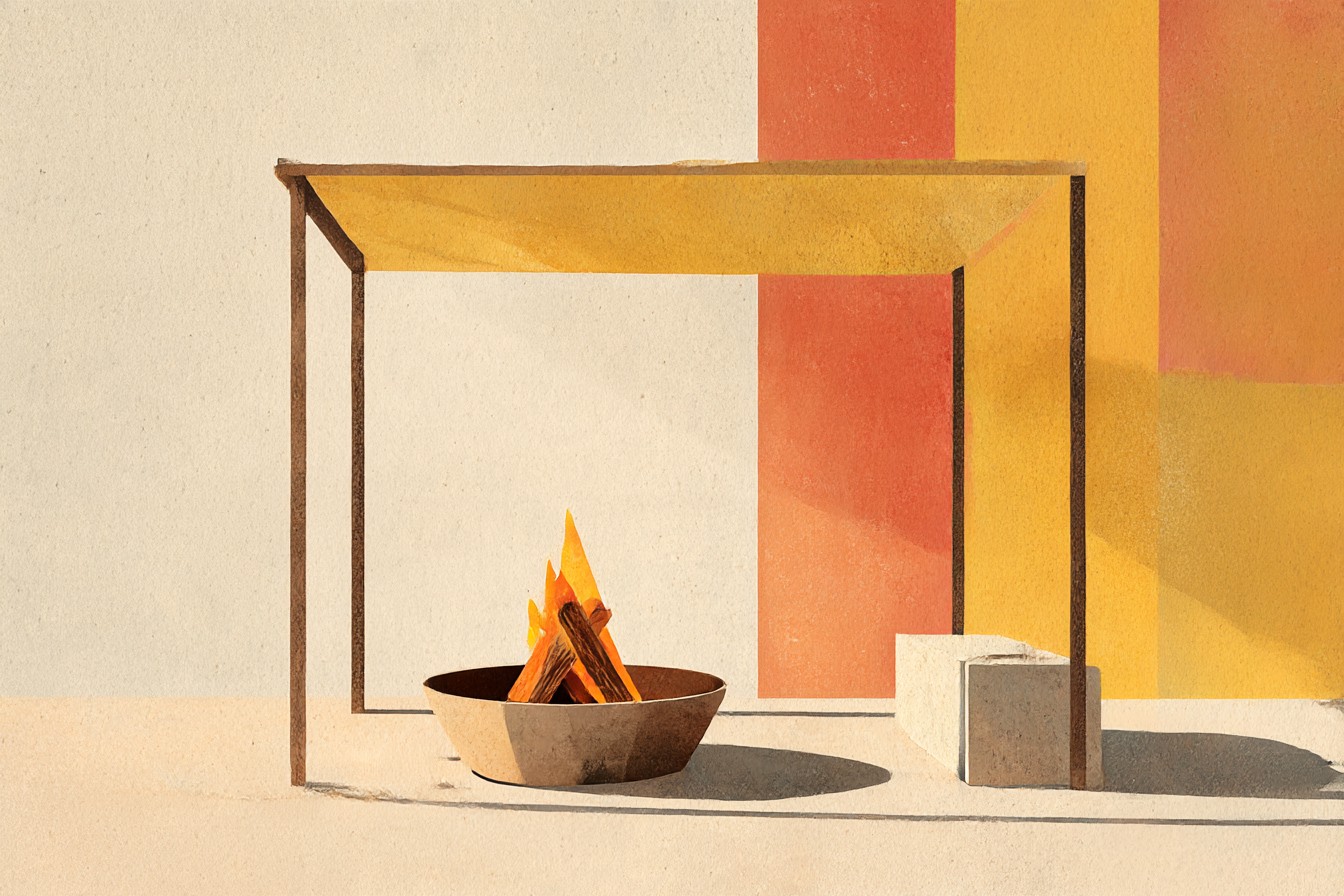
Everyone talks about chimineas like they’re the polite, contained cousin of a fire pit. Something you can tuck into a corner of a deck, light with one match, and forget about until the marshmallows come out. I believed that too, for about a year and a half, right up until I actually owned one and watched it try to fall off my back porch during a fairly unremarkable gust off the Providence River.
My reputation problem with chimineas was that everyone talks about the fire, the sparks, the “will it scorch the wood” question, as though that’s the whole story. It isn’t. The thing that changed my mind wasn’t a spark at all. It was the shape.

A chiminea is basically a bulbous clay or metal belly on short little legs with a tall skinny neck stacked on top of it, like someone built a bowling pin and then set it on fire. That’s an inherently top heavy object, and my deck, like most decks attached to a hundred and thirty year old triple-decker, is not perfectly level, not perfectly still, and gets wind funneled straight down the gap between my house and my neighbor’s in a way that no landscaping magazine photo ever accounts for.
So I want to answer the actual question, can you put a chiminea on a wood deck, but I want to answer it through that lens specifically. Not “is fire near wood bad,” obviously it can be, everyone knows that. I mean the combination that makes chimineas their own particular category of deck hazard: a tall unstable shape, a chimney that throws sparks upward and sideways in wind, and a firebox that gets hot enough underneath to matter even when the flames themselves look perfectly tame and contained. I didn’t get rid of mine. I use it three or four times a season, still, right now, on the same deck. But the way I use it changed completely after that one gust, and I think most of what gets written about chimineas skips straight past the part that actually caused me a problem.
[Chimineas on Wood Decks]
The Shape Itself Is the First Problem
Before I ever lit mine I set it up empty on the deck, mostly to see where it would live, and my downstairs tenant Marcus walked past, looked at it, and said “that thing looks like it wants to fall over.” He wasn’t wrong, and he doesn’t know anything about outdoor fire safety, he was just looking at the physics of it honestly, which is more than the box it came in did.
A chiminea’s center of gravity sits high, in that curved belly and neck, not down low and wide the way a proper fire pit’s does. Mine is cast iron, not clay, which people assume is heavier and therefore safer, but heavier at the top doesn’t help you, it makes the tip more consequential when it happens, not less likely. On a deck specifically, you’ve usually also got boards that aren’t dead level, railings close by that people lean chairs against, and in my case a slight slope toward the drainage gap between decking boards that I only noticed once I’d set a full, lit chiminea on it and watched it look very slightly, unnervingly off center.
The fix wasn’t complicated, it just wasn’t obvious from the marketing. I bought a flat, rigid paver to sit under the legs, leveled properly with a torpedo level, not eyeballed, and I never move it once it’s loaded and burning. If I need to adjust position, I do it cold and empty. That one habit has done more for my confidence around this thing than anything printed on the box.
[The Shape Itself]
Sparks and the Chimney Draw
The chimney neck is the entire design idea behind a chiminea, that’s what pulls smoke up and away from your face, and it works, I’ll give it that, my eyes don’t sting the way they do around an open fire pit. What nobody tells you clearly enough is that the same draft pulling smoke upward is also perfectly happy to pull a lit ember up and out the top, especially once the wood’s burned down to that crackling, popping stage rather than a calm steady flame.
I found this out on a night with barely any wind at ground level, which is exactly the trap, because I’d stopped watching the chimney top by then, I was watching the fire like you’d watch a fireplace. An ember came out the neck, caught a small updraft off the house wall behind it, and landed on the decking about four feet away. It didn’t catch. The board was slightly damp from an evening the night before. That’s the only reason I’m writing this calmly instead of writing about something considerably worse.
I bought a spark screen for the chimney opening after that, the kind that clips onto the top like a small cage, and I genuinely think it should come standard rather than sold separately. I also stopped burning anything resinous, no pine, no anything I’m not completely sure is seasoned hardwood, because wet or sappy wood is what throws the most aggressive sparks in the first place.
[Sparks and the Chimney Draw]
Heat on the Deck Boards Underneath
This is the one I underestimated the most, because the fire itself sits well up off the deck surface, inside that curved firebox, and it looks contained in a way that made me assume the heat stayed contained too. It doesn’t. Cast iron holds and radiates heat downward through those short legs for a genuinely long time, and my deck boards directly underneath went from fine to visibly scorched, a dry, slightly bleached looking patch, over the course of maybe six uses before I noticed.
You Might Also Like

I only caught it because I was moving a plant pot and saw the discoloration properly for the first time in daylight, not evening firelight, which flatters everything. That patch is permanent now. It’s under the chiminea so nobody sees it, but I know it’s there, and it’s the reason I finally bought a proper heat resistant mat rather than continuing to trust four small feet and a paver to manage something burning at several hundred degrees for two or three hours at a stretch.
The mat matters more than people think it does when they’re focused entirely on the sparks flying out the top. Heat traveling straight down through direct contact is quieter and slower than a spark landing somewhere, but it’s doing damage the entire time you’re enjoying the fire, not just in the one dramatic moment.
[Heat on the Deck Boards]
Wind on an Old Porch Changes Everything
My deck sits between two triple-deckers close enough together that wind does something specific there, it accelerates and swirls rather than just blowing through, and I didn’t understand that until I owned something tall enough for it to matter. A fire pit sitting low and wide barely notices that wind. A chiminea, with all its height concentrated well above the ground, catches it properly, and that’s when the top heavy shape from earlier stops being a theoretical problem and becomes an actual one.
The evening it nearly tipped, there was no storm, nothing you’d think twice about, just one of those gusts that comes down the gap between the houses and hits like a shove rather than a breeze. The chiminea rocked, visibly, on its base. I got to it in time. I’ve thought about that moment more than I’ve thought about almost anything else related to this thing since.
Now I don’t light it at all if the forecast mentions sustained wind over about fifteen miles an hour, and I genuinely watch the gap between the houses before I decide, not a weather app, because that gap has its own weather entirely, and no app has ever accounted for it.
[Wind on an Old Porch]
What Actually Made This Workable
I want to be honest that none of this made me stop using it, it just made me use it properly, which took longer than it should have.

The paver and level base solved the tipping issue. The chimney spark screen solved most of the ember problem, though I still watch the top the way you’d watch a toddler near a pool, constant, low level attention rather than trust. The heat resistant mat solved the scorching, and I check underneath it every few uses now, not because I expect a problem but because I didn’t expect the first one either.
What I never solved, and stopped trying to, is the wind. There’s no accessory for that. There’s just judgment, and mine got considerably better after that one rocking, unsteady evening than it was after reading a single box label or online forum post beforehand.
[What Actually Made This Workable]
Final Thoughts
So can you put a chiminea on a wood deck. Yes, mine sits on one right now, has for three seasons, and I’ll light it again this weekend if the wind cooperates. But the honest answer isn’t a flat yes, it’s a yes with the specific list above attached to it, because the risk was never really the fire itself, it was the shape carrying that fire eight feet off the deck on short legs, the chimney throwing embers exactly where you’re not looking, and the heat sitting quietly underneath while you watch the pretty part happening above.
I’d rather tell you about the paver, the level, the mat, and the wind gap between my house and the one next door than tell you it’s simply fine, because “simply fine” is what I believed right up until the evening it very nearly wasn’t. That’s the whole difference between reputation and reality here, not that the danger’s exaggerated, but that it’s specific, and specific problems have specific fixes, once you’ve actually watched one rock on its base at nine in the evening and decided you’d rather not find out what happens next.