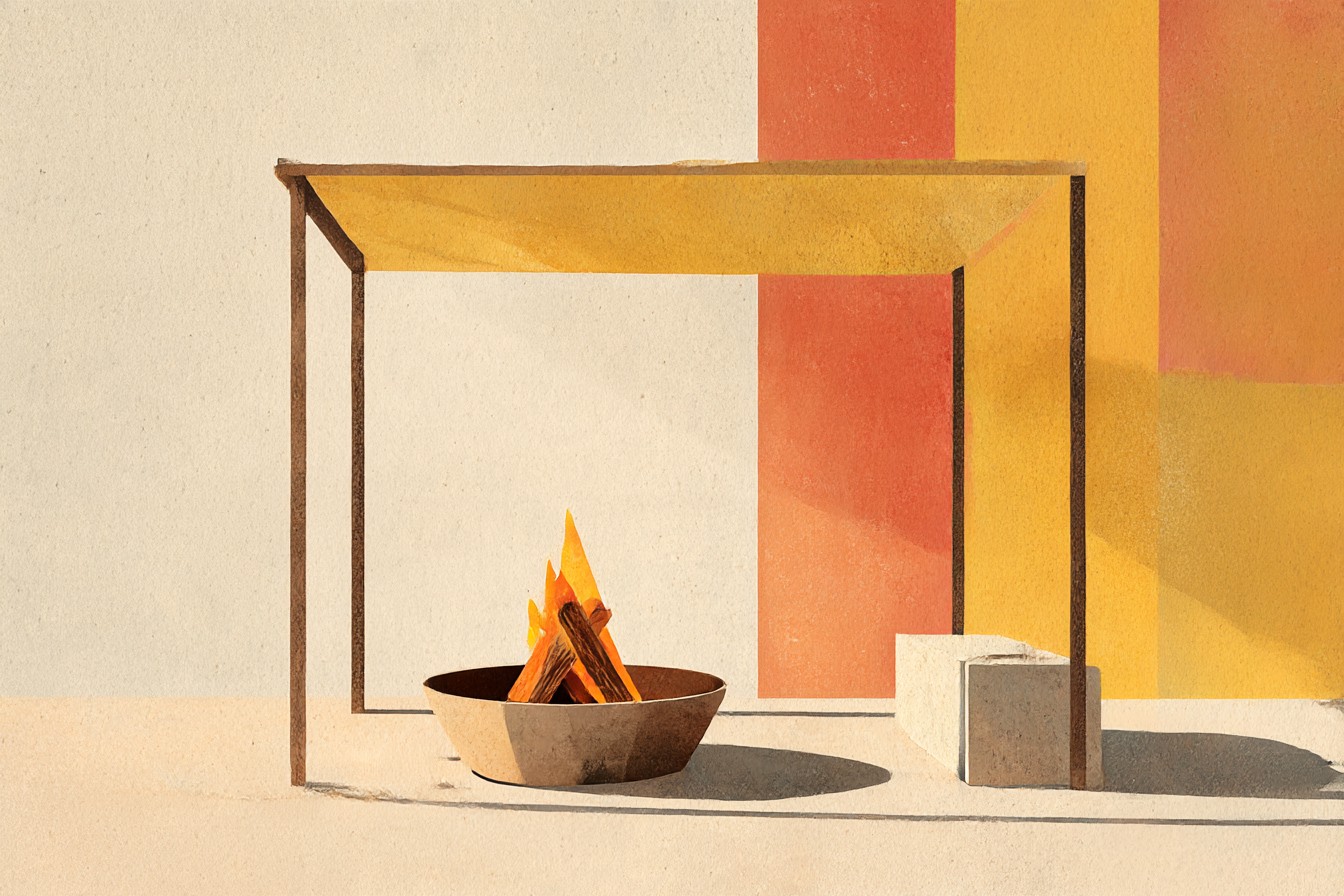
Marcus texted me a photo at eight o’clock on a Friday night. New gazebo, cedar posts, asphalt shingle roof he’d put on himself over a long weekend, and sitting dead center under it, a steel fire pit he’d bought that afternoon from the big box place on 41. The message said “good to light this thing tonight?” like he already knew the answer he wanted. I called him instead of texting back, because some questions deserve a voice, not a thumbs up.
Here’s the thing about a fire pit under a gazebo. As a picture, it’s about as good as outdoor living gets. String lights, the roof keeping the rain off, a couple chairs pulled in close, smoke curling up into the rafters instead of blowing straight into your face like it does out in the open.

I get why people want it. My dad’s had a screened porch for going on thirty years and he still talks about the one summer he ran a chiminea in there before my mom made him drag it back outside, and he still brings it up like it was the good old days instead of a genuinely bad idea he got away with.
But I frame things for a living. I look at a structure and I think about what’s above it, what it’s resting on, and what happens to heat and smoke once they’ve got nowhere honest to go. A gazebo isn’t a chimney. It’s a roof on posts, built to keep sun and rain off a patio set, not to manage an open flame or a gas burner underneath it. The romance of the picture is real. So is the physics happening about eight feet above your head, and so is the air quality happening at head height if the sides are closed in even a little.
This isn’t a hard no across the board. It’s a “depends entirely on the structure you’ve actually got” answer, and that’s the part that gets skipped when someone posts a nice photo and everyone in the comments says cozy without asking a single question about airflow. So let’s actually go through it, the way I’d walk a job before I quoted it. Structure first, then roof, then the fire source itself, because those three things determine whether you’re looking at a nice evening or a call to your insurance company.
[A Fire Pit Inside A Gazebo]
Open Sided Gazebos
Start with the structure, because it’s the first thing I’d check on any job and it’s the first thing that decides this question. A true open sided gazebo, the kind with a roof and posts and nothing else, no screens, no curtains, no half walls, is a completely different animal from anything with sides on it. Smoke and heat can actually move. They rise, they hit the underside of the roof, and if there’s real open air on all sides they keep moving out past the eaves instead of pooling.
I built one for a neighbor two summers back, standard hip roof, eight posts, nothing enclosing it at all, and even then I told him to keep the fire pit off center and closer to one open side rather than dead in the middle, because the middle is where smoke sits longest before it finds an exit. He thought I was being fussy. He wasn’t thinking it three weeks later when his wife wanted to sit under there in a cardigan with the fire going and not smell like a campfire for two days after.
Where this goes wrong is the gazebos that started open and didn’t stay that way. Vinyl weather panels zipped onto the sides for winter. Mosquito netting that someone’s swapped for heavier curtains once the bugs got bad. Every one of those decisions makes sense on its own and every one of them turns an open structure into something closer to a tent with a hard roof, which is exactly the kind of enclosed space you don’t want an open flame or a gas burner sitting inside. If your gazebo’s got sides on it right now, of any material, that’s not a fire pit structure anymore until those sides come off, full stop.
[Open Sided Gazebos]
Gazebo Roofs and Clearance
Above the fire pit, the two things that matter are height and material, and most people only ever think about the first one. Height’s the obvious one, and there’s a reason manufacturers publish minimum clearance numbers, usually somewhere around eight to ten feet from the fire pit’s flame to the underside of the roof structure, more for anything gas with a bigger flame profile. Heat doesn’t spread out evenly on the way up, it concentrates, and a roof that’s sitting closer than that is taking direct, sustained heat exposure it was never built to handle.
Material’s the part that actually worries me more, because I’ve framed enough of these roofs to know what’s usually up there. Asphalt shingles over OSB decking, which is what most prefab gazebo kits ship with because it’s cheap and it looks the part in a catalog photo. That combination doesn’t need flame contact to fail. Sustained radiant heat alone can soften shingle adhesive, dry out the OSB faster than it should, and over a season of regular fires you’ve aged that roof structure in ways that don’t show up until the day it actually fails. A metal roof handles heat a lot better than shingle ever will, and a few of the higher end gazebo kits are moving that direction for exactly this reason, but even metal roofing over untreated framing timber isn’t a green light to run a big fire underneath it every weekend.
Sparks are the other half of this. Wood fires throw them, gas doesn’t really, and that difference alone should steer which fire source you’re even considering under a roof. A spark landing on shingle isn’t usually catastrophic, but it’s not nothing either, and I wouldn’t want to be the one explaining that risk to an insurance adjuster after the fact.
[Gazebo Roofs and Clearance]
Wood Burning Fire Pits
I’ll say this plainly. Wood burning fire pits and gazebos are a bad combination, and I don’t hedge that one much. Wood fire is unpredictable in a way gas isn’t, flame height varies with what you’re feeding it, sparks are part of the deal whether you like it or not, and smoke volume is genuinely difficult to control once the wood’s caught properly. Under an open sky, all of that dissipates. Under a roof, even a properly open sided one, you’re putting all of that directly against a structure that’s got nowhere to send it but sideways and up into timber framing.
You Might Also Like

I took a look at a friend’s setup a while back, secondhand fire pit, gazebo he’d inherited from the previous homeowner, and the underside of that roof had a scorch pattern on the rafters directly above where the pit sat, dark, almost black in the center, fading out toward the edges. Nobody had ever caught fire. Nothing had ever gone wrong in any dramatic way. But that pattern was heat damage building up fire by fire, and it told me everything about where that structure was headed if nothing changed. Wood doesn’t need a big dramatic failure to cause a problem. It just needs enough repeated exposure.
If you’re set on wood specifically, under a roof isn’t the place for it. Move it out from under the structure entirely, well clear of the eaves, or switch what’s actually burning. That’s not me being precious about it, that’s just what the material does whether we like the tradition of it or not.
[Wood Burning Fire Pits]
Gas and Propane Fire Pits
Gas and propane fire pits solve some of the wood problems and introduce a different one entirely, and this is the part where I stop talking about roofs and start talking about air, because it matters more here than anywhere else in this whole conversation. Any open flame appliance, gas included, consumes oxygen and produces carbon monoxide as part of combustion. Outside, in genuinely open air, that’s not a meaningful risk because it disperses as fast as it’s produced. Under a gazebo with sides on it, or even one with limited airflow because of where it’s positioned against a house or a fence line, that CO doesn’t have anywhere reliable to go.
Propane specifically worries me more than natural gas here, because propane is heavier than air. If it’s not combusting cleanly, or if there’s a leak before it even reaches the burner, it doesn’t rise and drift off the way you’d hope. It sinks and pools low, right around ankle and knee height, which happens to be exactly where the people sitting around the fire pit are breathing if they’re standing up to grab another drink. That’s not a maybe. That’s just what the gas does.
None of this means gas fire pits can’t work under a gazebo. It means the structure has to actually be open on the sides, genuinely open, not open with the curtains drawn most of the way, and the unit itself needs to be rated for the clearance and BTU output the manufacturer actually specifies, not whatever feels close enough by eye. I wouldn’t run a gas fire pit under any structure I couldn’t confirm was moving air properly, and neither should you.
[Gas and Propane Fire Pits]
Ventilation and Safety Gear
This is the section I’d want someone to read even if they skipped everything above it. If you’re running any fire pit under any gazebo, wood or gas, you need a carbon monoxide detector rated for outdoor or semi enclosed use out there with you, not just the one bolted to a wall inside your house. CO doesn’t announce itself. No smell, no color, no warning sign until people start feeling headachy or dizzy and by then you’re already behind the problem instead of ahead of it.
Beyond the detector, check what the fire pit manufacturer actually specifies for clearance and ventilation, printed right there in the manual most people never open. Those numbers aren’t decoration. They come from actual testing, and they’re usually more conservative than whatever a gazebo kit’s own installation guide assumes, because the gazebo manufacturer never pictured a fire source going underneath it in the first place. Two sets of specs that were never designed to talk to each other, and you’re the one standing in the middle deciding whether they’re compatible.
Practically, that means treating airflow as a real design decision, not an afterthought. Keep at minimum two, ideally more, sides genuinely open with nothing zipped or clipped across them while the fire’s going.

Position seating so nobody’s parked directly in the path smoke naturally travels toward the lowest point of the roofline. And build in an honest habit of checking the underside of that roof every season for the kind of scorching I mentioned earlier, because that discoloration is the structure telling you something before it tells you something worse.
[Ventilation and Safety Gear]
Final Thoughts
I told Marcus to hold off lighting his that night, and he wasn’t thrilled about it, but a week later he’d swapped the fire pit for a smaller propane model, pulled the vinyl panels off two sides of the gazebo permanently, and put a CO detector on one of the posts at head height. That’s the honest answer to the whole question. Not never, and not without thinking either.
A fire pit under a gazebo can work. It works when the structure’s genuinely open on the sides, when the roof’s got real clearance and isn’t already scorched from past fires, and when whatever’s burning down there, wood or gas, is matched to a space that can actually move air through it. It doesn’t work as a picture you copied from somewhere without checking what your own structure is built like underneath. Those are two different projects wearing the same photo.
I’d rather tell someone their setup needs changes before they light it than get a call after. That’s just how I look at any structure, fire pit or otherwise, before I trust it to hold what it’s meant to hold.