
My mom walked into my living room in February, took one look at the ceiling, and said, “Are those the lights from the porch?” Not a question, really. More like she’d already done the math on how her daughter, a grown woman with a job at the county hospital system, ended up with a string of outdoor bulbs zip tied to a curtain rod in her actual living room, the one with the couch and the rug and everything, like it was a screened in porch that lost an argument with a hurricane.
Yes, Mom. They were the lights from the porch. Or they would have been, if I’d ever gotten around to putting up the porch I don’t have, because I live in a rowhouse with a stoop, not a porch, and I bought a forty five dollar box of outdoor globe string lights on a Home Depot end of season clearance rack in September because the box said seventy percent off and my brain stopped doing anything else useful for about four minutes.
Here’s the thing nobody tells you when you’re standing in that aisle doing the math wrong on purpose because the discount feels too good to argue with: outdoor string lights and indoor string lights are not the same product wearing different packaging. They look almost identical on the shelf. Same warm little bulbs, same coiled green wire, same promise of “cafe vibes” on the box, whatever that means.
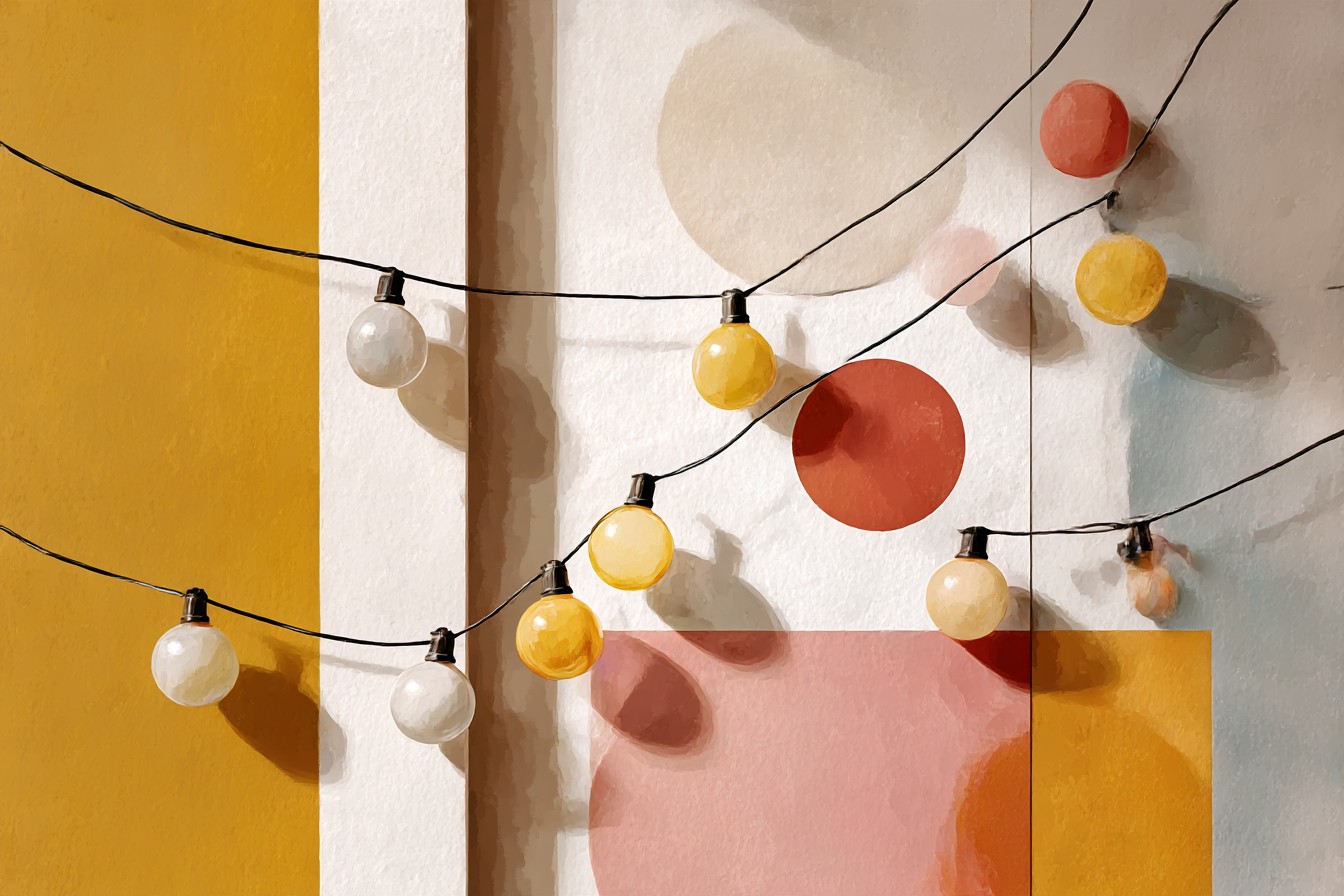
But everything about how an outdoor set is built exists to solve a problem you don’t have inside your own living room. Rain. Wind. Temperature swings. Bugs getting into a socket. None of that happens between your ceiling and your bookshelf, and yet you’re paying for the solution anyway, every single time, whether you notice it or not.
So I hung mine up. Obviously. I’m not going to tell you I returned them and lived a sensible life, because that’s not this blog and it’s definitely not me. What I did instead was live with them for four months, notice every single thing that was wrong for the room, and start keeping a mental list, which is basically my whole personality at this point. Ledger’s got a new entry. Let’s talk about what’s actually on it.
[Outdoor String Lights]
The Plug Is the First Clue
Turn the plug over in your hand before you buy anything, that’s rule one, and I didn’t do it, which is exactly why I’m writing this section with feeling.
Outdoor string lights come with a plug built for a different job. Big, chunky, usually rubber coated, sometimes with a little flip up cover over the prongs like it’s expecting to get rained on directly, because it is designed to. Mine has a grounded three prong plug the size of a small potato, and I say that with love because I’ve now dropped it on my foot twice reaching behind the couch.
Indoors, that plug is doing nothing for you. There’s no water event it’s protecting against, there’s no need for the third ground prong most of the time, and it takes up double the space at the outlet, which matters more than you’d think when you’ve only got two outlets behind a couch and one of them’s already got a lamp and a phone charger fighting for it. I did the math on buying a cheap outlet extender just to accommodate the stupid plug, four dollars, fine, not a big deal, except then I needed a second one for the other end of the run and that’s eight dollars I spent solving a problem that an indoor rated set would never have created in the first place.
[The Plug]
The Cord Was Built for a Yard, Not a Wall
The cord is the part I actually resent the most, if I’m honest, more than the plug even.
Outdoor cord is thick rubber, usually a dark green or black, stiff in the cold, and heavy in a way that fights you when you’re trying to drape it gently along a picture rail. I tried pinning mine with the little clear adhesive hooks you get at the hardware store, the kind that hold, I don’t know, a picture frame or a small wreath. Three of them popped clean off the wall within a week because the cord itself has weight and stiffness that indoor cord just doesn’t carry. Indoor sets use a thinner, more flexible cord, usually a cloth covered or lightweight vinyl wire, because it’s never going to be dragged across a deck or coiled up in a shed all winter. It’s made to bend around a doorframe and stay there.
I ended up buying actual cup hooks and screwing them into the trim, which worked, but that’s a whole extra step and eleven dollars in hardware I wouldn’t have needed if I’d bought the right product to begin with. Cost per year on the lights themselves is fine, genuinely fine, we’ll get to that math, but the hidden cost of making the wrong cord behave in the wrong room is the part that never shows up on the receipt.
[The Cord]
You Might Also Like

The Waterproofing You’re Paying For and Never Using
This is the one that actually annoys me, because it’s the whole reason the product costs what it costs, and none of it does anything for you on a living room ceiling.
Outdoor string lights are IP rated, usually somewhere around IP44 or IP65 if they’re the good ones, which means sealed sockets, rubber gaskets around each bulb, sometimes a little rubber boot you have to peel back to even access the plug. All of that engineering exists so the thing survives a thunderstorm on your patio without shorting out. It’s genuinely clever when you think about what it’s built to withstand. But in my living room, forty feet from the nearest window, that gasket is just extra plastic bulk around every single bulb, making the whole string heavier, thicker, and honestly uglier up close than the delicate little indoor sets that don’t need to survive anything more dramatic than a candle getting blown out nearby.
I actually pulled one bulb apart to look at the seal, because I’m the person who checks a joint before deciding an item’s worth writing about, and it’s a proper rubber gasket, nicely made, doing a job that will never once be asked of it in my house. That’s money spent on a feature I’ll never use, and once I clocked that, I couldn’t unsee it. TWENTY DOLLARS of that forty five dollar box, by my rough count, was waterproofing I paid for and get zero benefit from indoors. That’s the moment the clearance discount stopped feeling clever.
[Waterproofing]
The Bulbs Are Where the Outdoor Set Actually Wins
Okay, fairness check, because I did promise I’d admit when something’s actually good and not just drag the whole box through the mud.
The bulbs on my outdoor set are genuinely nicer than most indoor fairy light sets I’ve owned. Bigger, warmer, proper little Edison style filament bulbs instead of the tiny rice grain ones that come on the delicate copper wire strands everybody puts around a mirror. They throw real usable light, not just decorative glow, which matters in my living room because the overhead fixture is weak and I’ve basically been using these as a second light source since October. That’s not nothing. A coworker of mine, Renata, who has opinions about resale value on literally everything I own, saw a photo I posted and asked where I got them, assuming they were some pricier indoor brand, which felt like a small win even though I know it doesn’t undo the plug situation.
So the bulbs are the good column. If I’m doing the ledger honestly, that’s buy number five for the year that’s split down the middle, half regret over the hardware, half genuine relief that the light itself is better than anything I’d have picked from an indoor specific display.
[The Bulbs]
What I’d Actually Buy Next Time
If I’m redoing this, and I probably am redoing this the second my current set gives out, I’m buying indoor rated string lights and paying full attention to what that label actually gets me. Thinner cord that drapes properly along trim. A slim two prong plug that doesn’t need its own outlet negotiation.

No rubber gasket bulk I’m never going to use. And usually, weirdly, a lower price, because you’re not paying for weatherproofing you don’t need.
I did the cost per year math on my current set three times, because the first two answers annoyed me. Forty five dollars, I’ll get at least three years out of them realistically, that’s fifteen dollars a year, which is fine, genuinely fine, four cents a day and I’m not returning them over principle. But if I’d bought an indoor set for twenty two dollars, which is roughly what they run at my corner thrift shop’s new old stock shelf when the volunteer restocks on Fridays, I’d have hit the same three years for about seven dollars a year less, and I’d have never dropped a plug on my foot.
[Indoor Alternatives]
Final Thoughts
Can you use outdoor string lights in the living room? Yes, obviously, mine are still up, they’re staying up, I’m not a hypocrite about my own bad decisions. But “can you” and “should you buy them for that purpose specifically” are two very different questions, and I answered the wrong one back in September because a clearance sticker did something to my judgment that I still can’t fully explain.
If you already own an outdoor set and you’re wondering whether to bring it inside for the winter, do it, enjoy the better bulbs, just budget a few extra dollars for hooks and outlet space you didn’t think you’d need. If you’re starting from scratch, buy the indoor set. It’s built for the job you’re actually asking it to do, it’s usually cheaper, and nobody’s mother is going to walk into the room and ask if you moved the porch inside.



[…] trick is coiling, not draping. If you just drop a string of lights in, it pools at the bottom in a tangle and looks exactly like what it is, a bundled cable. Coil it […]
[…] is basically me working through the question out loud, the same way I worked through it on the living room floor that afternoon. Can you actually have both? An ottoman and a coffee table, doing their […]
[…] about the sofa itself, it’s about what the thing was even for. One camp bought it as a proper outdoor room, the kind of purchase where you picture yourself out there most evenings with a book and something […]