
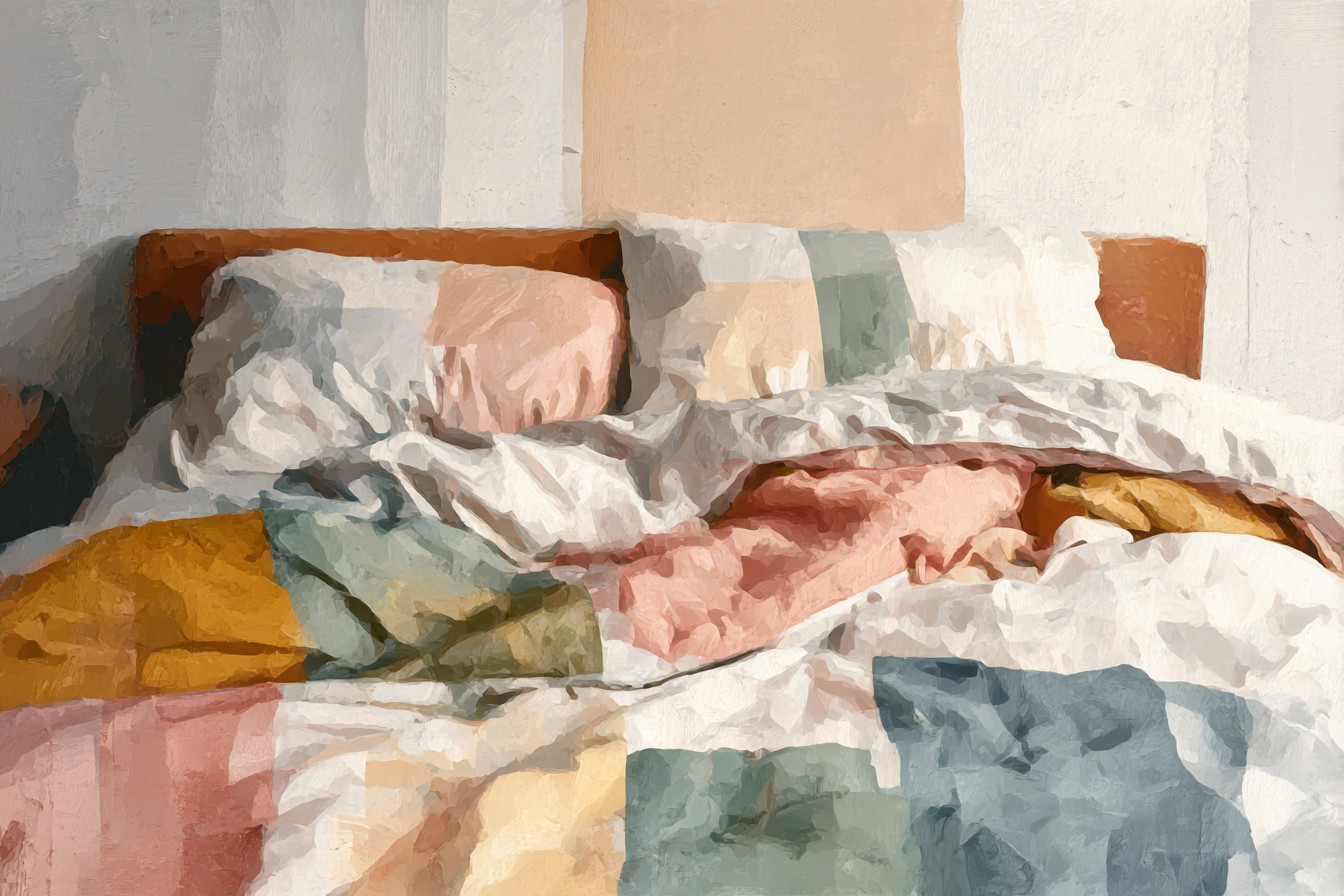
I’ve slept in a bed with no headboard for going on six years now, ever since the actual headboard I owned, a sad particleboard thing from a big box store, finally gave up and cracked clean through the slat holes during a move to a rental on Bull Street. I never replaced it. Partly because headboards in Savannah antique shops run about three hundred dollars for anything with real bones, and partly because somewhere around year two I noticed I’d rearranged what was behind that bed eleven separate times and hadn’t missed the headboard once. Eleven. I counted them up recently sitting on the floor of that same bedroom, going through old photos on my phone looking for something else entirely, and there it was, a little visual diary of every phase I’d gone through trying to fill that wall.
Here’s the thing nobody tells you when your headboard breaks or you buy a bed frame that never had one to begin with, which is more common than you’d think, plenty of good iron frames and low platform beds are built that way on purpose. The wall behind your bed isn’t a problem to solve once.

It’s a spot that gets to change its mind as often as you do, without you having to haul a hundred pound wooden thing to the curb every time. A headboard is a decision. What goes behind a headboardless bed is more like a conversation you keep having with the room.
I say this as someone who has genuinely tried nearly everything back there. Leaning mirrors, wallpaper I regretted within a season, a shelf that fell down at 2am and scared my cat half to death, and eventually some things that actually stuck. What follows isn’t a ranked list, because half of what worked for me won’t suit a room that gets less light or has lower ceilings or belongs to someone who hates clutter more than I do. It’s more the story of what I tried, what fell over, literally, and what earned its spot on that wall for good. Wall treatments first, because that’s the base layer everything else sits on top of.
[Beds With No Headboard]
Wall Treatments That Do the Heavy Lifting
The first thing I did, before I owned a single decent piece of salvage, was paint. Just paint, a deep clay red called something ridiculous like Autumn Harvest that I found on clearance at a hardware store off Victory Drive because it was the wrong color for whoever ordered it. I only painted the one wall behind the bed, floor to ceiling, and left the rest of the room a boring off white. It did more work than any object I’ve bought since. There’s something about a saturated color stopping right at the edges of where a headboard would have been that tricks your eye into reading it as furniture rather than wall.
Wallpaper does the same trick but louder. I went through a phase with a botanical print, dark green with these oversized cream magnolias, that I put up myself with a level I borrowed and never returned, bless that friend’s patience. It bubbled slightly near the baseboard because I rushed the smoothing, a mistake I’d make again if I’m honest, because even bubbled it looked more finished than the bare drywall it replaced. Peel and stick versions have come a long way if you’re renting and can’t commit, though I’ll say the cheap ones peel back at the corners within about a year, mine did exactly that above the bed by month eleven.
Paneling is the quieter option and the one I’d actually recommend first to anyone nervous about commitment. A run of tongue and groove boards, painted or left raw, gives you texture without asking you to pick a print you might hate by Christmas. I found a stack of old beadboard at a salvage yard out past Thunderbolt, water damaged on one end but perfectly good for the last four feet, and used it behind a guest bed. Cost about eleven dollars and an afternoon with a miter saw I don’t fully trust myself with.
[Wall Treatments]
Architectural Salvage, Leaned Rather Than Hung
Nearly didn’t bother with the Sunday yard out near Bacon Park one weekend, the gate looked like it hadn’t been touched since spring, just flat pack shelving stacked four deep and a dumpster nobody had emptied. I almost turned the car around. Then behind three identical radiators, shoved sideways like it was embarrassed to be there, was a pair of old shutters, louvered, paint worn down to bare wood in a pattern that only happens from decades of actual sun, not distressing done with sandpaper in someone’s garage. The dealer who runs that yard most Sundays kept them back once he saw me circling, didn’t even ask if I wanted them held, just knew.
Those shutters live leaned against the wall behind my bed now, not mounted, just resting there at an angle with the headboard height they were always meant to sit at. That’s the trick with salvage like this. An old door, a section of iron fencing, a church window frame with the glass long gone, none of it needs hardware if it’s tall enough to lean and heavy enough not to slide. It reads as intentional in a way a mounted piece sometimes doesn’t, like it wandered in from somewhere with more history than your bedroom and decided to stay.
I’ll admit I’ve gotten this wrong too. Fell hard for a pair of shutters at an estate sale off Wheaton Street, got them home, and found woodworm damage I’d somehow missed entirely in the dim light of that stranger’s carport, which happens more than I’d like to admit for someone who’s been doing this a decade. Check the joints. Check for that fine sawdust trail along the bottom edge. Ask the dealer straight out if they know the piece’s actual age rather than trusting a sticker that says antique.
[Architectural Salvage]
Shelves, When You Want Function Along With Presence
The shelf that fell on my cat wasn’t the shelf’s fault, it was mine, I’d mounted it into drywall with the wrong anchors because I was in a hurry and didn’t want to find a stud finder at 9pm. It came down with a stack of books and a candle and scared poor Biscuit into the closet for two hours. Lesson learned. Find the studs, or use a French cleat rated for actual weight, because a shelf behind a bed gets treated like furniture whether you meant it to or not.
You Might Also Like

Once I did it properly, with a long floating shelf salvaged from an old shopfitting job a dealer friend was clearing out, cut down to fit and refinished with dark wax, it became the single most useful thing I’ve put in that room. A lamp on each end, a stack of books in the middle, room for a framed photo that gets swapped out more than anything else in the house. It sits at roughly headboard height, low enough that pillows can lean against the wall beneath it, which gives you the visual anchor of a headboard with actual storage thrown in.
Two shelves, one above the other, work even better if your ceiling allows it, staggered so they don’t read as too matched. Mine aren’t identical on purpose, one’s a proper piece of reclaimed pine, the other’s a plain bracket shelf from a hardware store I’m not precious about at all. Nobody’s ever clocked the mismatch. They just see storage and warmth where drywall used to be.
[Shelves as Headboards]
Pillows and Bolsters, Doing the Job of Upholstery
This one’s less about the wall and more about faking the shape a headboard gives you, which is really what people miss most, not the object itself but the sense of something solid to lean against reading in bed. A run of oversized European shams stacked two or three deep against the wall does that job for almost nothing. I use a set of linen ones in a rust color I found through a secondhand textile seller at a market off Habersham, the covers alone were four dollars each, and they get washed constantly because I drink coffee in bed like it’s a personality trait.
A long bolster cushion, the kind that spans most of the width of the mattress, gives you a firmer line underneath the softer pillows, almost like the frame of a headboard hiding under upholstery you can rearrange whenever the mood strikes. I made mine from a length of vintage grain sack fabric wrapped around a foam roll I ordered online, which took me an entire Saturday and more hand stitching than I’d care to admit for something nobody sees the back of.
The honest downside, and I’ll say it plainly, is that this only works if you’re willing to fluff and rearrange fairly often. Left alone for a week they slump sideways and start looking less like a design choice and more like you gave up halfway through making the bed. Worth it anyway, for the price and the flexibility, but go in knowing it asks a little upkeep of you.
[Pillow Arrangements]
Vintage Textiles, Hung Rather Than Worn Out on a Bed
Quilts get sold as bed coverings, always, every yard I’ve ever been to has a stack of them folded on a card table, priced by how worn the binding is. What almost nobody does is hang one instead, which I only tried because a particular quilt I found, hand stitched, a faded double wedding ring pattern, had a tear along one entire side that made it useless as actual bedding but didn’t show at all once it was hung flat against the wall with a simple wooden dowel through a fabric sleeve I sewed onto the back.
It’s become my favorite thing in that bedroom, full stop. There’s a warmth a stitched textile gives a wall that paint and paneling can’t quite match, some softness in the weave that catches the afternoon light differently depending on the season. I’ve since done the same with a smaller piece, a woven coverlet from an estate sale that smelled unmistakably of someone else’s cedar closet for the first two washes, hung above the bolster pillows as a second, lower layer.
The one warning I’d give, because I learned it the annoying way, is check for moth damage before you buy, not after you’ve hung it and lived with it for six months.

Hold it up to a window. Look for the tiny pinprick holes that don’t show under yard lighting but absolutely show once you’ve got it home and the sun’s coming through your own windows instead.
[Vintage Textiles]
Final Thoughts
If I’m honest, the thing that took me longest to accept is that a headboardless bed isn’t a problem waiting for a permanent fix. It’s an invitation to keep experimenting in a way a real headboard never really allows, because once you’ve spent three hundred dollars on a tufted velvet one, you’re stuck with it whether you still love it or not. Behind my own bed right now, it’s the shutters and the quilt together, layered in a way I never would have planned on paper, and I fully expect that to change again by next spring, because it always does.
What ties all five of these together, paint, salvage, shelving, pillows, and textiles, is that none of them ask you to commit the way a headboard does. You can paint over a color. You can swap a quilt for a mirror. You can move a shelf six inches to the left when you finally admit the anchors were wrong the first time. That flexibility is the actual gift of not having a headboard at all, even if it took me eleven attempts and one very startled cat to figure that out properly.



[…] bottle from 2019 still in its box, your hairbrush, a small tray for the rings you take off before bed and the earrings you put on in the morning, that’s the real daily cast. These are the things your hand should be able […]