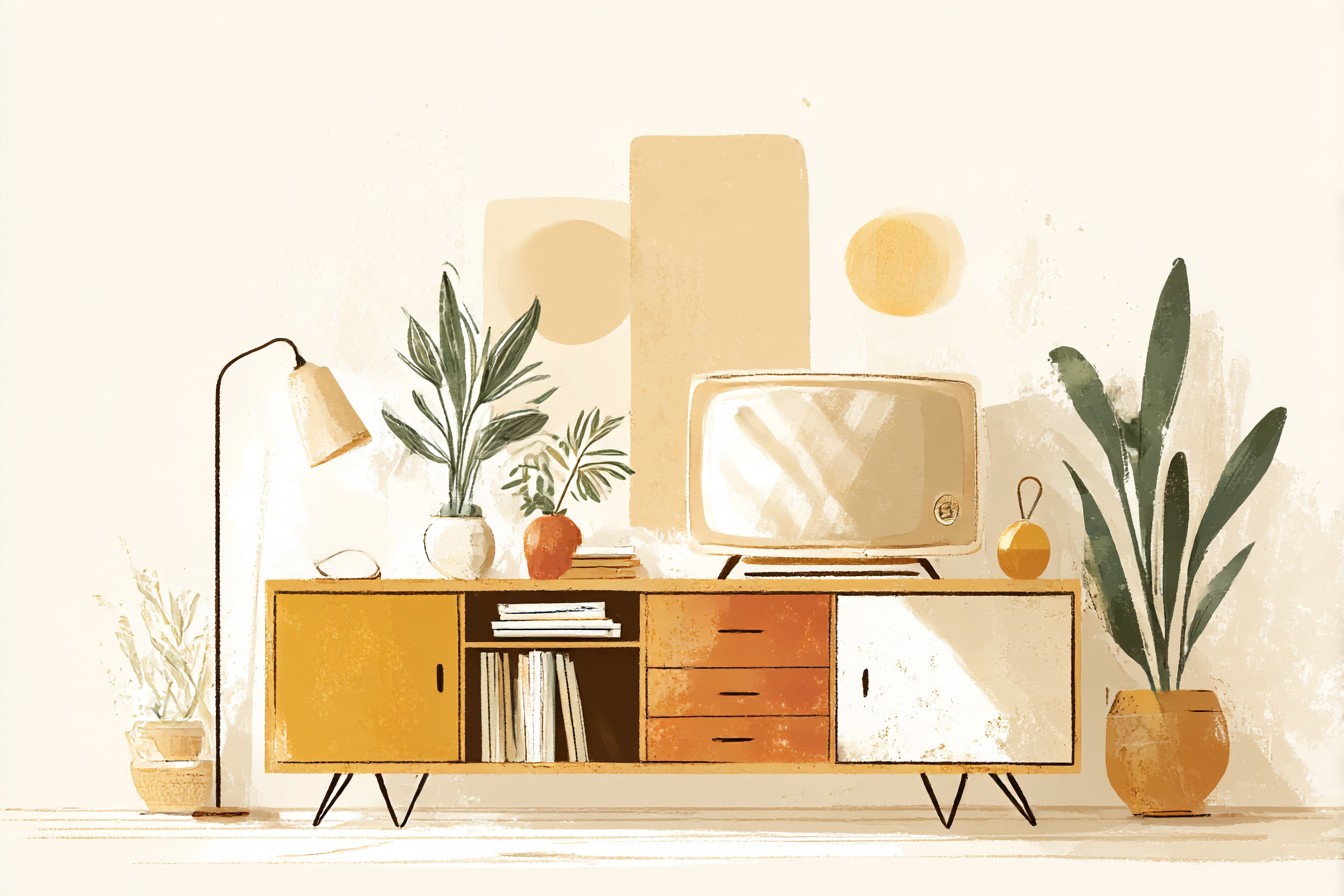
I own fourteen things right now whose entire job in life is to sit on either side of my TV stand and look like they didn’t cost anything, when at least three of them absolutely did. Fourteen. I counted them properly last Tuesday because my downstairs neighbor came up to borrow a drill and stood in my living room for a solid ten seconds just looking at the console table situation like she was doing inventory for an estate sale. Two lamps. One plant that’s real and thriving out of pure spite because I forget to water it. One plant that’s fake and looks it, from an angle, in certain light, which is the only angle and light I now arrange the room around.
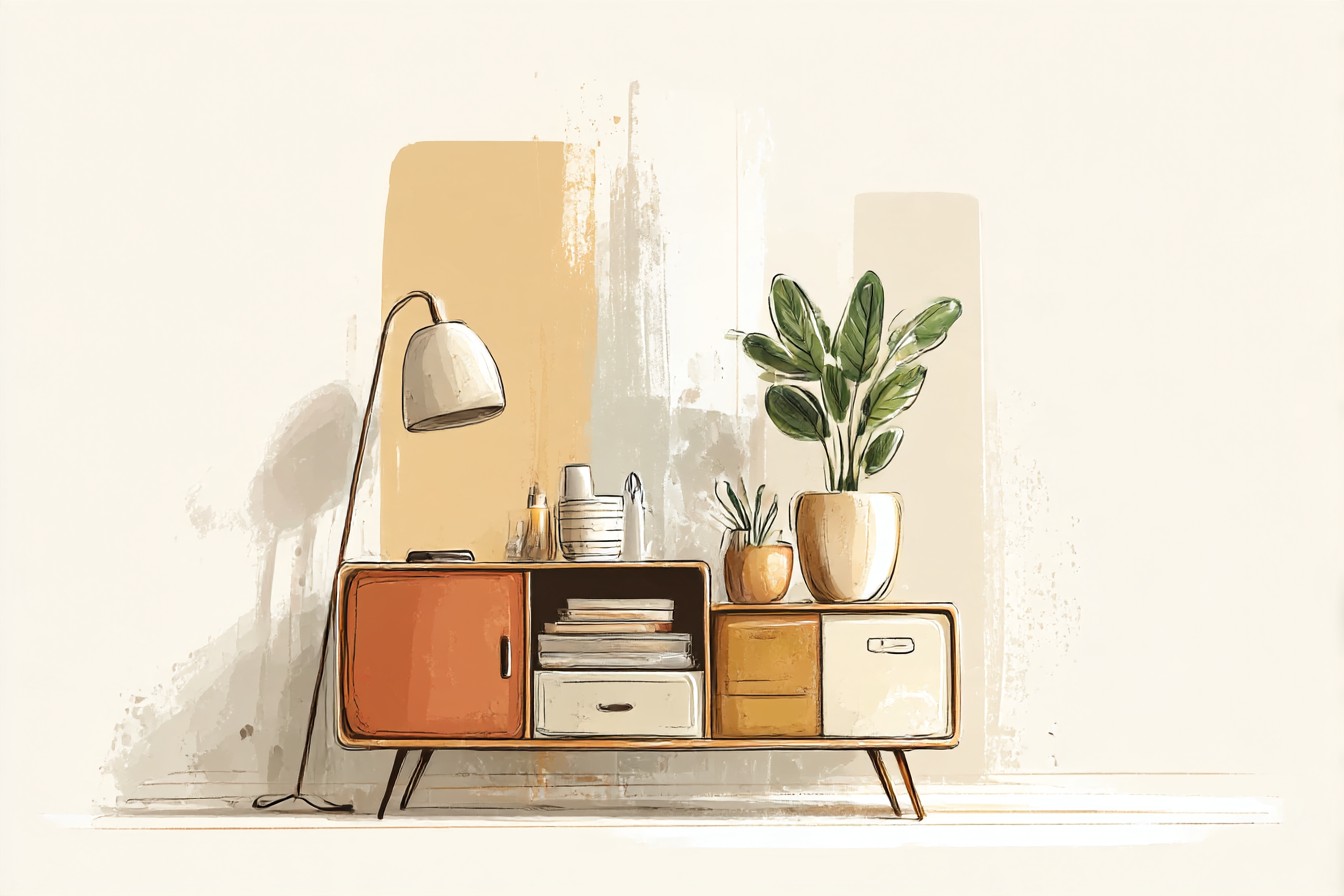
Three woven baskets of varying uselessness. A stack of five books nobody’s read, chosen entirely for spine color. Two ceramic somethings I can’t actually name the function of. A bowl. It’s a lot.
Here’s how it happened, because nobody sets out to own fourteen flanking objects, it accumulates like a bad texting habit. I bought one lamp because the TV stand had a bare patch and bare patches make me anxious in a way I’ve stopped trying to justify. Then I realized one lamp on one side and nothing on the other looked like I’d been burgled, selectively, by someone with very specific taste, so I bought a second lamp to match. Except it didn’t match, not in height, and a mismatched pair of lamps flanking a television is somehow worse than nothing at all, it reads as a decision rather than an accident, and it’s a bad decision. So then came the plant, to fix the height problem on one side. Then a basket, because the plant made the other side look bare again by comparison. You see the spiral. This is how you end up with fourteen.
What I’ve actually learned from all this, aside from the obvious lesson about impulse control I clearly haven’t learned at all, is that the sides of a TV stand are not decoration, they’re an engineering problem disguised as one. It’s about balance. It’s about height. It’s about the fact that a television is a big flat rectangle that dominates a wall whether you like it or not, and whatever you put on either side of it either fights that rectangle sensibly or just adds to the visual noise. So let’s go through what actually works, and what I bought that didn’t.
[Sides of a TV Stand]
Lamps, and the Height Argument Nobody Wins on the First Try
A lamp on either side of a TV stand sounds like the easiest decision in the world until you actually try to buy two lamps that are the same height and somehow can’t find any, anywhere, that aren’t either identical twin lamps from the same overpriced set or two completely unrelated objects that happen to both plug into a wall. I went through four lamps before I landed on a pair that worked, and by worked I mean they’re the same height, which turns out to be the entire assignment.
Here’s the thing about lamp height next to a television. Too tall and the lamp competes with the screen, drawing your eye sideways every time you’re trying to watch something, which defeats the purpose of the television being there at all. Too short and it disappears into the stand, doing nothing, might as well not exist. The sweet spot, in my experience, sits with the lamp shade landing somewhere around the bottom third to half of the television’s height, so it reads as a companion to the screen rather than competing furniture.
I will say this directly to the brand that sold me my first attempt at this, a “minimalist” ceramic lamp that arrived at a height roughly four inches shorter than advertised because the base photo apparently didn’t include the base. Sixty eight dollars. For a lamp that looked like it was cowering next to my television. You do not get to photograph a lamp standing on a box and call that an honest listing.
What actually works long term is a proper matched pair, bought at the same time, from the same place, so the height problem never even becomes a decision you have to make. Mine have survived one move and a cat who’s tried to knock the left one over at least six times. It hasn’t gone yet. That’s the whole review.
[Lamps]
Plants, Real and Otherwise, for the Height You Didn’t Plan For
The real plant on my TV stand is a pothos that’s been repotted twice, ignored for weeks at a stretch, and is somehow thriving anyway, which tells you everything about how much attention it actually needs versus how much guilt I feel about giving it none. It’s on a small plant stand that adds about eight inches, which turned out to be the actual fix for a side of the stand that always looked too low no matter what I put there.
That’s the real lesson with plants next to a television. It’s rarely about the plant itself, it’s about the riser underneath it. A plant sitting flat on the surface of the stand tends to read as squat and a bit lost, especially next to a screen that’s four feet wide and demanding all the visual attention in the room. Put it up on even a small stand or a stack of books and suddenly it’s doing a job, filling the vertical gap between the stand’s surface and the bottom of the television, instead of just sitting there looking optional.
I also own a fake plant on the other side, and I’m not precious about admitting it, because trying to keep two real plants alive in a room that gets maybe forty minutes of decent light a day was a fight I was always going to lose. The fake one is a snake plant, and it’s a genuinely convincing one from an angle that isn’t dead on, though I did make the mistake of buying the first fake plant I saw and it had leaves so shiny and uniform it looked like it belonged in a dentist’s waiting room. Returned it within the week. The second attempt, with actual texture variation in the leaves, cost about eleven dollars more and looks about a hundred times less like a mistake.
[Plants]
Storage Baskets, for the Clutter You Pretend Doesn’t Exist
Every TV stand attracts the same specific junk regardless of how organized you think you are, and mine is no exception. Remote controls that multiply overnight for reasons I can’t explain, since I own one television and somehow four remotes. Charging cables. A game controller. Whatever the cat has decided to relocate that day. The baskets exist to hide all of that, and they do the job, but I made a genuinely dumb mistake with mine early on that’s worth admitting.
You Might Also Like

I bought two baskets that were too small, thinking small and neat was the goal, and ended up with lids that wouldn’t close because the cable mess just wouldn’t compress down to basket size no matter how I folded things. So I upgraded to one larger basket on the floor beside the stand instead of two small ones on top of it, and that single change fixed both the storage problem and, unexpectedly, the height problem, because a taller floor basket does some of the same visual work a plant stand does, filling that vertical gap between floor and screen instead of leaving it empty.
The material matters more than I expected too. I went through a rattan basket that looked lovely for about three months before it started fraying at the rim from the cat using it as a scratching post she wasn’t supposed to have opinions about. Swapped it for a tightly woven seagrass one and it’s held up considerably better, no fraying, no visible cat opinions at all. If you’ve got any kind of pet near your TV stand, that’s the detail that actually matters more than the color.
[Storage Baskets]
Stacked Books, Because Height Doesn’t Have to Cost Anything
This is the cheapest fix in the entire piece and I resisted it for months because a stack of books sitting next to a television felt like the kind of thing a magazine would suggest without ever actually trying it themselves. Then I tried it, out of pure desperation because one side of my stand was sitting noticeably lower than the other and I didn’t want to buy anything else to fix it, and it turns out a stack of five or six hardcovers does exactly what a proper riser does, for free, using books I already owned and had no intention of reading again.
The trick, and I learned this the annoying way by stacking mine wrong the first time, is spine color and size consistency. My first attempt was a random stack, different heights, a paperback wedged in the middle, and it looked exactly like what it was, a pile of books someone couldn’t be bothered to put on a shelf. The second attempt, sorted by height with the biggest on the bottom and grouped loosely by color so it didn’t look like a rainbow had an accident, actually reads as intentional. It also gives you a surface to put something small on top, which is where my ceramic somethings finally found a job.
There’s a specific height satisfaction here too. A stack of books next to a lamp closes the visual gap between the lamp’s base and the surface of the stand, so the whole grouping reads as one considered arrangement instead of two unrelated objects that happen to share a shelf. It’s the closest thing to a free styling trick this entire piece has to offer, and I resent slightly how well it works.
[Stacked Books]
Vases and Small Sculptural Bits, for the Gaps Nothing Else Fills
The two ceramic somethings I mentioned earlier live here, and I still can’t tell you exactly what either one is meant to be, one’s vaguely bowl shaped and one’s vaguely nothing shaped, but they’ve earned their spot because they fill the small leftover gaps that lamps, plants, and books can’t. A stack of books takes up horizontal space. A lamp takes up vertical space and needs its own footprint. But there’s always a little dead zone left over, a few inches next to the lamp base or on top of the book stack, and that’s exactly where a small vase or an odd little object does its actual job.
I bought a proper vase for this once, tall and narrow, thinking height was the goal here too, and it looked completely wrong, too tall, too thin, competing with the lamp right next to it for attention in a way that made the whole grouping look crowded rather than balanced. The fix was going smaller, not taller. A low bowl. A squat little vase that’s maybe five inches at most. Something that adds texture and a bit of color without adding another vertical line to a spot that already has two lamps and a plant doing that job.
This is the section where balance actually means something specific rather than being a word I’m using because it sounds nice. It means look at what’s already tall in your grouping, the lamp, the plant, and then deliberately choose something low and quiet to sit near it, so your eye has somewhere to rest instead of climbing straight up every single object in a row like a staircase.
[Vases]
Final Thoughts
Fourteen objects is too many, I know that, I knew it while I was counting them, and I’ll probably own sixteen by next spring because that’s apparently who I am now. But going through all of it properly, actually thinking about why each thing earned its spot rather than just accumulated there, taught me something I didn’t expect. The sides of a TV stand aren’t really about decoration at all.

They’re about managing a big rectangular screen that dominates a room whether you like it or not, and giving your eye somewhere else to land that isn’t fighting the television for attention.
Height and balance, in the end, is the whole conversation. A tall lamp needs a low bowl nearby. A plant on a stand needs a book stack on the other side doing similar work at a similar level. A basket on the floor fills the same vertical gap a plant would, just doing it with your remote controls hidden inside instead of leaves. None of it needs to be expensive, and my sixty eight dollar lamp disaster is proof that expensive doesn’t even mean it’ll be the right height when it turns up.
If you’re standing in front of your own TV stand right now wondering what on earth goes on either side of it, my actual advice, after fourteen objects and at least four returns, is to stop buying things one at a time and start thinking about the whole grouping as one shape. Tall thing, short thing, something with texture, repeat on the other side. That’s it. That’s the entire secret, and it took me considerably longer than it should have to figure out.