My sister in law Dana walked into the guest room last spring, stopped dead in the doorway, and said, “Ben. There’s nothing up there. It looks like you’re mid eviction.” She was pointing at the wall above the headboard, which was, in fact, completely empty, because we’d moved in fourteen months earlier and I’d hung exactly one piece of art in the entire house and it was in the kitchen, over the trash can, for reasons I still can’t fully explain.
But she wasn’t wrong to notice it. The space above a headboard is weirdly loaded territory. It’s the first thing you see walking into the room, it’s the backdrop to every photo anyone takes of the bed, and somehow it’s also the spot people leave until dead last, usually because they can’t decide if anything belongs there at all. Some headboards, the storage ones with a flat top ledge running along the back, practically beg you to put something on them.

Others are just a tall upholstered wall and the “top” in question is really the stretch of wall above it, which is a different problem with different rules.
I’ve gone back and forth on this in three different bedrooms now, twice as the guy hanging the art and once as the guy holding the level while my wife told me it was crooked from six feet away with her arms crossed. I’ve also learned, mostly through having two kids who treat every horizontal surface as a personal Everest, that what looks good on a headboard and what survives a headboard are frequently two very different lists. A ceramic vase looks incredible for about nine days. Then someone’s climbing on the bed reaching for it because it’s shiny and just out of reach, which apparently is an irresistible combination if you’re four.
So here’s where I’ve landed, section by section, on what actually belongs up there, what’s a mistake waiting to happen, and where I think leaving it alone is honestly the smarter move. Dana still checks that wall every time she visits, for the record. It’s got a print on it now. She approved. That’s the last you’ll hear from her.
[Headboard Decor]
The Ledge Style Headboard
If you’ve got one of those storage headboards with a flat surface running along the back, you already know the temptation. It looks like a built in shelf and your brain immediately starts filling it with stuff. Books, a little succulent, a framed photo, your reading glasses, the fourth water glass you didn’t mean to leave up there. I had one of these in my twenties and treated it like a nightstand that happened to be six feet in the air, which was a mistake I only fully understood the night I rolled over and knocked my own alarm clock directly onto my face.
The honest rule here is weight and reach. Anything light, low, and boring survives. Anything tall, heavy, or remotely interesting to a toddler does not. My youngest went through a phase of climbing onto our bed and immediately making a beeline for whatever was on that ledge, and a glass jar of hand cream did not survive contact with the hardwood floor. It did not survive AT ALL, honestly, went everywhere, smelled like lavender for a week.
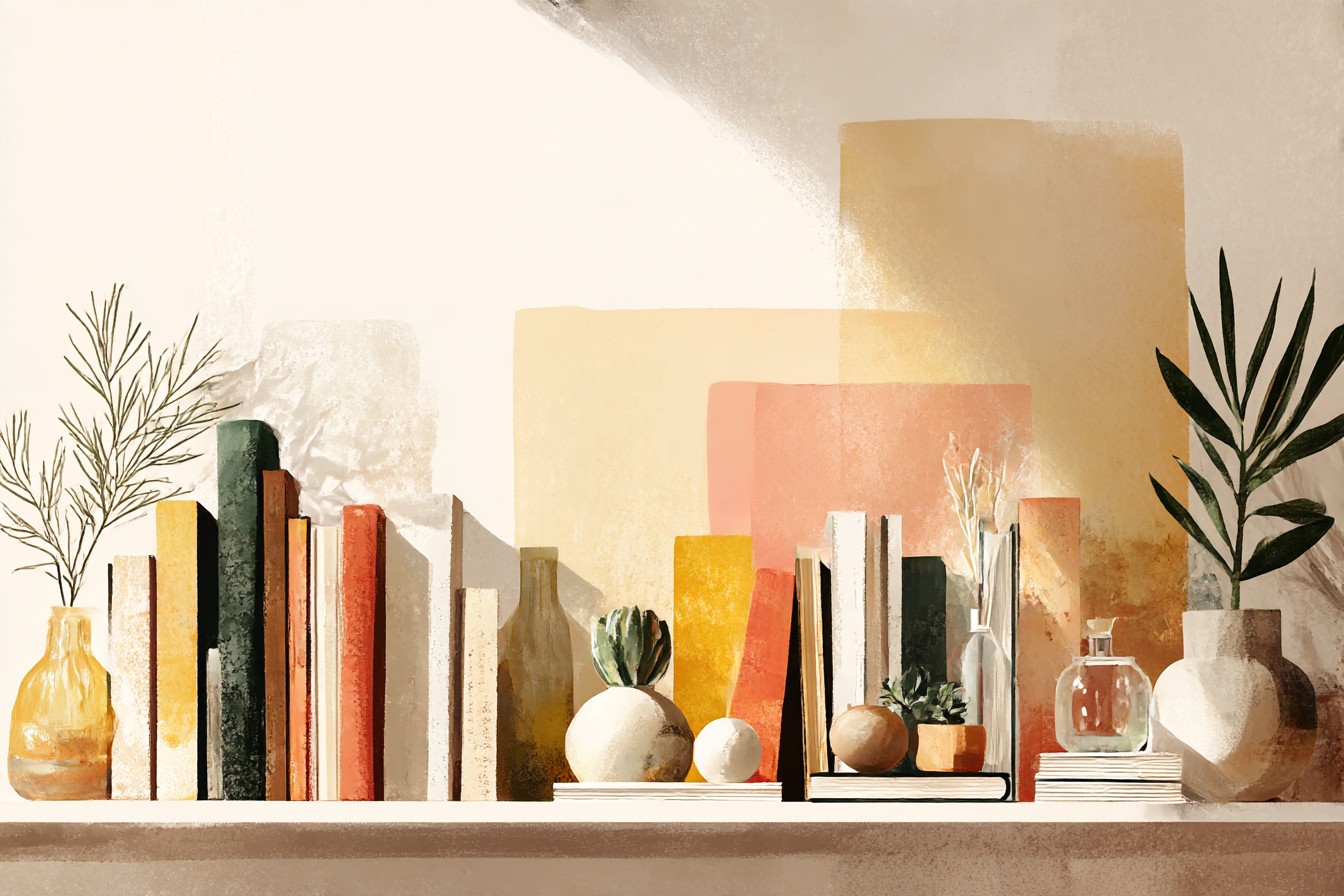
What’s actually worked, long term, is keeping it to two or three low, flat things. A single small plant in a squat pot that can’t tip, a photo frame lying flat instead of propped up, a stack of two books max. Nothing with a stem, nothing glass, nothing that rolls. It’s not glamorous. It’s also not something I’ve had to clean off the floor in about a year, which at this stage of parenting counts as a design triumph.
[Ledge Headboards]
One Big Piece of Art
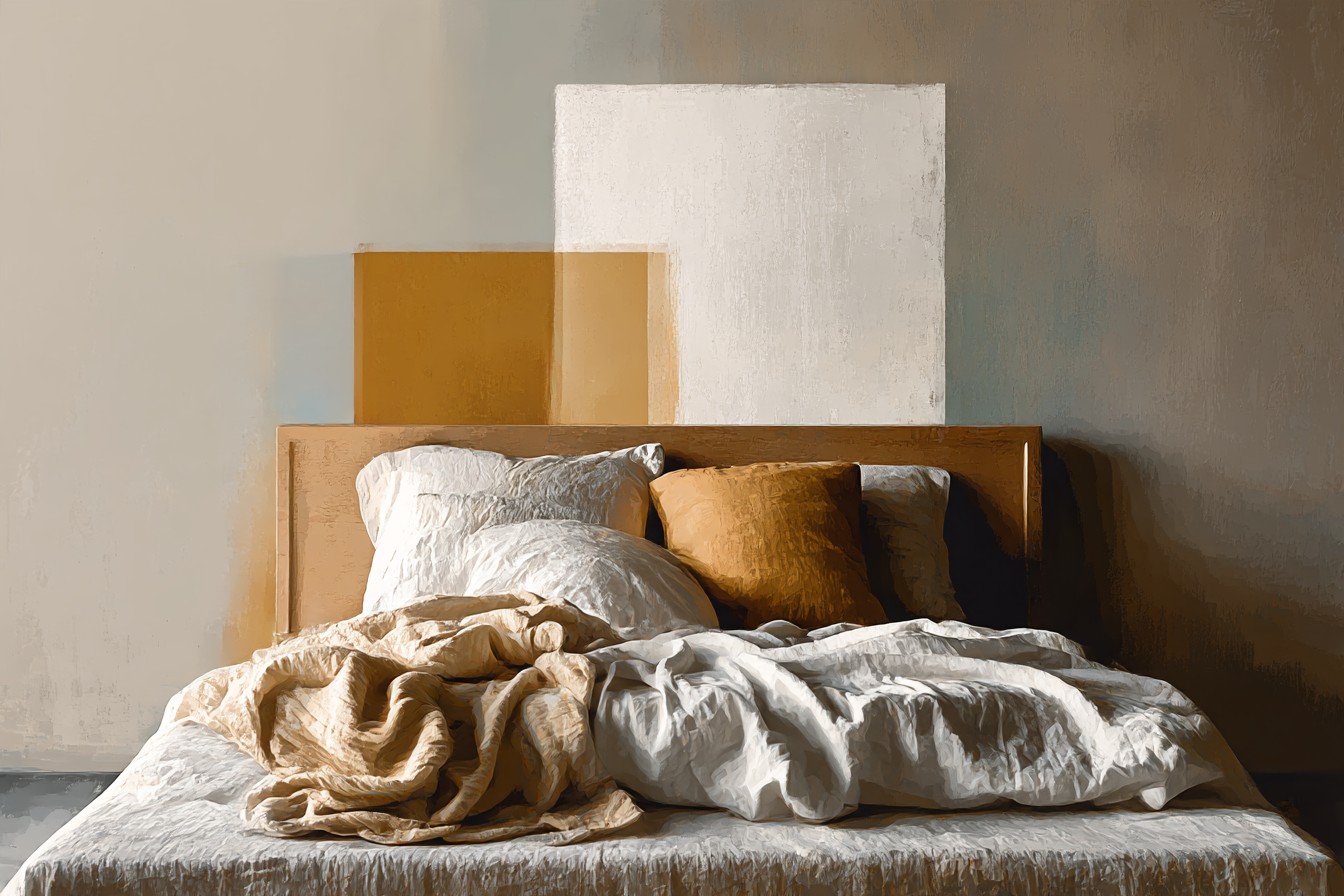
This is the one I actually did in the guest room, the one Dana was reacting to before I fixed it. A single oversized piece, either hung properly or just leaned against the wall resting on the headboard itself, which is a trick I resisted for years because it felt like admitting defeat on actually hanging it. Turns out leaning is a completely legitimate choice and also the one that’s saved me from patching about six unnecessary holes in drywall.
The mistake I made the first time was going too small. A modest 16 by 20 print above a queen headboard just looks lost, like it wandered in from a different, smaller house. The piece needs real presence, something in the range of two thirds the width of the headboard at minimum, or it just reads as an afterthought floating in a sea of wall. Once I sized up to something properly large, the whole room settled in a way I didn’t expect from one change.
The other thing nobody tells you: leaned art is a liability with kids who bounce on beds, because it will eventually get knocked askew or fully off the wall by a rogue elbow or a pillow thrown with more enthusiasm than aim. Mine’s actually hung now, properly anchored, specifically because my oldest treats every trip to grandma’s guest bed as an Olympic event and I got tired of straightening a frame every single morning.
[Wall Art Above Headboard]
Sconces Instead of Lamps
If your bedside table space is tight, or if you’re like us and every lamp cord eventually becomes a toy, wall mounted sconces flanking the headboard are the move nobody recommends loudly enough. Mine went in two years ago, one on each side, and they’ve completely replaced the pair of table lamps that used to get knocked off, cord and all, roughly every third night by someone rolling over wrong.
You Might Also Like

The symmetry does something a single lamp on a nightstand can’t manage. It frames the whole headboard like a proper display, and because the fixtures are mounted, there’s nothing at kid height for small hands to grab, pull, or use as a climbing aid. My youngest tried to yank one down during the “everything is a handle” phase. It did not move an inch. He was furious about it, honestly stood there shaking it like it owed him money, and that was the moment I knew we’d made the right call.
The one thing I’ll admit I didn’t think through was the installation. Sconces need actual wiring or a hardwired plan, not just a nail and a hope, and I paid an electrician more than I want to say out loud to get ours properly set into the wall. Plug in versions exist and work fine if you’re not ready for that commitment, though the cord has to go somewhere, and “somewhere” in our house usually means directly across the path a toddler takes to launch himself onto the bed.
[Sconces Above Headboard]
Floating Shelves
I want to like floating shelves above a headboard more than I actually do, because on paper they solve everything. Storage, display, that layered look magazines are obsessed with. In practice, with two kids under six, they’ve been the single riskiest thing I’ve tested in this entire house.
We put one up in our room for about four months. Books, a small frame, one of those little wooden trays. It looked properly good, right up until my oldest figured out she could stand on the headboard itself to reach it, which is a maneuver I did not see coming and genuinely should have. She got the tray down. The tray did not survive the trip back to the floor, and neither did the lamp base it landed near.
If your kids are older, or if the shelf is high enough that a five year old standing on a bed genuinely can’t reach it, this might work fine for you. Ours came down. Not permanently retired, just relocated to the office where the worst that can happen is a stapler falling on my own foot, which feels like an acceptable risk I’m choosing to take on personally rather than delegating to my children.
[Floating Shelves Headboard]
Leaving It Completely Bare
Here’s the option nobody wants to hear is actually fine: nothing. A blank wall above the headboard, on purpose, not because you haven’t gotten around to it.
I resisted this for years because it felt like an unfinished room, the visual equivalent of leaving a sentence hanging. But our current primary bedroom has a textured upholstered headboard, dark green, properly tall, and it turns out putting anything above it just competes with a headboard that’s already doing plenty of visual work on its own. We tried a small print up there for about a month. It looked crowded, like the wall was trying too hard.
Bare isn’t the absence of a decision, it’s a decision, and for a headboard that already has presence, texture, or a strong color, it might be the right one. It’s also, not for nothing, the only option on this list that has never once resulted in something crashing to the floor at 6am.
That alone has earned it a permanent place in my rotation of acceptable answers.
[Bare Above Headboard]
Final Thoughts
If you’d asked me five years ago, I’d have said every headboard needs something above it, because an empty wall felt like a room that wasn’t finished. I don’t believe that anymore. What I believe now is that the answer depends entirely on what kind of headboard you’ve got, what kind of humans are sleeping near it, and how much you enjoy sweeping up broken glass before coffee.
The ledge headboards want small, flat, boring things. The plain walls want either one big committed piece or nothing at all, and both are legitimate. Sconces solved a lamp problem I didn’t know I had until it was gone. Shelves looked incredible for four months and then taught me something about my daughter’s climbing ability that I did not need to learn at 6am on a Tuesday.
Mostly what I’ve learned is that the top of a headboard doesn’t need to hold a verdict for every bedroom in the house. Ours differs room to room, kid to kid, headboard to headboard, and every version has been right for exactly as long as it lasted. Pick the one that suits your wall, your bed, and honestly, your kid’s wingspan, and don’t feel bad if the answer eventually changes.