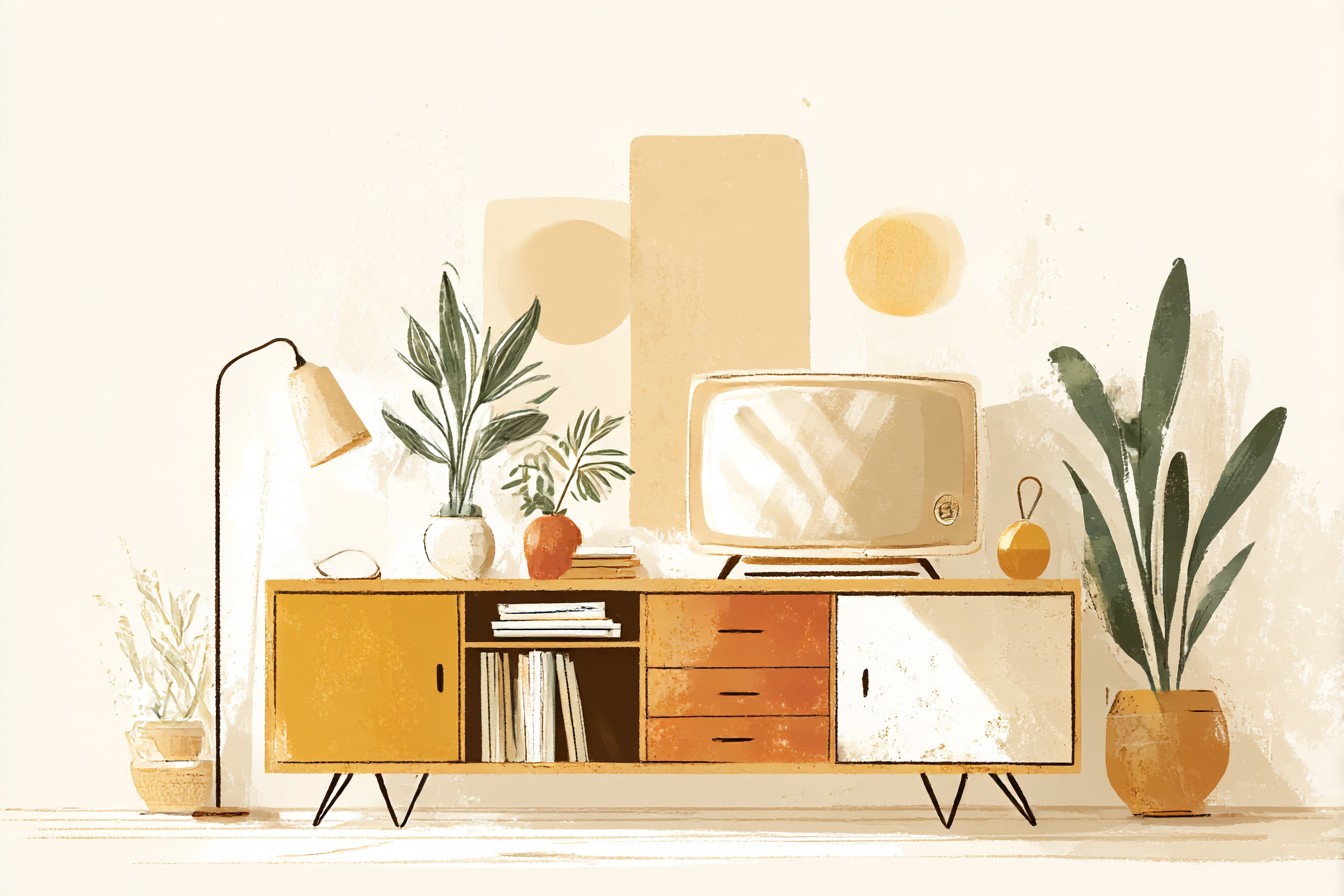
I own six dining room sideboards right now, if you count the one currently living in a storage unit in Daly City because I couldn’t bear to donate it and couldn’t justify the truck to bring it home either. Six. For one dining room that seats eight people on a good night and four most nights. That number should embarrass me more than it does.
Here’s how it happened, roughly. Two are client returns I ended up keeping because the finish didn’t match a paint color and nobody wanted to eat the restocking fee, so I did instead. One is the sideboard that came with my apartment when I moved in, technically the landlord’s, technically still there, technically mine now in the sense that nobody’s asked for it back in four years.

One I bought at 11pm during a specific low point in 2021 that I’m not going to explain further. One is genuinely excellent and I’ll get to it. And one is 34 inches deep, was listed as “space saving,” and lives now purely as a cautionary tale I bring up with clients whenever they use that phrase to me unprompted.
The thing about sideboards, the thing nobody tells you when you’re shopping for your first one, is that the category is doing two completely different jobs that people shop for as if they’re the same job. There’s the sideboard that serves. Surface height matched to your dining chairs, sturdy enough to hold a stack of plates and a hot casserole dish without you thinking about it twice, positioned close enough to the table that carrying things over doesn’t become a production. And there’s the sideboard that displays. Glass fronts, open shelving, a spot for the good glassware and the ceramics you don’t actually use but like looking at. Most people buy one sideboard expecting it to do both jobs perfectly, and most sideboards are quietly better at one than the other. I’ve built entire client consultations around explaining that distinction because nobody arrives at it on their own. So that’s where I want to start, because it’s the actual decision underneath every other decision in this room, and everything after it, storage, material, scale, styling, sits on top of getting that first call right.
[Dining Room Sideboard]
The Serving Sideboard: Built for the Job, Not the Photo
A serving sideboard has one function and it should be judged entirely on how well it performs that function, which is a sentence I say to clients more than I’d like to admit because everyone gets distracted by the finish before they’ve checked the height. Standard dining chair seat height runs around 18 inches. Standard dining table height is 30 inches. A serving surface that’s genuinely comfortable to use, plate up, pour from, set a dish down on without hunching, sits somewhere between 32 and 36 inches. I measured four “buffet style” sideboards last year for a client in Oakland whose dining room was, generously, 11 feet by 9. Two were 34 inches. One was 30, which is table height, meaning it functioned more like a second table than a serving surface, fine for stacking but useless for pouring. One was labeled “buffet height” and measured 29.5. Buffet height apparently now means whatever the listing copy needs it to mean.
Depth matters more here than anywhere else in the category, because a serving sideboard lives in the traffic path between the kitchen and the table, and I have watched a hip catch a corner at a dinner party badly enough to send a full water glass sideways across a tablecloth someone’s grandmother made. That sideboard was 20 inches deep in a room where 20 inches was 4 inches more than the space realistically had. The fix isn’t complicated. Measure your actual walking path, not the wall length, the path, and subtract at least 36 inches for a person to pass comfortably while someone else is serving. A serving sideboard should also survive heat and moisture without flinching, because it will have a hot dish on it eventually whether you planned for that or not, so a sealed or solid top wins over anything that needs a trivet reminder taped to the surface. The one I actually recommend without caveats runs 34 inches high, 18 deep, solid oak top, no drama. It’s the boring correct answer and I stand by it completely.
[Serving Sideboards]
The Display Sideboard: Glass Fronts, Open Shelves, and What They’re Actually For
Display sideboards get bought for the wrong reason constantly, which is that they photograph beautifully with three ceramic vases and a stack of linen napkins arranged by someone who does not live with the piece day to day. In real use, a glass front sideboard is doing a specific job: showing off dishware, glassware, or a collection you actually want visible, while keeping dust off it, which open shelving does not do, a fact I learned the hard way with a set of my grandmother’s water glasses that sat on open oak shelving in my old apartment for two years and needed a full wash before every single use because the kitchen was 12 feet away and cooking dust travels further than you’d think.
Glass front sideboards solve that, but they come with their own measurement trap, which is interior shelf depth versus stated cabinet depth. A cabinet can be listed at 18 inches deep overall and have interior shelving at 15, once you account for the door swing clearance and the frame. That 3 inches matters enormously if you’re trying to fit a full dinner service or anything wider than a standard dessert plate. I had a client last year who bought a glass front sideboard specifically to display an inherited set of serving platters, and the platters, at 16 inches across, did not fit on the 15 inch interior shelf at any angle short of leaning them, which is not display, that’s storage with extra steps and a door in the way.
Open shelving, by contrast, is the honest choice for a smaller collection you’re willing to dust monthly, and it tends to make a narrow dining room feel less closed in than a solid cabinet front does, purely because your eye reads through the piece rather than stopping at it. If your dining room doubles as a hallway, which mine effectively does, open shelving is the better call. If it’s a room that closes off with a door and stays relatively still, glass fronts earn their keep.
[Display Sideboards]
Storage First: Drawers for the Stuff Nobody Wants on the Table
Not every sideboard needs to look good doing its job, and honestly some of the hardest working pieces in this category are the ones nobody photographs, the drawer heavy sideboards built to hold linens, flatware, the spare tablecloth you use twice a year, and the takeout menus that somehow still exist in a drawer despite every restaurant having an app now. This is the sideboard that answers the question people actually search for, which is some version of “where do I put everything that isn’t on the table,” and the honest answer is drawers, specifically drawers with proper dividers, because I’ve owned two sideboards without them and both turned into a drawer you open and immediately regret opening.
You Might Also Like

The detail worth checking here, and the one brands are laziest about, is drawer depth versus drawer box construction. A drawer front can measure 6 inches and still only have 4 usable inches inside once you account for the runner mechanism and the base panel, which sounds like a small gap until you’re trying to fit a flatware tray that’s a standard 3.5 inches tall and it catches on the underside of the drawer above every single time you close it. I measured this on a sideboard from a well known flat pack brand last spring, drawer front listed at 6.3 inches, usable interior clearance was 4.1, and the flatware tray they sold as a matching accessory for that exact sideboard did not fit inside it. Nobody at that company had apparently tried putting their own product inside their own product.
A genuinely useful storage sideboard also separates its drawers by size intentionally, shallow ones up top for cutlery and coasters, deeper ones below for tablecloths and serving linens, rather than four identical drawers that all just become the same junk drawer at a slightly different height. If you only remember one thing from this section, check the interior drawer height against what you actually plan to store, not the front measurement, because the front measurement is decoration and the interior measurement is the whole point.
[Storage Sideboards]
Small Dining Rooms and the Word “Compact”
I need to say something plainly here because I’ve built a reputation on being annoyed about this exact phrase and I’d like to be specific about why. “Space saving” on a sideboard listing means, roughly a third of the time in my actual experience checking these things with a tape measure, that the piece is narrower than average but exactly as deep, which does nothing for a room where the problem is walking clearance, not wall length. I had a client whose entryway was 42 inches wide who was told, by a very confident salesperson, that a specific “compact” sideboard would fit. She ordered it. It arrived at 34 inches wide, which technically fit the wall, but at 19 inches deep it left 23 inches of walking clearance in a space where the front door swung in and needed 24. She never used the word “fits” casually again in my presence, and honestly neither did I after watching her face when the delivery guys tried to angle it through the doorway.
The sideboards that actually solve small room problems tend to be genuinely shallow, 14 to 16 inches deep rather than the standard 18 to 20, and they make up for the lost depth with height, running drawers or shelving upward rather than outward. I measured one recently that was labeled “slim profile,” genuinely was 15 inches deep against a stated 15, which I want to acknowledge properly because I spend most of this article annoyed at brands that don’t do this, and this one did exactly what it claimed. It’s not glamorous to say a brand simply told the truth about their own product, but it happened, and I should say it more plainly than I usually do. If your dining room is under 100 square feet, which describes more San Francisco apartments than any interiors magazine wants to admit, prioritize depth over width every time, and measure the piece yourself before it arrives, not after.
[Small Space Sideboards]
What Actually Goes On Top
This is the question I get more than any other, more than finish, more than price, and it’s usually phrased exactly like this: what do I even put on a sideboard. The honest answer is that it depends entirely on which of the two jobs from the start of this piece your sideboard is doing. If it’s serving, keep the top mostly clear, a stack of plates, serving utensils in a tray or a low dish, maybe a pitcher, because the surface needs to function during an actual dinner and clutter defeats the purpose. If it’s a display piece, this is where I’ll allow the thing every interiors site tells you to do, a lamp if the room’s dim, a low bowl, one or two pieces of ceramic with actual visual weight rather than five small identical objects that read as clutter from across the table.
The mistake I see most, in my own home included, is treating the top of the sideboard as leftover surface for whatever doesn’t have a home yet, mail, keys, a candle that’s never been lit, and within a month it looks like a landing strip rather than a considered surface. My rule, which I don’t always follow, is nothing on top that isn’t either used weekly or genuinely liked looking at, no in between objects. A mirror or a piece of art above it does more visual work than another object on the surface itself, because it draws the eye up and makes the whole wall read as intentional rather than accumulated. And leave some surface bare. Not because bare photographs well, but because a fully serving sideboard with zero clear space is a sideboard you’ll resent by the third dinner party.
[Sideboard Styling]
Final Thoughts
Six sideboards in, the thing I keep coming back to is that this category punishes vague shopping more than almost any other piece of dining room furniture, because it’s asked to do so many different jobs depending on the household, and most listings are written as if one set of dimensions solves all of them. It doesn’t. A serving sideboard and a display sideboard and a storage sideboard can all technically be called the same piece of furniture and still be completely wrong for each other’s rooms.
If I’m being straight with you, the fix isn’t complicated, it’s just unglamorous.

Measure your walking path, not your wall. Check interior drawer depth, not the front. Ask what “compact” is being compared against, because it’s rarely your actual space. And decide, before you buy anything, whether you’re serving off this thing or showing it off, because that one decision determines almost everything else that follows. I got that wrong twice before I got it right, which is a fairly expensive way to learn a lesson I could have written on an index card. Measure twice. Buy once. Try to stop at one sideboard, though I recognize I’m not exactly the person to be giving that particular piece of advice.