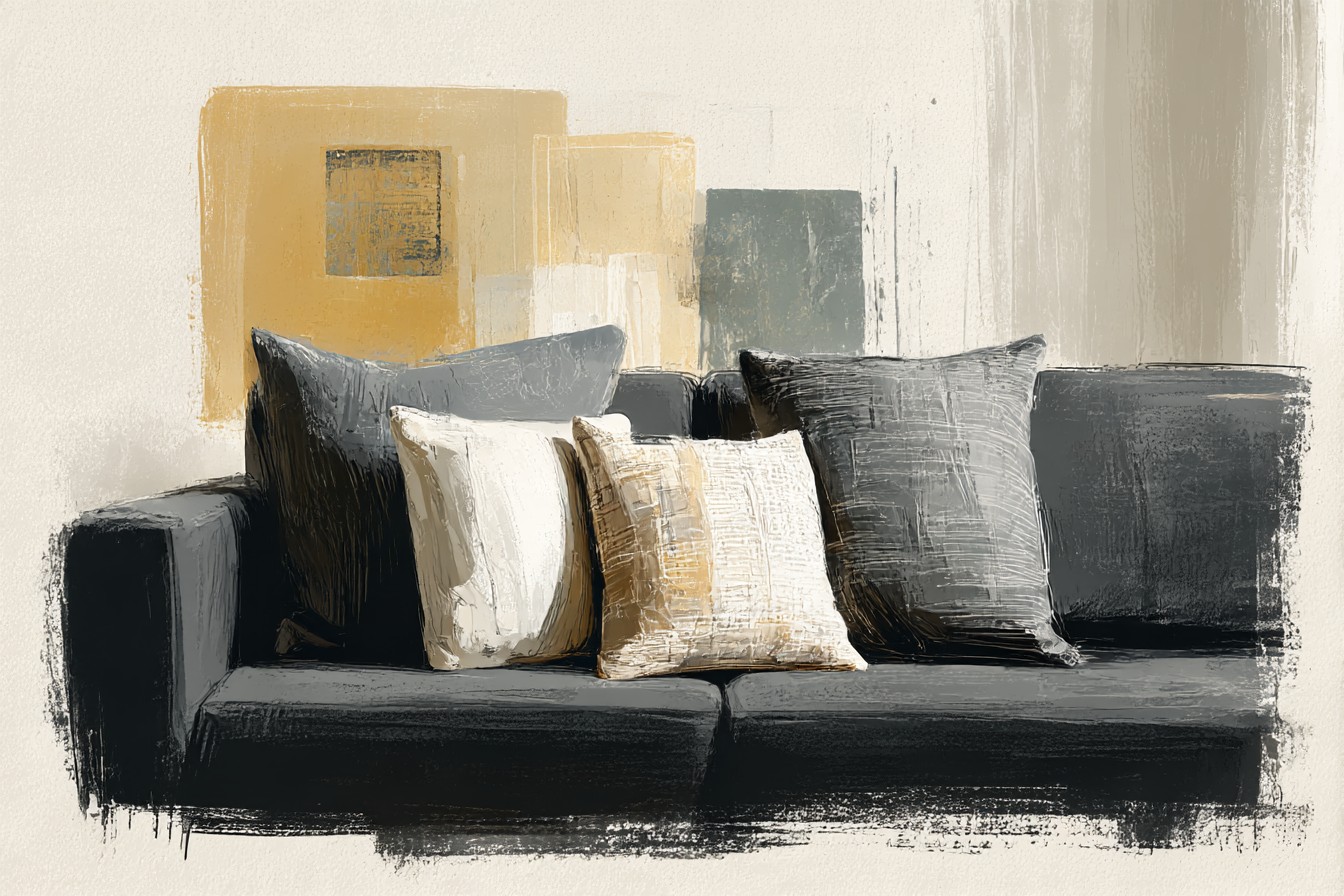
I was rearranging my own couch pillows for a video call last Tuesday, the kind where you can see your own square in the corner and start obsessing over what’s behind you, and I caught myself thinking, not for the first time, that my sofa looked like a hole punched into the wall. Just absence. A dark gray rectangle swallowing the corner of the room and giving nothing back. I bought that sofa two years ago convinced charcoal was the smart, adult, will-never-look-dated choice, the color equivalent of a navy blazer, and mostly I still believe that. But nobody tells you that a charcoal sofa without the right pillows doesn’t read as moody and sophisticated. It reads as a couch that’s sulking.
Here’s the thing people get wrong constantly, including past me: charcoal is not black.

I know that sounds obvious written down, but I spent about eight months treating my sofa like it was black, styling around it the way you’d style around a black leather chesterfield, all sharp contrast and cool metals, and it looked stark in a way I didn’t actually like. Charcoal has warmth hiding in it. Hold a true charcoal gray up against actual black and you’ll see it, there’s a brownish, almost graphite undertone in most charcoal fabrics that black simply doesn’t have. That undertone is doing you a favor. It means charcoal can hold warm colors and cool colors both, it’s genuinely more flexible than black, but only if the pillows you put on it acknowledge that instead of fighting it.
What charcoal actually needs is contrast with a pulse in it, not just brightness for brightness’s sake. A white pillow on a charcoal sofa looks fine. It also looks like the safest decision a human being has ever made, and I say that as someone who owned four white pillows for way too long because I was scared of getting it wrong. The sofa doesn’t need safe. It needs pillows that make you notice the room again.
So that’s what this is. Not a definitive ranking, just the combinations that actually worked on my own dark gray couch, the ones that made friends ask what I did differently, and a couple of colors I tried that I will not be trying again.
[Charcoal Gray Sofa Pillows]
Warm Ivory and Cream, the Combination That Actually Started This
Cream against charcoal is the first thing I got right, and I got it right by accident, because I already owned two ivory linen pillows from a sofa I’d sold and didn’t want to waste them. Put them on the charcoal couch out of pure laziness and the whole room lifted. Not brightened exactly, lifted, like someone had opened a blind I didn’t know was closed.
This is the pairing that answers the actual question everyone’s Googling, what color goes with a charcoal sofa, because cream is the low risk, high reward answer and it deserves that reputation. It works because it’s pulling on that warm undertone I mentioned, the one hiding inside charcoal that people mistake for cool gray. Put a stark, blue-white pillow next to charcoal and it looks clinical. Put a warm ivory or bone colored pillow there and the two colors look like they were always meant to sit together, because chemically, undertone-wise, they basically were.
The texture matters more than the color here, honestly. A flat cotton ivory pillow does fine. A slubby linen one, something with actual visible weave, does better, because charcoal fabric is usually pretty flat and smooth itself, velvet or a tight weave, and you want at least one pillow on that couch doing something with its hands. My cheap flat ivory cushion cover from a big box store looked fine for a year. The linen one I paid three times as much for looks like a decision. That’s the whole difference.
Don’t do all four pillows in cream though. I tried that for about a month and it went straight back to looking like absence, just a paler absence. Two ivory, and let something else carry the rest of the weight.
[Ivory and Cream Pillows]
Mustard and Ochre, for When You Want the Couch to Have an Opinion
I resisted mustard for years because I associated it with a specific 2016 apartment situation that I’m not going to describe in detail except to say there was a lot of exposed brick involved and none of it was mine. Mustard felt like a trend I’d already watched die once. Then I put a single ochre velvet pillow on the charcoal sofa on a whim, genuinely just to see, and I sat down across the room and stared at it for a solid minute like an idiot.
Mustard on charcoal does something black could never pull off with the same warmth. Against true black, mustard reads a bit costume, a bit Halloween, orange and black doing their thing. Against charcoal, because of that graphite warmth again, mustard looks rich instead of loud. It looks like the couch has a personality now instead of just a job.
I’ll go to caps for exactly one sentence here because I mean it: THIS IS THE COMBINATION THAT GETS THE MOST COMMENTS, more than anything else on that couch, more than the actual sofa itself, which I paid considerably more for. People notice one mustard pillow before they notice the eight hundred dollar couch it’s sitting on, and there’s something both humbling and hilarious about that.
Keep it to one, maybe two pillows in this family, and pick a fabric with some depth, velvet or a heavier cotton, not a thin flat weave, because mustard in a cheap fabric can slide into looking dated fast, and dated is exactly the reputation I was trying to avoid in the first place. Rust works the same way if mustard feels like too much commitment, slightly more grounded, slightly less likely to make your mother ask if you’re going through something.
[Mustard and Ochre Pillows]
Blush and Dusty Rose, the One I Was Genuinely Wrong About
I need to admit something. I told a friend, confidently, that pink on a charcoal sofa would look like a teenager’s bedroom that got lost and wandered into the living room. I was wrong, and I was wrong in a way that annoys me because I said it out loud to multiple people before I tried it.
You Might Also Like

Dusty rose, the muted, almost mauve kind rather than anything bubblegum, does something quietly excellent against dark gray. It’s soft where charcoal is heavy, which sounds obvious when I write it down, but the effect in person is less about softness and more about temperature. Charcoal can run cold looking in certain lights, especially if your room doesn’t get much sun, and blush warms that right up without turning the whole space precious or fussy.
The mistake I made initially, once I’d come around on the color, was buying it in a shiny satin fabric, thinking dressy equals better. It looked cheap almost immediately, catching light in a way that read more prom dress than living room. Swapped it for a boucle blush pillow instead and the whole thing calmed down into something I actually like walking past every day. Texture keeps softening from turning into slickness, that’s the lesson, and it applies beyond just this color honestly.
One dusty rose pillow paired with a charcoal throw or a darker gray patterned pillow keeps it grounded. Two is still fine. I would not go further than two unless you actually are decorating a teenager’s bedroom, in which case, by all means, lean all the way in.
[Blush and Dusty Rose Pillows]
Boucle, Wool, and Anything With Actual Texture
This section isn’t really about a color at all, it’s about the fact that a charcoal sofa in a smooth fabric, velvet especially, needs at least one pillow that looks like it has weather in it. Boucle is the obvious one, that nubbly, looped texture that photographs like a sheep had a very good day, and it’s everywhere right now for a reason that isn’t just trend chasing.
Here’s my actual gripe, and it’s a pricing one, because it’s always a pricing one with me. I saw a boucle throw pillow at a mid-range home store for fifty-eight dollars, a single cover, no insert, and the tag called it “affordable luxury texture.” Affordable compared to what, exactly. Compared to a pillow made of solid gold thread? You do not get to call fifty-eight dollars for one pillow cover affordable and expect nobody to notice, and I noticed, and I said so to the checkout person, who did not deserve that but listened politely anyway.
Anyway. I bought a nearly identical boucle cover for twenty-two dollars from a different retailer a week later and it does the exact same job, catches light the same nubby way, sits on the charcoal couch looking equally expensive to anyone who doesn’t know better. Which is everyone, because nobody who visits your apartment is running their fingers along your pillow seams checking for quality.
Wool works the same textural function if boucle feels overdone at this point, slightly more structured, a bit more tailored looking. Either way, the point is the same: charcoal in a flat fabric needs texture somewhere on that couch or the whole arrangement looks like a furniture store display nobody’s allowed to touch.
[Textured Wool and Boucle Pillows]
Deep Jewel Tones, for the Nights You Want Drama
Emerald green on a charcoal sofa is one of those combinations that shouldn’t work on paper and completely does, the same way navy and black shouldn’t technically go together but somehow always do at a funeral. I added one emerald velvet pillow before hosting a dinner where I genuinely knew nothing about the food I was serving, and every single person commented on the pillow instead, which honestly took the pressure off the mediocre risotto more than I can properly express.
Jewel tones, emerald, deep sapphire, even a burgundy that leans more wine than red, sit against charcoal the way they’d never sit against black. Against true black, jewel tones can look almost muddy, swallowed, competing for the same dark space. Charcoal gives them somewhere to actually breathe because it’s lighter than black even when it doesn’t feel that way at first glance, and it’s got that warm undertone doing quiet work in the background again, same as it did with the mustard.
The trick with jewel tones is restraint, more than any other color on this list. One pillow, maybe two if your couch is a genuinely big sectional and one just looks lonely out there. More than that and the room stops being a living room and starts being a slightly overwhelming velvet showroom, which I know because I tried three jewel toned pillows at once for approximately four days before admitting defeat and putting two of them back in the closet.
[Jewel Tone Pillows]
Final Thoughts
If you take one thing from all this, take the undertone point, because it’s the thing that actually changes how you shop. Charcoal is not black’s understudy.

It’s got warmth built into it that black never had, and once you stop styling around it like it’s black, the pillow choices basically open right up, cream, mustard, blush, jewel tones, texture, all of it plays nicer than you’d expect.
My couch currently has an ivory linen pillow, one mustard velvet, one boucle in a sort of oatmeal color, and a single emerald one I refuse to remove even in summer when it technically clashes with nothing else in the room. Four pillows, one couch, roughly a year of trial and error and one very unnecessary comment to a checkout worker about pricing integrity that I stand by completely.
The sofa itself hasn’t changed. Same charcoal, same corner, same shape. What changed is that it stopped looking like a gap in the room and started looking like a decision I actually made on purpose. That’s the whole job pillows are doing here, and it’s not complicated once you stop being scared of color near something dark. Buy the texture. Skip the shiny satin unless you really love it. And if a store tries to sell you a single pillow cover for the price of a decent dinner out, you’re allowed to say something about it out loud, at the register, to whoever happens to be standing there.

[…] is that a coffee table’s job with a big leather couch is partly about scale, not just color. Dark leather couches tend to be chunky, thick arms, deep seats, the kind of furniture that takes up visual real estate […]
[…] got a charcoal gray sectional now, the kind of practical, slightly boring purchase I made specifically because I have […]