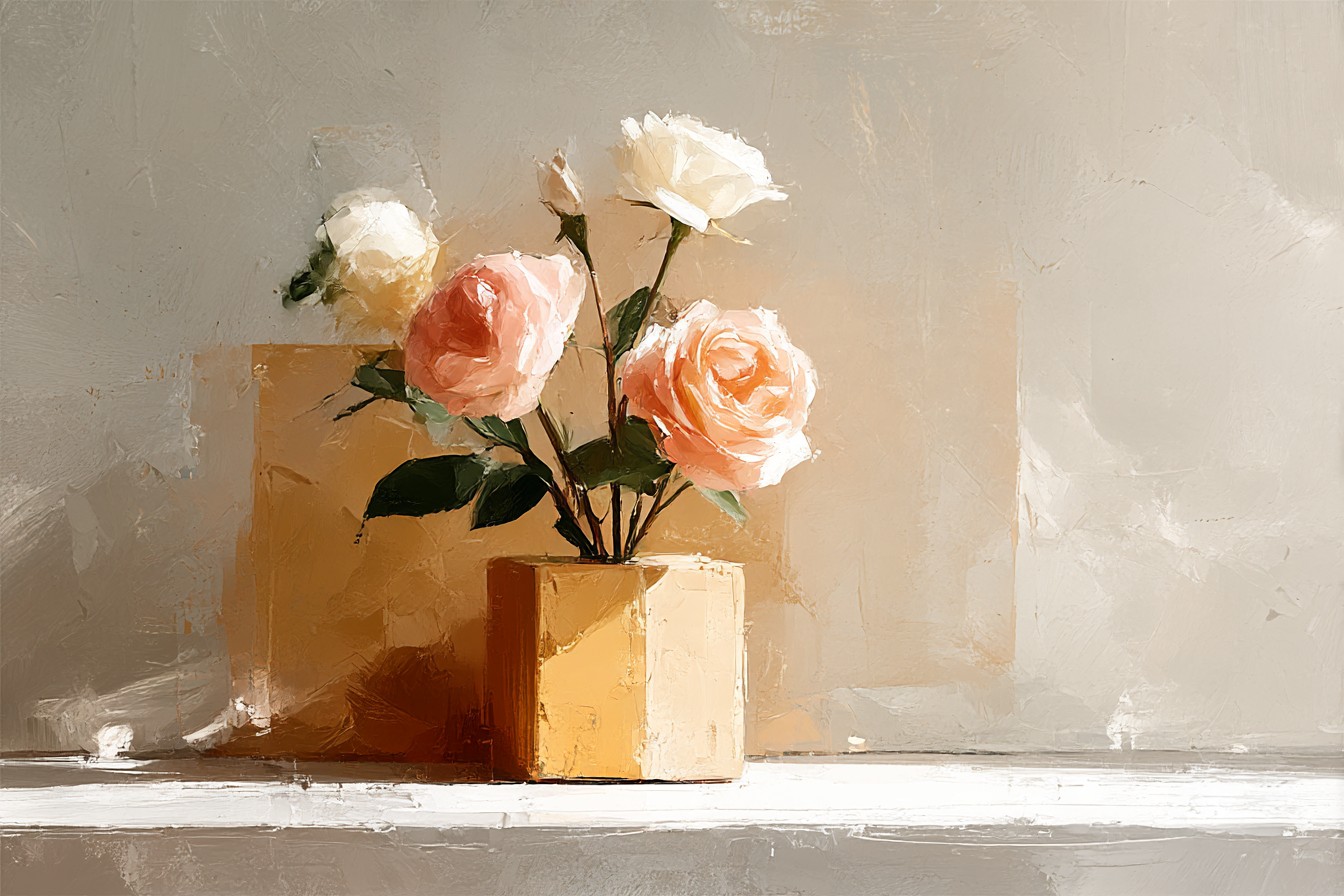
Roses in a vase have a reputation for being the safest flower purchase a person can make, and also the most boring. I believed that for years. A dozen red roses from the grocery store cooler, still banded together with a rubber band, dropped into whatever glass was closest to the sink, felt like the floral equivalent of a store bought greeting card. Fine. Correct. Says nothing.

My aunt used to keep a vase of roses on her dining table that looked so uniform, so upright, so evenly spaced, that I genuinely thought for a few years they were silk. They were real. That’s how stiff a room full of matching roses can look, like nobody’s touched them since the florist tied the bow.
What changed my mind wasn’t a magazine spread or some styling trick. It was a Sunday market table outside Thunderbolt, a bucket of garden roses the color of weak tea, and next to them, in a rusted coffee can, a fistful of queen anne’s lace the vendor had pulled from the ditch behind his truck that morning and wasn’t even charging for. He tossed it in with my roses like an afterthought. I got them home, dropped the whole mess into a chipped ironstone pitcher I’d had sitting empty on the counter for months, and it looked like something that had grown that way on purpose. Nothing about it matched. That was the entire point. The roses had somewhere to lean, something to be messier against, and suddenly they didn’t look like they were standing at attention anymore.
That’s the thing nobody tells you about roses on their own. They’re gorgeous, they’re not the problem, the problem is that a vase of only roses has no shadow and no give. It’s all one texture, one size, one rhythm. What roses actually need is company that doesn’t try to compete with them, stuff with looser shapes, smaller faces, some of it borrowed from the yard rather than bought at all. Here’s what I’ve learned, mostly by accident, about what earns a place in that vase alongside them.
[Roses in a Vase]
Frothy Fillers That Soften the Edges
Astrantia was the first filler I ever bought on purpose instead of by accident, and I only found it because I was standing at a flower stand in the City Market trying to figure out why my roses at home looked like they were posing for a school photo. The woman running the stall handed me a small bunch without me even asking, said “trust me,” and she was right, bless her for it. Astrantia has these tiny pincushion heads, almost papery, and dropped in among the roses they read like a haze rather than a shape. It doesn’t fight for attention, it just fills the gaps roses leave behind, because roses, for all their drama, actually take up very little visual real estate once you look closely.
Scabiosa does something similar but with more personality, those little pincushion centers with the pale halo around them, and bupleurum is the one I reach for when I want something almost invisible, a soft chartreuse cloud that just makes everything around it look fresher without anyone clocking why. I ruined a bunch of it once by overpacking the vase so tight the stems couldn’t breathe and the whole arrangement went limp within two days. Lesson learned the annoying way. Fillers work because of the air they leave, not despite it.
What all three of these have in common is scale. They’re small enough that they never compete with a rose head for the eye’s attention, they just occupy the space between roses so the eye has somewhere gentler to land in between. A vase of only roses is all peaks. Filler is what gives it valleys.
[Fillers for Roses]
Greenery With Some Backbone
I used to think greenery meant whatever leftover leaves came stapled to the rose stems from the store, which is a bit like thinking seasoning means whatever salt was already on the table. Seeded eucalyptus changed that for me, specifically the silver dollar kind I found at a little nursery stand off Bull Street that I still drive past for no other reason some Saturdays. It’s got weight to it, actual physical weight, and the silvery blue of the leaves makes red or blush roses look richer instead of louder.
Olive branches do something completely different, more architectural, almost stern next to something as soft as a rose, and I like that contrast more than I expected to. A florist I chatted with at a wedding fair once told me the whole trick of greenery is that it should look like it’s holding the roses up, not decorating around them, and that’s stuck with me since. Ninebark, if you can get your hands on some with the burgundy leaf, does that job beautifully too, gives the whole arrangement a spine.
The mistake I made for years was treating greenery as an afterthought, something to hide the mechanics at the base of the vase. It’s not filler for the bottom, it’s structure for the whole thing, and once I started buying it on purpose instead of accepting whatever came free, my vases stopped looking like they were assembled and started looking like they’d grown that way.
[Greenery for Roses]
Whatever’s Growing Wild That Week
The best thing I ever put in a vase with roses cost me nothing and came from the side of a dirt road on the way back from a yard sale near Pooler that turned out to be mostly broken lamps and one genuinely good oak side table. Queen anne’s lace, growing right there in the ditch, tall and lacy and slightly wild looking in a way nothing from a florist ever quite manages. I’ve since learned to keep a pair of clippers in the car for exactly this reason, which my husband finds ridiculous and I find completely reasonable.
You Might Also Like

Cosmos does something similar if you’ve got a garden or a neighbor with one, that same airy, slightly untamed quality, and herbs are the sleeper hit nobody mentions, a few stems of mint or rosemary tucked in near the base do double duty, they smell wonderful and they add this soft, almost gray green texture that store bought greenery rarely has. Ornamental grasses, the wispy kind, work the same trick with movement instead of scent, catching a breeze from an open window in a way roses never will on their own.
The thing about foraged stems is they refuse to look arranged, which is exactly why they work. They bring a bit of chaos back into something that can otherwise feel overly considered, and roses, for all their formality, actually welcome a little chaos leaned in beside them.
[Wild Stems With Roses]
Blooms in the Same Weight Class
Not everything you add needs to be small and quiet. Sometimes roses want a partner their own size, and that’s where ranunculus earns its keep, those tightly layered petals reading almost like a rose that got confused about which flower it wanted to be. I put a bunch of coral ranunculus in with some pale pink garden roses last spring and couldn’t tell at first glance where one flower ended and the other began, which I’ve decided is the whole goal.
Dahlias do a heavier version of the same job, more presence, more drama, good for autumn arrangements when the roses themselves are starting to look a bit more russet at the edges anyway. Sweet peas are the opposite end of that same idea, delicate, ruffled, almost old fashioned in a way that suits a rose that’s already leaning vintage, the kind of pale lavender or dusty pink variety you find at a market stall rather than a grocery store bucket.
I got this wrong once with peonies, threw a handful in with roses that were already fully open, and within a day the whole vase had gone over, too many big soft heads with nothing left holding shape. Timing matters here more than it does with filler. You want your second bloom to be a step behind the rose, not competing with it stem for stem on the same day it opens.
[Companion Blooms for Roses]
The Vase Is Doing More Work Than You Think
I nearly skipped an estate sale off Victory Drive because the driveway was full of the kind of flat pack shelving units that mean somebody’s already been through and taken the good stuff. Almost turned the car around. Went in anyway out of stubbornness, and behind three identical particleboard bookcases, half hidden, was a milk glass pitcher with a hairline crack near the handle that the family clearly hadn’t noticed or hadn’t cared about. FOUR DOLLARS. I nearly said nothing and just paid it before anyone changed their mind.
That pitcher does more for a bunch of roses than any filler I own. Milk glass has this soft, slightly cloudy quality that makes even grocery store roses look intentional, and ironstone does something similar, a bit heavier, a bit more forgiving of an uneven arrangement because the vessel itself already has so much texture and history sitting in the surface. Mercury glass is the one I reach for around the holidays, roses look almost lit from within against it.
The dealer who runs the Sunday yard, a fella named Otis who’s sold me more good junk over the years than I’d like to admit to my husband, keeps an eye out for pitchers like that one now without me even asking. That’s the actual reward of ten years of showing up. Not every vase needs to be a proper vase at all. Some of the best ones started as something else entirely and just happened to be standing empty when the roses needed somewhere to go.
[Vases for Roses]
Final Thoughts
I still buy plain dozens of roses sometimes, still hand them over at the register in that same rubber band, because there’s nothing wrong with a rose on its own merit. But I don’t drop them straight into water anymore without stopping to think about what they’re missing.

A little astrantia for softness. Some eucalyptus for backbone. Whatever’s growing wild by the ditch that week if I remember the clippers. A vessel that’s already got some history in it rather than whatever glass is nearest the sink.
None of this is complicated, and none of it costs much, which is maybe the part that surprised me most. The difference between a stiff vase of roses and one that actually looks like it belongs in your house isn’t money or skill. It’s just remembering that roses were never meant to stand alone in the first place. They look better with something leaning into them, something a little looser, a little wilder, a little more like it came from a ditch or a dealer’s back table than a delivery truck. Mine usually did, and I wouldn’t have it any other way now.