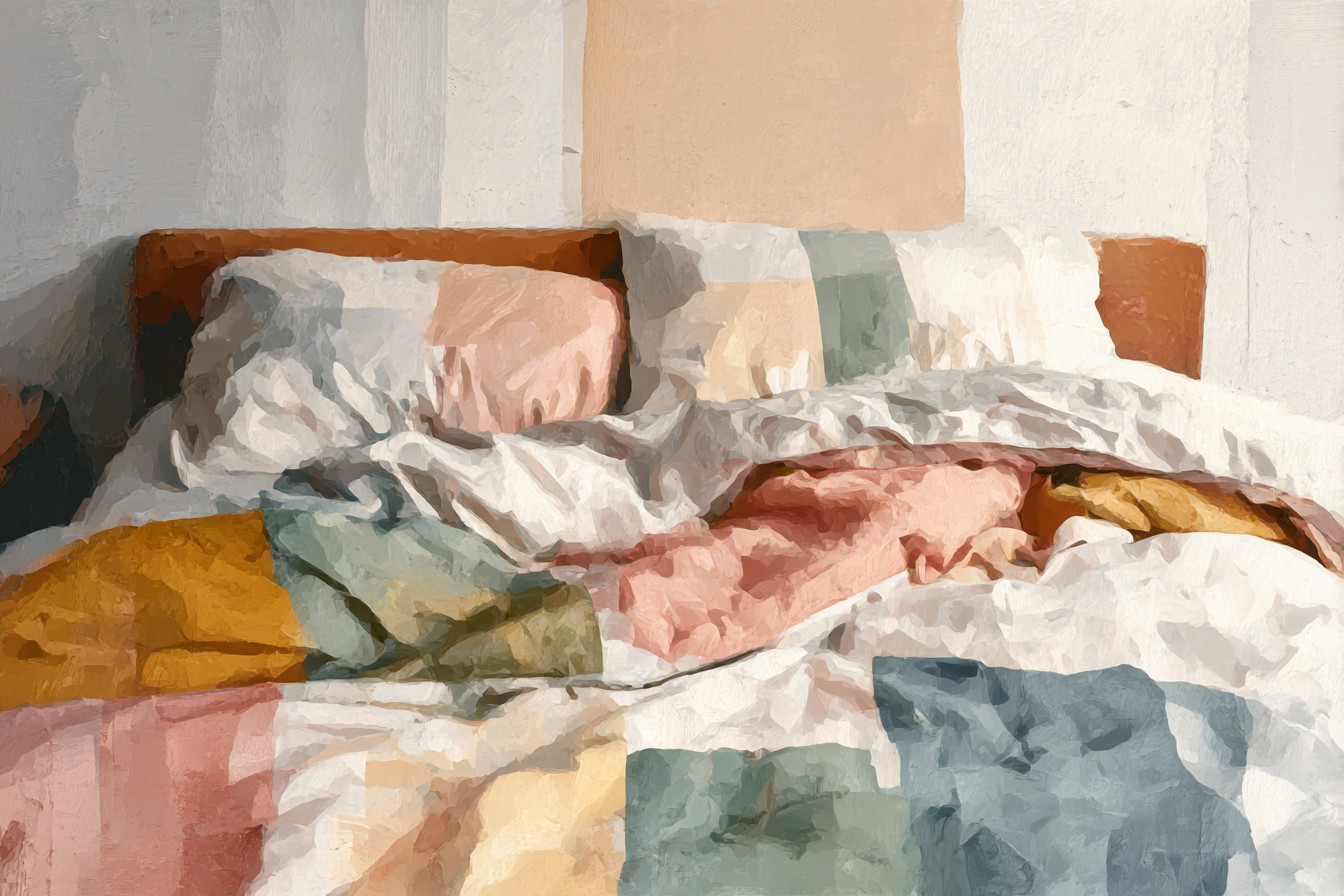
I woke up on a Sunday in November, decided the rain outside was reason enough to stay exactly where I was, and made it to about 2pm before I noticed something. I hadn’t moved my hips in maybe four hours. Not shifted, not rolled, not adjusted a pillow. Just flat, phone in hand, scrolling a decorating account showing someone’s “cozy Sunday reset,” which is a funny thing to call lying still long enough that your own body starts sending you memos.
I’ve spent years thinking about how people use rooms, where the weight goes, what a body actually does in a space versus what the listing photo implies it does. Turns out a bed gets almost none of that attention. Everyone talks about mattresses in terms of firmness ratings and cooling gel and whatever, but nobody talks about what an entire day of horizontal actually does to you physically, hour by hour, joint by joint.

Not the sleep part. The staying part. There’s a difference between eight hours flat and asleep, which your body is built for, and fourteen hours flat and half awake, which it very much is not, and I don’t think I understood that difference until I accidentally ran the experiment on myself.
So this isn’t a piece about whether you should get up, whether it’s lazy, whether you’ve earned the day or wasted it. None of that’s my business and honestly it’s not the interesting part. The interesting part is purely mechanical. What actually happens to your lower back after hour six. Why your hip starts to ache on one side and not the other. Why your legs, which have done nothing all day, somehow feel more restless at hour ten than they would after an actual run. It’s all just physics and blood flow and pressure points, and once you start paying attention to it, a full day in bed stops being a mood and starts being a genuinely strange physical event your body is quietly logging complaints about the entire time.
[Lying In Bed All Day]
The Lower Back
This is the first thing to go, and it goes early, way earlier than you’d think for something that’s supposedly resting. By around hour three of lying mostly flat on a mattress that isn’t doing anything special in the support department, my lower back had that specific dull ache that isn’t pain exactly, more like a held note. The problem is the same reason sitting all day is bad for your back, just horizontal instead of vertical. A body that isn’t moving doesn’t distribute pressure, it just sits on it. Standing, walking, even fidgeting in a chair, all of that constantly shifts where the load goes. Lying still for hours does the opposite. Your lumbar spine ends up holding one position against gravity for an unreasonable length of time, and it complains exactly the way any muscle does when you ask it to hold a plank for six hours instead of thirty seconds.
What actually helped, and I only figured this out by accident around hour five when I gave up and tried it out of sheer discomfort, was putting a pillow under my knees. Suddenly the ache backed off by what felt like half. There’s a real mechanical reason for that, it tilts the pelvis and takes the lower back out of that stretched, unsupported position it’s stuck in when your legs are flat and heavy and pulling on it all day. I didn’t know that going in, I just wanted the ache to stop, and it did, enough that I noticed the difference within about ten minutes.
The other thing nobody tells you is that the ache doesn’t stay in one place. It starts central, low, right where your belt line would be, and by hour eight or nine it had migrated slightly to the left, which is exactly the side I’d been favoring without noticing, because apparently even lying “still” isn’t actually still, your body’s making tiny unconscious corrections all day to protect whatever’s hurting most in that moment.
[The Lower Back]
Neck and Shoulders
Nobody warns you about the neck. I went into this thinking the back would be the main event and the neck would just come along quietly, and instead the neck turned out to be its own separate complaint entirely, arriving on its own schedule.
Pillows are the whole story here, and I don’t think I’d ever actually paid attention to how much a pillow height matters until I spent an entire day noticing it change. Propped up to check my phone or watch something, my neck was fine for maybe forty minutes before it started to pull at the base of my skull, that specific tight band feeling. Flat with one thin pillow, different problem, my neck would tip back slightly and by the time I noticed, my shoulders had crept up around my ears trying to compensate. I must have adjusted the angle of that pillow eight or nine separate times over the course of the day, which is a genuinely stupid amount of pillow management for someone who was supposedly resting.
The shoulders themselves stiffen in a way that’s almost sneakier than the back, because you don’t feel it happening, you feel the aftermath. I rolled onto my side around hour six to give my neck a break from the propped up position, and that’s when I noticed my top shoulder had rounded forward, curling in toward my chest without my permission, the whole time I’d been reading. Rolling onto my back to stretch it out, there was an actual audible click, which is never a great sound to hear from your own shoulder on a Sunday. Ten seconds of just rolling both shoulders backward, slowly, fixed most of it, but it needed doing, it wasn’t going to fix itself just because I was lying down and technically resting.
[Neck and Shoulders]
Hips and Restlessness
This is the one that actually surprised me most, because it makes no logical sense on the surface. My legs had done nothing all day. No steps, no stairs, nothing. And yet by hour ten they were restless in a way that felt almost worse than the ache in my back, a kind of buzzy, need to move sensation that had nothing to do with tiredness.
You Might Also Like

The hip on whichever side I was lying on took the worst of it. Side sleeping, or side lying, puts a real amount of your body weight directly onto one hip joint and holds it there, and after enough time that pressure point starts to genuinely hurt, not in a vague way, in a specific spot right at the hip bone itself. I switched sides probably every twenty minutes toward the end of the day, which tells you something, my body wasn’t asking, it was insisting.
The restlessness in the legs, I think, is just circulation catching up with stillness. Blood pools differently when you’re not using the muscles to pump it back up, and legs that haven’t moved in hours start to feel heavy and also somehow twitchy at the same time, which is a strange combination to sit with, or lie with, whichever. I ended up bicycling my legs in the air for about thirty seconds at one point purely because lying still had become physically worse than moving. That’s the whole irony of it. The thing that was supposed to be restful had turned into the thing my legs wanted rescuing from.
[Hips and Restlessness]
Skin and Circulation
This is the part that’s almost embarrassing to admit, because it sounds so minor until you’re the one dealing with it. Around hour seven, I had a faint pink line pressed into my forearm from where it had been resting against the seam of the pillowcase, the actual seam, not the fabric, the seam, and it took a solid twenty minutes after I finally sat up for that line to fade. That’s how long a genuinely light, unremarkable amount of pressure can leave a mark when it’s sustained for hours instead of minutes.
Then there’s the sweat and heat side of it, which nobody wants to talk about but is completely real. Sheets that felt cool and fine at 9am were noticeably warmer and slightly damp by 3pm, from nothing more than one body lying on them for six straight hours. Skin under sustained contact with fabric just runs warmer, and warmer skin against fabric for that long starts to feel slightly clammy in a way that has nothing to do with the room temperature and everything to do with not having moved.
Pins and needles showed up too, predictably, in whichever arm I’d been lying on, that specific fizzy, prickling wake up call your limb gives you when the blood supply’s been restricted for too long. It’s a completely normal, harmless thing your body does, and it’s also the single most convincing physical argument I encountered all day for the idea that staying exactly still for that many hours isn’t actually neutral. Your circulation is doing something in response to it, constantly, whether you’re paying attention or not.
[Skin and Circulation]
Getting Up
The moment I actually stood up, around 6pm, was its own separate event entirely, and honestly the most physically dramatic part of the whole day. My lower back, which had been a dull ache lying down, turned into something closer to a genuine twinge the second I bore weight on it again. My knees, doing nothing all day, somehow felt stiff, actually stiff, like they needed convincing to bend properly. And my balance was off for a few seconds in a way that caught me off guard, a kind of light headed wobble that had nothing to do with standing up too fast and everything to do with a body that had gone hours without asking its joints to hold any real weight.
It took a genuine two or three minutes of just walking around the apartment before everything started moving normally again, before my hips stopped feeling like they needed oiling and my back loosened out of that tight, held position it had been stuck in all day.

That gap between lying down and standing back up properly is the clearest evidence of everything that happened in between. A body doesn’t come back online instantly after that many hours flat, it has to physically catch up, joint by joint, and you feel every single one of them clocking back in.
[Getting Up]
Final Thoughts
None of this is a verdict on the day itself. It’s just what actually happened, physically, to one very ordinary body that stayed flat for way longer than it’s built to. The back complains first, the neck follows on its own separate timeline, the hips make their objections known through sheer restlessness, the skin quietly logs pressure marks you don’t notice until you sit up, and the whole thing ends in a slightly wobbly reintroduction to standing that no one warns you about.
What struck me most is how specific and physical every single complaint was. Not vague tiredness, actual, locatable sensations, a click in the shoulder, a line pressed into an arm, a hip that hurt in one exact spot. Your body isn’t being dramatic about a day in bed, it’s just responding, plainly and mechanically, to being asked to hold one position for far longer than it usually does. Move a knee here, prop a pillow there, and half of it eases immediately, which tells you it was never really about the day being wrong, just about the body needing the occasional adjustment it wasn’t getting.
I’d do it again, honestly, rain permitting. Just with a pillow under my knees from the start next time, and a lot less faith in the idea that lying still is the same thing as resting.