Small coffee tables have a reputation for being the consolation prize of furniture, the thing you buy when you couldn’t fit the real coffee table, the one with the ottoman and the shelf and the whole nine yards. I believed that for a long time. I had a studio in Hampden for two years with a coffee table so small my ex called it “the amuse bouche,” which is a phrase I still resent him for, because it was accurate and funny and I hate both those things in an ex.
What changed my mind wasn’t a design revelation. It was math, because it’s always math with me. I worked out that my old, “real” coffee table, the big one I’d hauled from three apartments ago, was costing me almost eighteen inches of walking room I didn’t have, and I was tripping over it at least twice a week, which at my hourly rate in stubbed toe frustration alone was not a good return. I sold it for forty bucks to a guy who drove a truck that cost more than my rent, and I bought a thirty inch round table from the Charles Village estate sale circuit for twenty two dollars.
Ledger entry, good column, and it’s stayed good column for three years running, which for me is basically a marriage.
Here’s the thing nobody tells you about a small coffee table: it has to do more, not less. A big table can afford to be lazy, half of it can sit empty and nobody notices. A small one is on duty every single day, holding your coffee, your laptop, your mail you’re ignoring, occasionally a foot. There’s no slack in the system. So when people ask me what actually earns a spot on a tight surface, that’s the real question, not “is it cute” but “does it deserve to be here,” and that’s a much harder table to shop for than people think.
I’ve bought maybe nine small coffee tables in six years, kept four, regretted two badly enough that I still think about them, and turned one into a plant stand out of spite. What follows is what actually held up, sorted by the problem each one solves, because a small coffee table isn’t one category, it’s five different jobs wearing the same disguise.
[Small Coffee Table]
Nesting Tables
Nesting tables are the closest thing to cheating that furniture offers, and I mean that as a compliment. You get a small footprint most of the year and then, the one night you’re hosting and someone needs somewhere to put a drink that isn’t the floor, you pull the second table out and suddenly you have surface area you didn’t have to store.
Mine came from a big box store, forty six dollars for the set, and I did the cost per year thing obsessively at first because the finish looked thin to me in the listing photos. Three winters in, no chipping, no water rings, though I will say I learned the hard way that the smaller table’s top is not rated for a full pan of lasagna straight out of the oven. It survived. The finish did not love it. Ledger stays good, barely.
The trick with nesting tables in a small space is resisting the urge to leave them both out permanently, because then you’ve just built yourself an oddly shaped big table and lost the entire point. I keep the second one tucked almost fully under, just a sliver of the top corner showing, which honestly bothers my mother more than actual clutter does, she thinks it looks unfinished, I think it looks like I have a plan. We don’t agree and that’s fine.
What they’re bad at: anything heavy or permanent. Don’t put your lamp on the nested table thinking you’ll always remember to move it first. You won’t. I didn’t. There was a small incident with a mug of tea and a yanked table leg that I’m not going to describe in detail except to say the rug forgave me eventually.
[Nesting Tables]
Round Coffee Tables
I resisted round tables for years because I associated them with dentist office waiting rooms, which is an unfair and slightly deranged prejudice to hold against a shape, but there it is. What actually flipped me was living in a place narrow enough that I clipped my hip on the same square corner for eight straight months before I finally admitted the problem wasn’t me.
A round table in a tight room does something a rectangular one physically cannot: it lets you walk closer to it. No corners means no dead zone of “give it six extra inches so nobody loses a shin,” so a thirty inch round table in a cramped living room can actually sit nearer the sofa than a rectangular one two sizes smaller. That’s not a style opinion, that’s geometry, and I don’t say that about furniture very often.
The one I bought for twenty two dollars, mentioned above, is round, oak veneer over what I’m fairly sure is particleboard, and I checked the leg joints before buying it out of habit because I’ve been burned by wobbly ones before. Solid. Three years, no wobble, one very determined toddler at a birthday party leaning his full body weight on it, still fine.
Round tables do lose you a bit of usable surface compared to a square of the same width, which matters if you’re the type who likes four coasters going at once. I am not that type. I’m the type who puts one mug down, forgets it, and finds it cold two hours later, so the shape suits my actual behavior rather than my aspirational one.
[Round Coffee Tables]
Glass Top Tables
Glass gets treated like the villain of small space furniture and I genuinely don’t think it deserves that, not fully. A solid wood table in a tight room reads as a block, a chunk of visual weight parked in the middle of your eyeline. Glass disappears a bit, the room reads a few inches bigger just because your eye slides through the tabletop instead of stopping on it.
You Might Also Like

I bought a glass topped one from the Friday restock at my usual thrift place for eleven dollars, iron legs, decent weight to the frame, and I will admit the first week I hated it, because every fingerprint and every dust mote showed up like a crime scene. That’s the honest tradeoff nobody puts on the label. It photographs beautifully and lives loudly.
It’s stayed in the good column of the ledger for one reason only: I stopped fighting it and started keeping a cloth in the drawer of the console table three feet away, twenty second wipe down maybe twice a week. Twenty seconds, twice a week, over a year, is about seventeen minutes total, which is nothing against eleven dollars and a room that looks bigger than it is.
Glass is a bad call if you’ve got cats who treat any reflective surface as a personal dare, or kids young enough to test gravity with anything on top of it. Mine has survived a coffee cup slide and one dropped hardcover, neither of which I’d recommend testing on purpose, but I was relieved rather than smug about it, which tells you I wasn’t fully confident going in.
[Glass Top Tables]
Storage Coffee Tables
This is the category that actually earns its keep in a small apartment, more than any other, because a small coffee table with storage isn’t really furniture, it’s a filing system disguised as furniture. Remotes, chargers, the coasters nobody uses, the blanket that lives on the couch until it doesn’t, all of it has somewhere to go instead of somewhere to be seen.
I own a lift top trunk style one, bought secondhand for thirty five dollars off a moving sale, and it does double duty as extra seating when I have more people over than chairs, which happens more than my lease technically approves of. Cost per year on that one is close to nothing at this point, four years in, and I’ve stopped even doing the math because the answer stopped being interesting.
The catch with storage tables in small rooms is they run bigger and heavier than the open leg style, visually and literally, so you’re trading floor space efficiency for storage efficiency. Not a bad trade, just a real one. I’d never put a trunk style table in a genuinely tiny room without measuring the walking path around it twice, because I did that once, badly, and lived with a table I had to sidestep for eight months before I sold it at a loss. Bad column, that one, and I still think about it when I measure anything now.
The hinges are the part to actually check before buying, not the finish. A cheap hinge sags within a year and then you’ve got a lid that won’t stay up on its own, which I learned from a friend’s disaster of a purchase rather than my own, for once.
[Storage Coffee Tables]
What Actually Goes On Top
This is the question I get asked more than any other, usually by someone standing in their own living room looking vaguely betrayed by their own coffee table. What do you actually put on a small one so it doesn’t look bare and doesn’t look like a junk drawer exploded.
My answer, tested across probably a dozen configurations: three things, max, and one of them should be doing a job rather than just sitting there. A tray first, always, because it draws a boundary around the clutter and makes even a messy surface look intentional, mine cost six dollars and has quietly organized my entire coffee table existence since. Then one object with actual weight or texture, a plant, a candle in a heavy jar, something that isn’t flat.
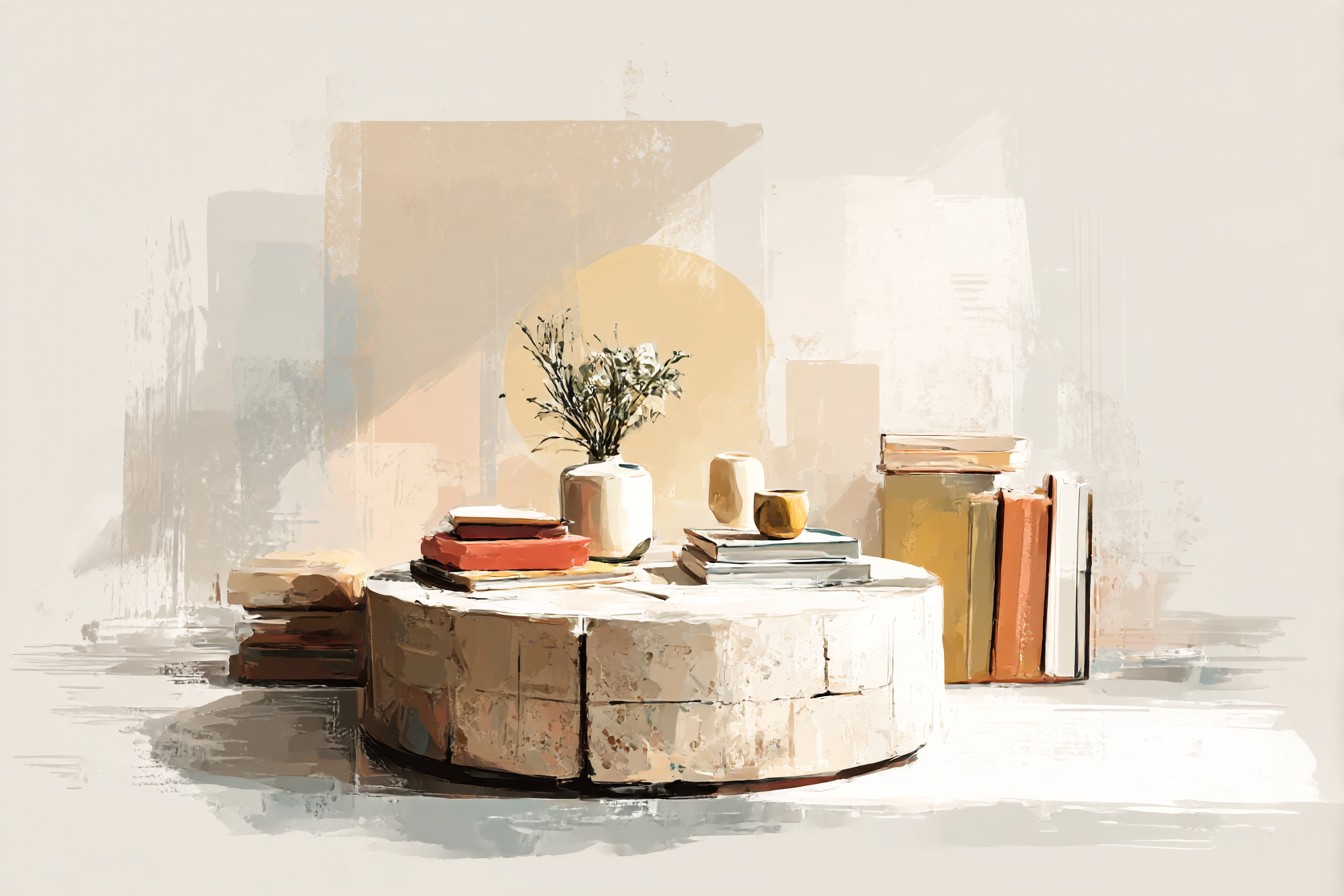
Then, if there’s room, one book, spine facing whatever direction actually looks good in your specific light, not because a magazine told you to.
What I’ve learned to leave off entirely: the stack of three matching hardcovers nobody’s read, because on a small table that’s not styling, that’s just less room for your coffee. Small surfaces punish decoration for decoration’s sake faster than big ones do, there’s nowhere for the eye to rest that isn’t the thing you put there.
[What Actually Goes On Top]
Final Thoughts
If there’s a thread through all of this, it’s that a small coffee table only works if you stop treating it like a shrunken version of a big one and start treating it as its own job description. Nesting tables solve the “not enough surface, occasionally” problem. Round ones solve the “I keep hitting my hip” problem. Glass solves the “this room feels boxed in” problem, at the cost of a cloth in a drawer. Storage solves the clutter problem outright. And what you put on top solves the problem of the thing looking either bare or like a landfill, depending on which way you overcorrect.
Nine tables, four kept, one turned into spite based plant furniture, and a ledger that’s mostly sitting in the good column this year, which is more than I can say for the lamp situation, but that’s a different piece entirely. The math almost always works out the same way in the end: small tables cost less to get wrong, so you can afford to actually find the right one instead of settling the first time, which is the opposite of what everyone assumes going in.

[…] happen until you actually live with the thing. Lamp on somewhere nearby, the weave throwing these small broken up shadows across the surface, the whole table looking about forty percent more expensive than it did at 2pm in direct sun. […]