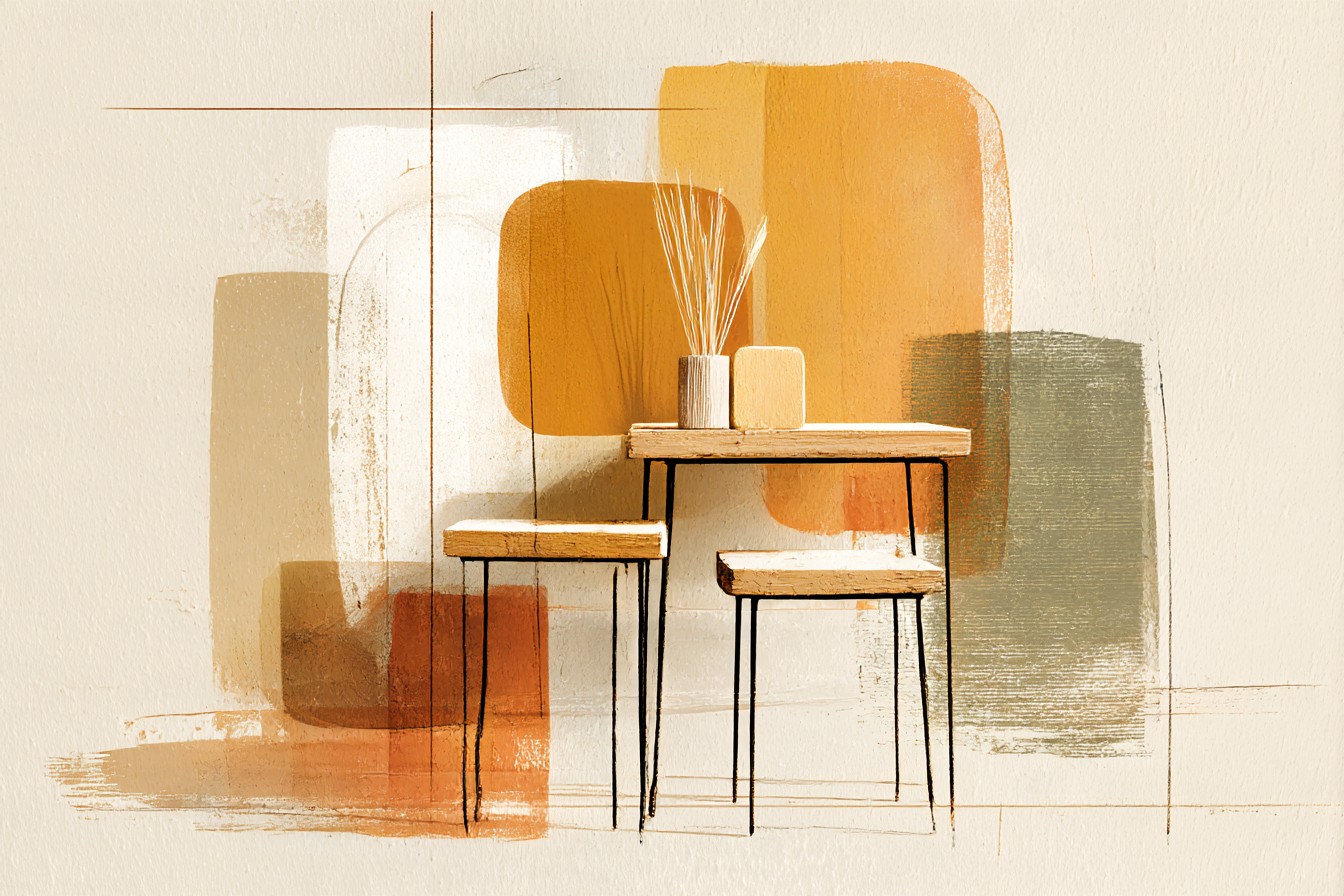
I’ve measured the arm of my sofa eleven times since March. I know that because I started keeping a tally on a sticky note stuck to the fridge, next to my grocery list, right under “buy stamps,” which has been there since February and still hasn’t happened. Eleven times, for one number, because I could never remember it long enough to write it down properly before I got distracted by something shinier at whatever thrift store I’d wandered into that weekend.
That number, if you’re wondering, is 24 inches. That’s the height of the sofa arm on my very secondhand, very lumpy three seater, the one I got for $180 off a guy moving to Ohio who I’m fairly sure undersold it because he just wanted it gone. Twenty four inches matters more than almost anything else in this whole nesting table conversation, and nobody tells you that up front. Everyone talks about the tabletop, the finish, whether it’s rattan or metal or that fake marble stuff that chips if you look at it wrong.

Nobody starts with the actual sizing logic, which honestly is not complicated once you sit with it for five minutes instead of just clicking “add to cart” at 11pm like I did the first time.
Here’s the thing about nesting tables nobody explains properly. You’re not buying furniture, not really. You’re buying a size relationship. Three tables, or two, that need to talk to each other and to the sofa arm and to the amount of floor you’re willing to give up. Get the tallest one wrong against your sofa and the whole set looks like it’s apologizing for being there. Get the gap between the smallest two wrong and you can’t actually pull them apart to use them, which, correct me if I’m wrong, is the entire point of the thing existing.
I’ve bought two sets of these now, one a disaster I still think about, one I’d genuinely defend to my last breath, and both taught me something specific about sizing that I wish someone had just said to me in plain English before I handed over money. So that’s what this is. Working it out, out loud, the way I actually did it, math mistakes included.
[Nesting Tables]
Sofa Arm Height Is Your Ceiling, Not a Suggestion
The rule I eventually landed on, after getting it wrong once, is that the tallest table in your nesting set should sit at or just below your sofa arm height. Not above it. Below it, or dead level at most. I know this because my first set, bought for $65 at an estate sale two summers ago, had a tall table that hit 27 inches, three inches taller than my sofa arm, and every time I reached over for my coffee I clipped the edge of it with my elbow. Every single time. For four months. I did the math on that eventually, out of spite more than curiosity, and worked out I’d knocked something over roughly once a week, which is fifty two incidents a year, which is an absurd number of spilled coffees to blame on a $65 table, but there it is.
The fix isn’t complicated. Measure your sofa arm from the floor, then look for a tall table that lands an inch or two under that number. Most sets run somewhere between 20 and 24 inches on the tallest piece, which happens to line up with a lot of standard sofa arms, so you’re not fighting the market too hard here. My current set, the one I’d defend to my last breath, has a tall table at 22 inches against a 24 inch arm, and I can rest a mug on either surface without ever thinking about it, which is honestly the whole ambition. Not beautiful. Not thoughtless. Just correctly sized so it disappears into the room instead of announcing itself every time you move your arm.
If your sofa’s on the lower side, one of those squashy low slung ones everyone seems to have now, you actually have more room to work with, which feels like it should be obvious but wasn’t to me until my coworker Marcus pointed it out while trying to convince me his glass topped set was worth more than I was giving him credit for. It wasn’t, for the record. But he was right about the height thing.
[Sofa-Height Nesting Tables]
The Slide-Out Gap Nobody Measures
Here’s the bit I got properly wrong the first time, and I mean properly, the kind of wrong that makes you feel a little stupid retroactively. Nesting tables need room to actually nest apart, not just stack together and look nice in a photo. The smallest table has to slide out from under the middle one and still have somewhere to go, and if you’ve shoved the whole set against a wall or wedged it into a corner because that’s where it looked good in the store, you’ve built yourself a display piece, not a set of tables.
My disaster set, the $65 estate sale one, had this exact problem. The gap between the middle table’s legs was maybe 14 inches, and the smallest table was 15 inches wide at its base. It didn’t fit. I want you to sit with that for a second, because I did buy it, I did try to force it, and I did eventually give up and just leave the small table sitting weirdly beside the other two like a kid who missed the bus. That’s not nesting. That’s three tables cohabiting.
What I check now, every single time, tape measure practically glued to my hand, is the internal leg width of each table going down the sizing chain. Middle table needs a gap wider than the small table’s widest point, plus an inch or two of breathing room so you’re not scraping wood against wood every time you pull it out, because that’s how finishes chip, and chipped finishes are the thing that ends a piece’s life around here faster than almost anything else.
The other thing, and this is the part that actually matters for your room, not just the tables themselves: work out how far you need that small table to travel. If you’re pulling it out to put in front of a second chair, or sliding it over for a laptop, measure that distance too. Mine slides out about 30 inches from home base before it hits the rug edge, and that’s exactly enough for movie night plates without anyone’s knees getting involved.
[The Slide-Out Gap]
Two Piece Sets Versus Three Piece Sets
I own a three piece set now, but I almost didn’t, because the math on two piece sets kept nagging at me and I couldn’t work out why until I actually sat down and did it properly instead of vibing my way through the decision like usual.
Two piece sets are simpler, obviously, one tall, one short, less sizing math because there’s only one relationship to get right instead of two. If your living room’s on the smaller side, and mine technically is, 11 by 13, don’t let anyone tell you different, a two piece set might actually serve you better because you’re not trying to find floor space for a third table that spends most of its life fully tucked away and forgotten. I had a two piece set for about eight months before the estate sale disaster, cost me $40 total, and cost per year on that one worked out to about five bucks, which is genuinely hard to argue with even now.
You Might Also Like

Three piece sets earn their keep differently. You get more surface area total, which matters if you host, if people actually put drinks down in your apartment on a semi regular basis, which mine do because my building has the good roof access and everyone ends up back at mine after. But the sizing math triples. You’ve now got a relationship between the tall and the middle table, and a separate one between the middle and the small, and if either of those gaps is off you’ve got a set that photographs fine and functions terribly, which is exactly the trap I fell into the first time around.
My current three piece set cost $95 from the Friday restock at my usual spot, the one where Denise puts new stuff out and I’ve genuinely started planning my week around it, which is its own problem for another post. Cost per year on that, two years in now, is under $50, and every table earns its space, every gap actually works. That’s the number that convinced me three piece was worth the extra sizing headache, but only because I did the math before I bought, not after.
[Two and Three Piece Sets]
Round Tops Versus Square Tops for Tight Corners
Nobody mentions this part enough and it drove me a little insane before I worked it out myself, mostly through bruised shins, honestly. Round tables and square tables behave completely differently once you’re trying to nest them in a tight spot, and it’s not really about looks, it’s about how the corners eat your floor space.
Square nesting tables give you a cleaner line against a sofa, they sit flush, they don’t leave weird triangular gaps of dead space the way round ones sometimes do when the diameters don’t quite match up going down the set. But square corners are exactly what catches your shin when you’re walking past in the dark trying not to wake anyone up, and I say that as someone who has genuinely sworn at furniture in my own living room at 1am more than once.
Round tables solve the shin problem entirely, obviously, nothing to catch on, but they need a slightly more generous footprint to avoid that gappy look where the smaller round table looks like it’s floating oddly under the middle one instead of tucking in properly. The fix, and this took me an embarrassingly long time to figure out, is to make sure the diameters step down by roughly the same ratio each time, not just by whatever random size happened to be on sale. A rough two inch difference in diameter per table down the set tends to look intentional instead of accidental, which matters more than I expected it to.
I went round in the end, mostly because my current apartment has a genuinely stupid layout with a walkway right past the sofa, and square corners there would’ve meant a bruise a week, easily. Not glamorous reasoning. Completely practical, and it’s held up, no shins lost since.
[Round and Square Tops]
Compact Sets for Small Rooms and Awkward Corners
My mom came over in January, saw the new set tucked into the corner by the window, and asked, completely deadpan, whether I was planning on opening a furniture rental business out of my apartment, because apparently three side tables in one room is “a lot for one person who lives alone.” I told her they were nested, that’s the entire point, they take up the floor space of one table when they’re closed up. She didn’t seem convinced. Mothers rarely are.
But she’s not wrong that small rooms need a different sizing approach than the general advice suggests. In a genuinely small space, and I mean under 150 square feet in the sitting area, not just “small” in the vague way everyone describes their apartment, you want the whole nested stack to have a footprint under about 16 inches square when it’s fully closed. Anything bigger and it starts eating the walking space you need to actually get past it, which defeats the purpose of a table designed specifically to shrink itself when not in use.
The trick I use now, and I wish I’d known this before the estate sale mistake, is to measure the closed footprint before you even look at the sliding gaps or the height. If the tables closed up don’t fit your corner, none of the rest of the math matters, you’ll never get that far. My current set closes to about 14 inches square, sits in the gap between my sofa and the window with about six inches to spare on either side, and I can still walk past it without turning sideways, which after the last apartment feels like an actual luxury.
Small space sizing isn’t really about buying smaller tables for the sake of it. It’s about buying tables whose closed size respects the room, even if the opened size does a bit more work when you need it.
[Compact Nesting Tables]
Final Thoughts
If I’m honest, the whole nesting table decision comes down to three numbers, and I spent way longer than necessary figuring that out.

Sofa arm height, so the tall one doesn’t fight your elbow every time you reach for coffee. The internal gap on the middle table, so the small one actually has somewhere to go when you pull it out. And the closed footprint, so the whole stack respects whatever corner it’s living in.
Everything else, the finish, the material, whether it’s round or square, matters, sure, but it’s decoration on top of a decision that’s really just measuring. I got it wrong once, spent $65 on a set that never worked properly and cost me a coffee spill roughly every week for four months, and I got it right the second time for $95 because I actually did the math before handing over cash instead of after.
That’s buy number six for the good column this year, for what it’s worth, and buy number six is doing more actual work in my apartment than the first four combined. Measure your sofa arm. Measure the gap. Measure the closed footprint. Then go find the set that fits the numbers you already have, not the other way around.



[…] Nesting tables get sold as a small space solution, which is true, but the reason they actually solve a reclining sofa problem specifically is different from the reason they solve a studio apartment problem. It’s not about the floor space they save sitting still. It’s about the fact that you can physically slide the front table back or pull it out of the footprint entirely the second someone wants to put the footrest down, then push it back for coffee time twenty minutes later. […]