
I own eleven rugs. Eleven. Across a one bedroom condo with, generously, five zones that could plausibly need floor covering, which means I’m carrying almost double the inventory the space actually requires, and I know that number precisely because I counted them last weekend while looking for a specific gray one and found three I’d forgotten I owned. That is not a healthy ratio. That is not “a few nice rugs,” that is a person with a problem, and I say that as someone who unloads spreadsheets for a living and generally prides herself on not having problems that show up as literal physical clutter in a hallway closet.
Here’s how I got there. I bought a round dining table eight months ago, oak, pedestal base, the kind of purchase I made with an actual document behind it, cost per year of expected use, resale value if I ever move, whether it would still make sense in a bigger dining room down the line.
Sound reasoning. What the document did not account for was the rug already living under where the table was going to sit, a square jute one I’d had since my first apartment, four years old, paid for, structurally fine. The table went down. The rug’s corners stuck out from underneath it at four points like the whole arrangement was reaching for something. My first reaction was pure horror, the kind you feel when a decision you were fairly proud of develops an obvious flaw the second it’s assembled. My second reaction, about a week later, was that I’d started to genuinely like it.
That’s the honest starting point for this whole piece, because the internet’s answer to “can you put a square rug under a round table” tends to be a flat no, buy a round rug, don’t overthink it, and I want to push back on that a little, slowly, the way you’d push back on a recommendation from someone who hasn’t actually looked at your room. The corners do behave differently than a round rug would. They’re not wrong, exactly. They’re a different kind of decision, and whether that decision works depends on things nobody puts in the generic answer, like room shape, like what else is in the sightline, like how much negative space you can tolerate before it starts reading as an error instead of a choice.
[Square Rugs Under Round Tables]
Square Rugs
The corner problem is real and I’m not going to pretend otherwise, because pretending otherwise is how you end up defending a bad decision out of stubbornness rather than logic, and I’ve done that with furniture before and regretted it. A round table sitting on a square rug leaves four triangular patches of exposed floor at the edges, and depending on the size ratio, those patches either read as intentional negative space or as a rug that’s fighting the shape of everything sitting on it. Mine, on reflection, sat right on the edge of both. The rug was six by nine. The table, with chairs pulled out, needed something closer to eight feet in diameter of clearance to actually work, and I’d done that math on the table but never re-run it once the rug entered the equation, which is a genuinely embarrassing oversight for someone who claims to run numbers on everything.
What saved it, and this took me longer to notice than it should have, is that my dining area sits inside a rectangular room, not a round one, and a square rug actually tracks the room’s lines in a way a round rug wouldn’t. The corners stick out past the table, sure, but they line up roughly with the edges of the space itself, so the eye reads “rug matches room” before it registers “rug doesn’t match table.” That’s not a universal fix. If your dining nook is an awkward alcove or genuinely round in feel, this argument falls apart fast. But in a standard rectangular room, which is most of them, the square rug’s corners aren’t really fighting the table so much as ignoring it politely and getting on with matching everything else.
[Square Rugs]
Round Rugs
The orthodox answer, and I want to be fair to it because it’s orthodox for a reason, not because interiors writers are lazy. A round rug under a round table removes the whole conversation. No corners, no exposed triangles, no decision to defend to a friend who notices these things, everything just echoes everything else, and there’s something genuinely restful about a room with no visual argument happening at floor level. I priced one out properly before deciding against it, an eight foot round wool rug running close to four hundred dollars more than my square jute one had cost new, for a shape that, by my own calculation, would only solve a problem I’d already half solved by accident.
Here’s my actual issue with the round rug as automatic advice: it assumes the table is the only shape in the room that matters, and it almost never is. My room has a rectangular window, a rectangular media console against the far wall, and a doorway that’s, obviously, a rectangle. A round rug under the round table would have made that one specific zone internally consistent while making it look slightly foreign to everything surrounding it, like a coin dropped into a room built entirely from straight edges. Round rugs earn their reputation in round rooms, in breakfast nooks, in spaces where the table genuinely is the dominant shape story being told. In a rectangular dining area that’s part of an open concept layout, which describes an enormous number of American apartments including mine, the round rug isn’t the safe choice so much as the choice that solves one problem while quietly creating a smaller one elsewhere.
[Round Rugs]
Rectangular Rugs
I’ll admit this one didn’t occur to me until the woman two desks over redid her dining room and sent me a photo, unprompted, of a long rectangular rug under an oval table, not round, oval, and asked if it looked wrong. It didn’t. It looked considered, actually, because oval and rectangle share a long axis even if they don’t share a shape, the same way my square rug and rectangular room shared corners. That got me thinking about how much of this whole debate is really about axis alignment rather than shape matching in the strict geometric sense people default to.
You Might Also Like

Rectangular rugs make the most sense under oval tables or long round tables in narrow galley style dining rooms, where a round or square rug would either be too small to matter or too large to leave any floor showing at all. The math is unforgiving in tight rooms; a round rug sized to properly frame a table often needs more clearance on all sides than a narrow room has to give, whereas a rectangular rug can run the length of the room and only need a foot or so of breathing room on the short sides. I don’t currently own one of these for the dining area, on paper it would suit my next place better than this one, but I’ve filed it away as the answer for a different room shape than the one I’m currently solving for, which is, I think, the most honest thing I can say about it without buying a twelfth rug I don’t need yet.
[Rectangular Rugs]
Oversized Square Rugs
If the corner problem genuinely bothers you, and it’s allowed to, there’s a fix that doesn’t require abandoning the square shape entirely, and it’s the one I’d actually recommend to someone stuck on this exact search. Size up. Properly up, not a little. My six by nine felt like a compromise because the table’s clearance zone was eating most of the rug’s width, leaving barely any margin before you hit the corners. An eight by ten, or even a nine by twelve in a larger room, pushes those corners so far out past the table and chairs that they stop reading as an accident of geometry and start reading as a floor treatment for the whole zone, with the table simply sitting inside it rather than dictating its edges.
The cost benefit case here is straightforward once you actually build it, which I did, because that’s apparently who I am now. A bigger rug costs more up front, sometimes considerably more, but it solves the corner problem without a second purchase, works if you ever swap the round table for a rectangular one down the line, and reads as a deliberate floor plan decision rather than a rug that happens to be under a table. The failure mode is sizing up without checking your actual room dimensions first; I’ve seen a nine by twelve dropped into a space that could barely fit an eight by ten, corners curling at the baseboards, which is its own kind of unacceptable and honestly worse than the small rug problem it was meant to fix.
[Oversized Square Rugs]
Patterned Square Rugs
I avoided anything with a bold border for years because of one rug, early on, a solid navy square that made every uneven edge in my old apartment look like a mistake I’d personally made, and it took me an embarrassingly long time to realize the rug wasn’t the problem so much as the total absence of anything to distract from its edges. Pattern, it turns out, does a lot of quiet work here. A square rug with a busy border or an all over print breaks up the eye’s ability to track a clean straight line all the way to the corner, which means the mismatch between a round table’s curve and a square rug’s edge gets absorbed into the pattern rather than sitting there as the only thing to look at.
Solid colors, especially dark or saturated ones, do the opposite; they make every edge crisp and deliberate, which is exactly what you want if the corners are working for you, and exactly what you don’t want if you’re still on the fence. My current rug has a small geometric print in cream and rust, nothing loud, and it’s done more to make the corner situation look intentional than any actual placement decision I made.
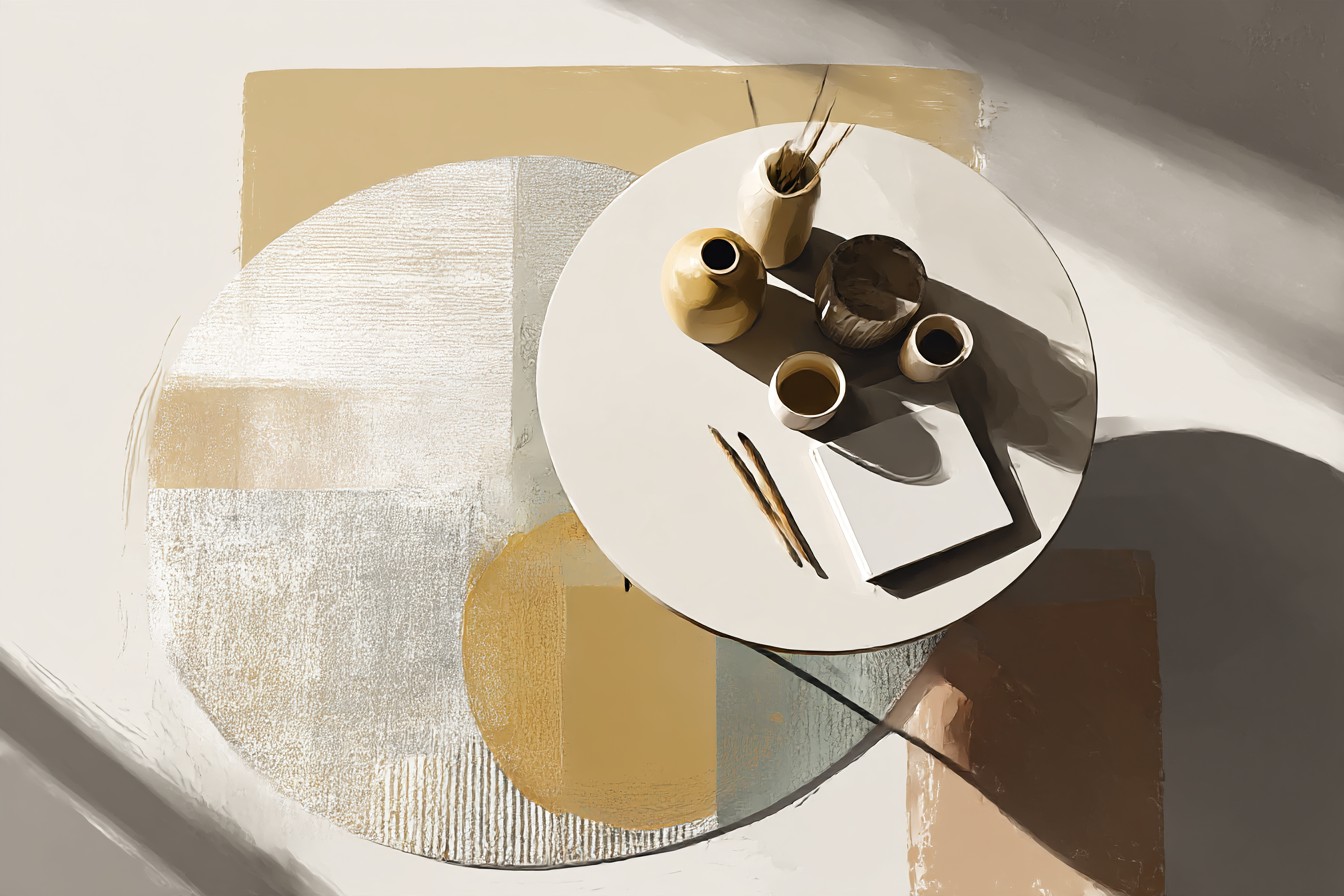
If you’re still deciding whether the shape mismatch bothers you, and you don’t want to commit to an entirely new size yet, changing from solid to patterned is the cheapest experiment available, and it’s the one I wish I’d tried before I nearly returned a rug that was, in hindsight, completely fine.
[Patterned Square Rugs]
Final Thoughts
So, does the shape fight back. Sometimes, and mostly when nobody’s checked the actual room around it. A square rug under a round table isn’t the design failure the flat internet answer suggests, but it’s also not a decision you get to make on autopilot the way you might with a round rug under a round table in a round room, if such a room even exists outside of very specific Charleston apartments. It’s a decision that depends on your room’s own geometry, on how much negative space you can live with, on whether you’re willing to size up rather than switch shapes entirely.
I kept my square rug in the end, oversized it slightly when I replaced it, and picked a pattern that does the corners a favor rather than exposing them. On paper that’s a reasoned, evidence based conclusion. In reality I kept it because I liked how it looked before I’d built any argument for it at all, and the spreadsheet came after, which is a fairly on brand admission for someone who insists she runs the numbers on everything. The shape mismatch is real. It’s just rarely the deciding factor people assume it is, and your room, not the internet’s flat answer, gets the final vote.



[…] guests don’t comment on, and probably should, is how much table you lose by going round instead of square. Feels obvious once you’ve lived with it, invisible until you have. You get a lovely shape […]
[…] look like it’s been measured with a spirit level. The other camp says a circle under a square table just means four chair legs permanently balanced on the edge, tipping like they’re auditioning […]