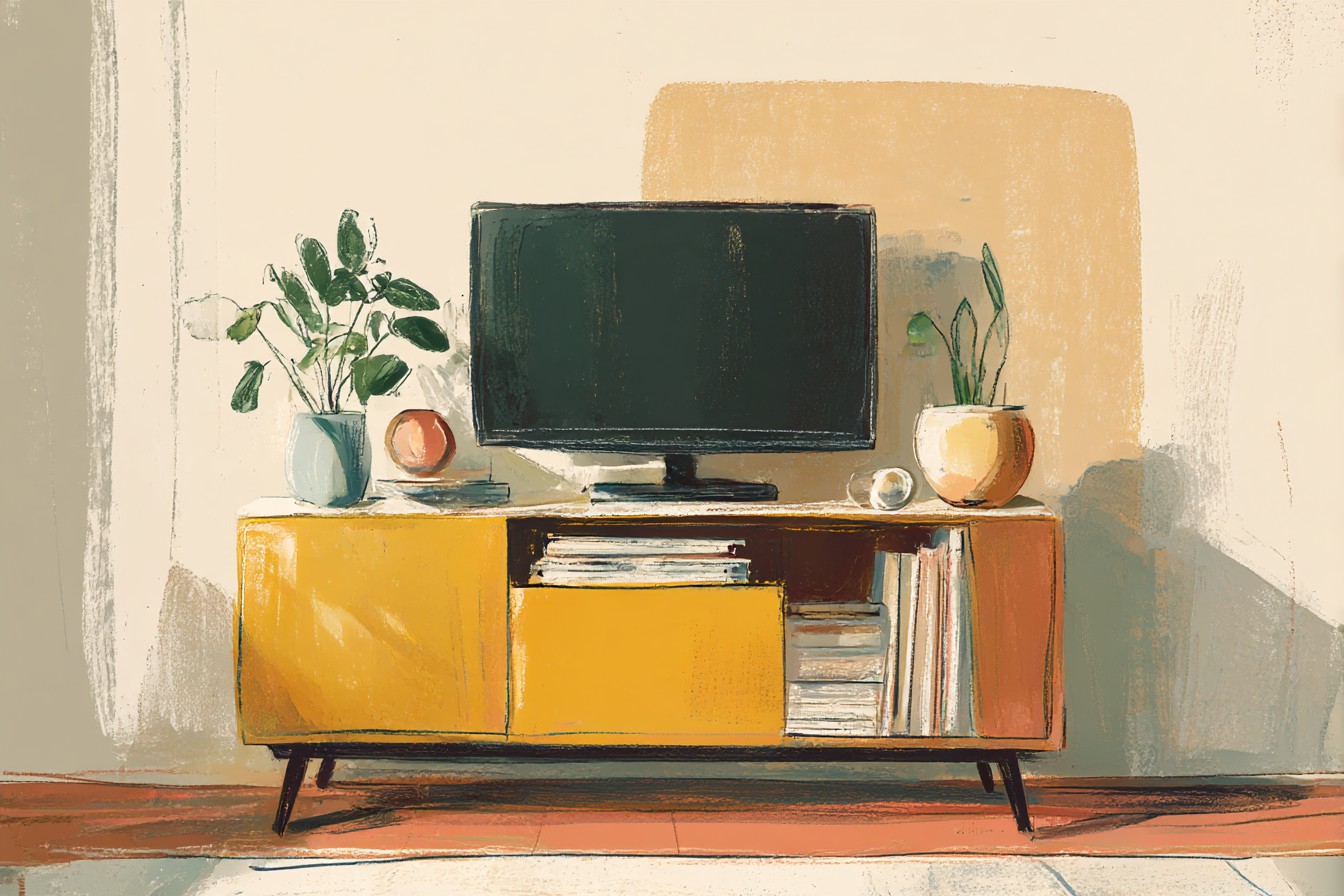
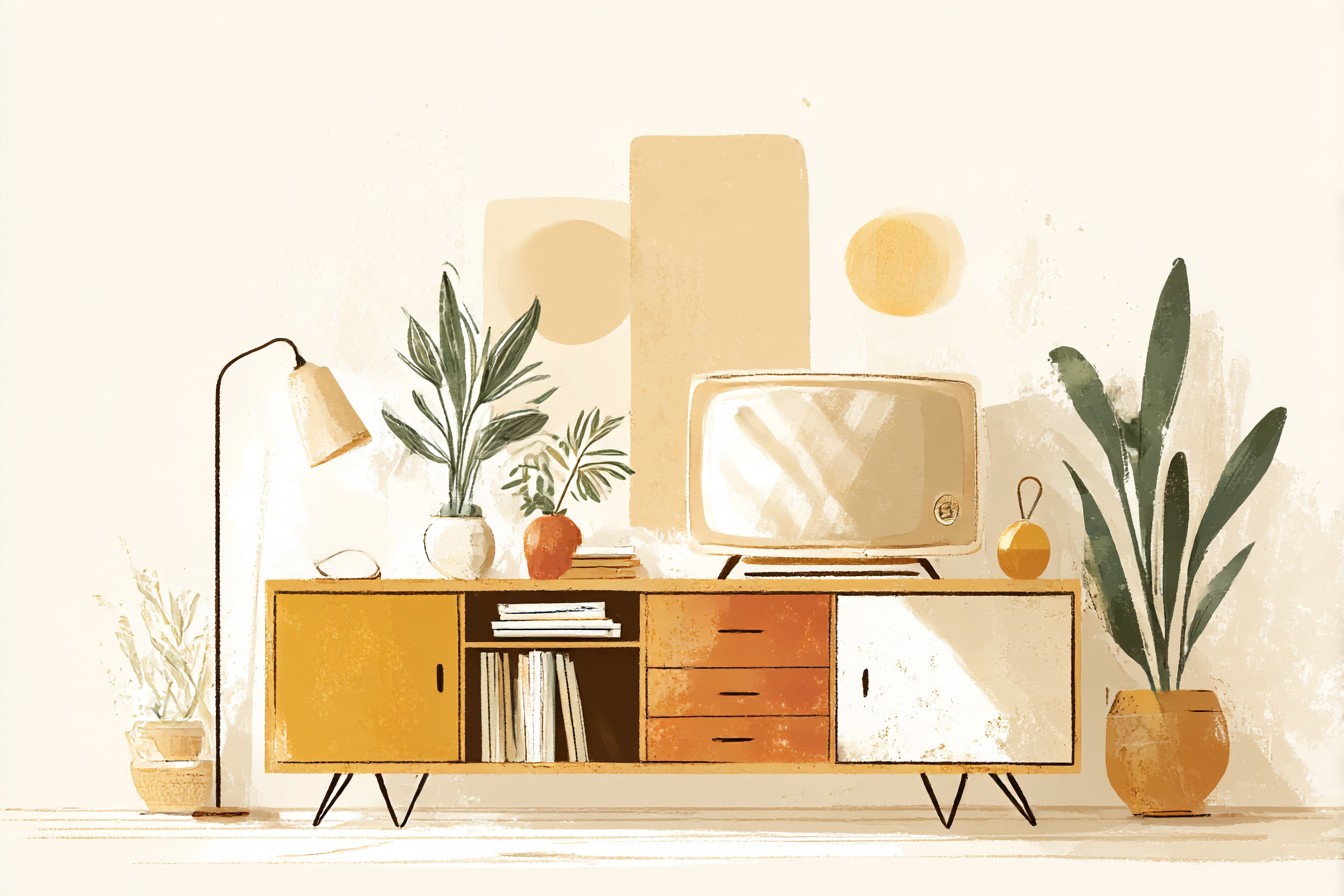
I counted it once, out of boredom more than curiosity, and the number stuck with me: I open or reach into my own TV stand shelves about nine times a day. Remote back in its spot, the router light I keep checking because the internet’s been temperamental since the building did whatever it did to the wiring in March, the basket where the cables that don’t belong to anything I currently own still live because I’m too anxious to throw them out. Nine times. That’s more than I open my fridge on a slow day, and nobody’s writing three thousand words about my fridge shelves.
The TV stand gets treated like furniture that exists purely to hold the television at the correct height, and sure, that’s the headline job. But the open shelves underneath and around it are doing something else entirely, and most people don’t plan for it until the console’s already installed and they’re standing there with a stack of paperbacks and a peace lily wondering where any of it is supposed to go. I’ve had a client, a guy in a one bedroom in the Mission, ask me point blank why his new “media console with generous open storage” had shelves twelve inches deep and nine inches tall, which is not generous, that’s barely enough to slide a game console in flat, forget standing a router upright without the antenna clipping the shelf above it.

Generous compared to what, is the question I wanted to ask the copywriter.
So this isn’t really a piece about TVs. It’s about the six or so inches of clearance under and around the screen that ends up doing the most honest work in the room, the part that either looks like a life happening or looks like a shelf nobody thought through. I’ve styled TV stands for people who wanted them to look like nothing lived there at all, and I’ve styled them for people who wanted every inch working overtime, and the good ones sit somewhere in between. What goes on those shelves says more about how a household actually runs than almost any other surface in the living room, the coffee table included. Let’s go through what actually earns its spot.
[TV Stand Shelves]
The Shelf That Actually Has to Hold Your Gear
Start with the boring one, because it’s the one that gets ruined most often by a brand’s optimism. Game consoles, soundbars, streaming boxes, the router if you’re not lucky enough to have it tucked somewhere else, this is the shelf where actual electronics live, and it is the shelf where I have measured the most disappointing gap between listing copy and delivered product. A console listed as fitting “most media equipment” that I measured myself came in at eight and a half inches of vertical clearance on the middle shelf. An Xbox Series X stood upright is roughly eleven and a half inches tall. That’s not a rounding error, that’s a completely different piece of furniture than the one photographed.
I had a client last year who’d bought a walnut veneer stand specifically because the listing showed a PlayStation sitting proudly on the middle shelf, only for hers to arrive with a shelf shallower by nearly two inches, so the console sat with its front lip hanging off the edge like it was trying to escape. Nobody measures ventilation clearance either, and a soundbar or console running hot in a nine inch gap with no airflow is a fire risk dressed up as tidy storage.
What I tell people now is to measure their actual gear, including cables plugged in at the back, then measure the shelf depth AND height before buying anything, not just width. If the brand only gives you width and overall dimensions and skips shelf by shelf depth, that’s not an oversight, that’s a listing hoping you won’t ask. This shelf doesn’t need to be pretty. It needs a cable clip, a bit of airflow, and honest measurements from whoever sold it to you.
[Media and Gaming Console Shelves]
Books and Records, Because Not Every Shelf Needs a Job Title
Then there’s the shelf that’s allowed to just be nice to look at while still holding something real. Books and vinyl do this better than almost anything else, because they’ve got spine color and texture built in, no styling required, you just need to stop yourself alphabetizing them like it’s a personality trait, which I did for exactly one week before admitting it made the shelf look like a showroom nobody actually lived near.
I keep a run of about fourteen books on the lower shelf of my own stand, mixed in with three records I never play because I don’t own a turntable anymore, I just like the covers, which is either a design choice or a small act of self deception, I haven’t fully decided. A friend of mine, a set designer, pointed out that leaning a couple of records against the side of a stack rather than stacking everything flat gives a shelf actual depth, front to back, not just a flat wall of covers, and she was right, it reads less like a shelf and more like someone actually collects things.
The mistake I made for years was treating this shelf as the one place clutter couldn’t go, keeping it aggressively minimal, three books, one object, done. It looked staged because it was staged. The shelves that photograph well in real homes, not showhomes, usually have a slightly uneven stack, a book laid flat under one standing up, something a little imperfect. Let the spines do the work. Just check the shelf depth first, because a stack of oversized art books needs more like ten or eleven inches of shelf depth to sit without hanging off the front edge, and plenty of open shelf units are built shallower than that.
[Book and Record Shelves]
Baskets, for the Stuff You’d Rather Not Discuss
Somewhere on every TV stand there needs to be a shelf that’s allowed to be a little ugly on the inside, as long as it’s tidy on the outside, and that’s what baskets are for. Chargers, the HDMI cables you’re keeping “just in case,” the universal remote that stopped working for anything except the volume, the instruction manual for a soundbar you bought in 2021 and will never open again but can’t bring yourself to recycle. All of it goes in a basket, and the basket goes on the shelf, and suddenly the whole unit looks composed instead of chaotic.
You Might Also Like

I went through three different basket sizes before landing on one that actually worked in my own stand, because the first two were either too shallow, meaning cables spilled over the top the second I added anything else, or too deep, meaning I couldn’t see what was in there without digging to the bottom like it was a lucky dip. The one that stuck is a woven rectangular basket about six inches deep, which sounds like an oddly specific detail to care about, and it is, but it’s the difference between a basket that hides mess and one that just relocates it somewhere you can’t see the true scale of the problem.
The other thing nobody tells you: measure the basket against the shelf opening, not just the shelf surface. Plenty of open shelving units have a lip or a support bar running along the front edge, and a basket that’s technically shallow enough to sit on the shelf can still be too tall to slide in past that lip. I know this because I bought a basket that fit the depth perfectly and then couldn’t get it past the front rail without tipping it sideways every single time. It’s a small annoyance that becomes a genuinely irritating daily one.
[Basket Storage Shelves]
A Bit of Green, Kept Deliberately Low Maintenance
One shelf, usually the top or the one at eye level from the sofa, gets a plant, and I’d argue it should, because it’s the one thing on the whole unit that isn’t reflecting light back at the TV screen or competing with whatever’s on it for attention. The trick is picking something that survives being near a screen that runs warm for hours a night and rarely gets moved, which rules out anything fussy.
I’ve killed two pothos plants on this exact shelf before switching to a snake plant, which has survived being forgotten for three weeks at a stretch, survived a cat knocking it half off the shelf, and survived me repotting it into a container about two sizes too small because I misjudged the space and didn’t want to buy another pot. It’s thriving out of what feels like spite at this point. A trailing plant works too if the shelf’s high enough for the leaves to hang without brushing the screen or the soundbar, but that only works with real clearance above, at least eight inches, or you end up trimming leaves every couple of weeks just to stop them draping across the remote.
The other option, and I say this as someone who used to think it was cheating, is a good faux plant on the shelf that gets the least light, usually the bottom one tucked furthest from the window. Nobody’s inspecting it that closely, and it solves the actual problem, which is a dead, brown, crunchy plant becoming the first thing anyone notices in the room. Green shouldn’t cost you a shelf’s worth of guilt every few months.
[Plant Display Shelves]
The Shelf That’s Just Allowed to Be Nice
And then, finally, one shelf that does absolutely no functional work at all, and I think every stand needs exactly one of these or the whole thing starts to feel like a utility closet with a television bolted to the front of it. A framed photo, a small ceramic object, one candle you never light because it’s really there for the shape of the jar. This is the shelf where I put a small brass dish a friend gave me that holds nothing, genuinely nothing, it’s just a dish, and I’ve been asked about it more than anything functional in the entire apartment.
The instinct is to fill this shelf with more storage because it feels like wasted space otherwise, and I’d push back on that hard. A living room where every single surface is working overtime doesn’t feel calm, it feels managed, like you’re living inside a system rather than a home.

One shelf that’s purely decorative, even if it’s a shelf nine inches deep holding one four inch object, does more for how the whole unit reads than another basket ever would.
The only real rule here is scale. A tiny three inch frame on a shelf that’s two feet wide just looks lost, like it wandered in from a smaller piece of furniture. Go slightly bigger than feels natural, or group two or three smaller pieces together so the shelf doesn’t read as empty by accident rather than by design.
[Decorative Display Shelves]
Final Thoughts
If there’s one thing I’d want someone to take from all this, it’s that the shelves around your TV are not an afterthought to the screen, they’re basically a small, low stakes stage for the actual texture of how you live, and treating every inch of them as either pure storage or pure display misses what makes the good ones work. Mine has electronics on one shelf, books leaning imperfectly on another, a basket holding cables I’m too anxious to throw out, a snake plant that’s survived my neglect out of spite, and one brass dish that does nothing useful and gets asked about constantly. That mix isn’t an accident, it’s five different jobs happening on one piece of furniture, and most stands sold as one size fits all storage aren’t built with that in mind, they’re built to photograph well with a single styled vignette and nothing else on them.
Measure before you buy, properly, shelf by shelf, height and depth, because I’ve been burned enough times by listings that round up or simply don’t mention it. And once it’s in the room, resist the urge to make every shelf work equally hard. Let one hold nothing but something you like looking at. It’s the shelf that ends up doing the most, oddly enough, for how the whole room actually feels to sit in.