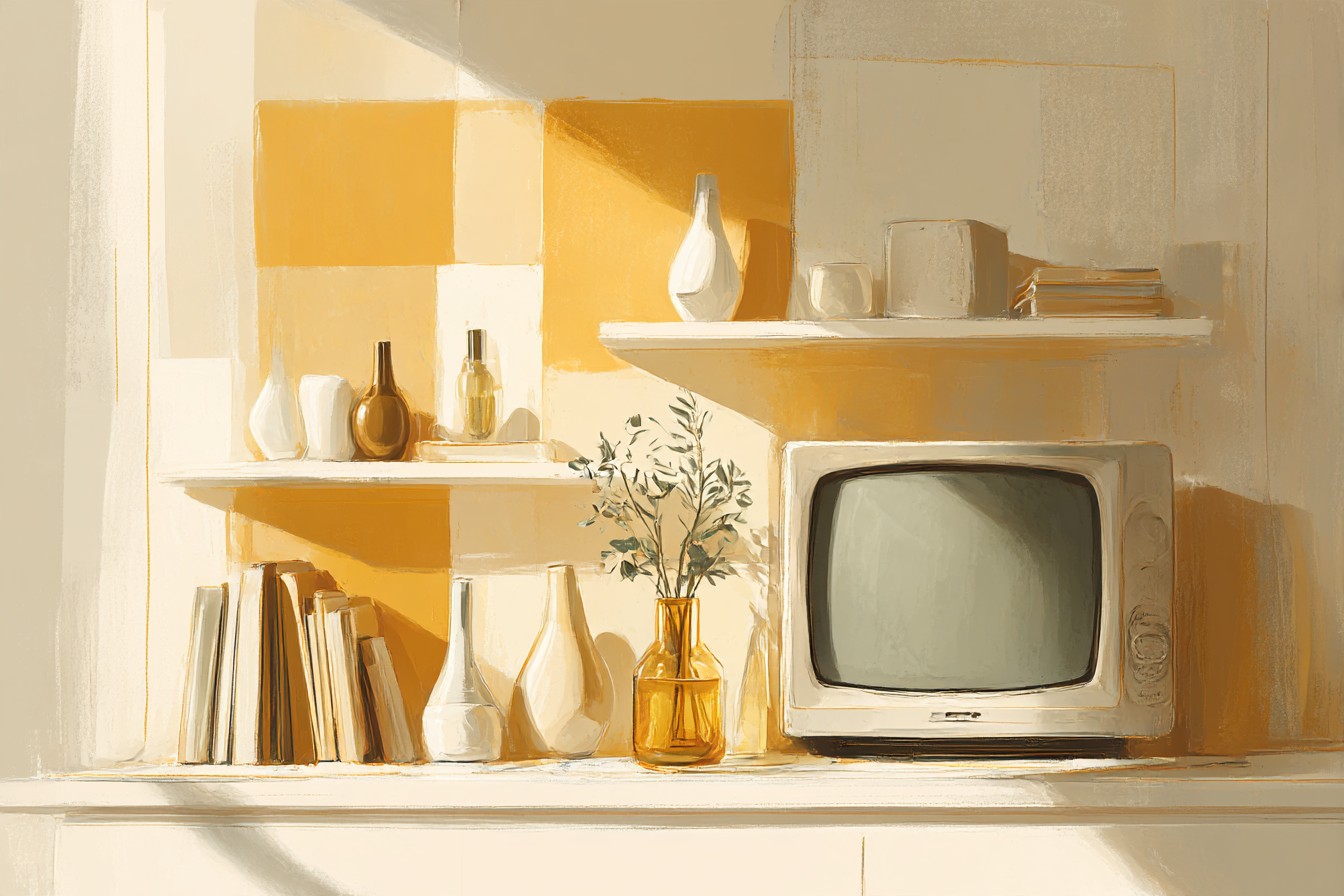
Okay so my roommate Marcus walked into the living room, looked at the entertainment center for a solid four seconds, and said “why does it look like a TV showroom died in here.” Which, rude, but also. Fair. I’d just spent an entire Sunday “styling” the shelves around our TV using literally zero of our actual stuff, just some spray painted vases from the dollar store and three books I don’t own turned spine in, because that’s what the inspo photo did. It looked incredible on camera. In person, at 9pm, trying to find the Xbox controller buried behind a fake fern, it looked like a set. Not a room.
A set.
That’s kind of the whole problem with entertainment center shelves, right. Everyone wants them to look like the photo, all breathing room and one (1) tasteful ceramic thing, but then real life happens. The router needs to live somewhere. So does the PS5, and the four remotes nobody can identify by touch, and the cable box your provider swears is “the new slim model” but is somehow the size of a toaster oven. You end up with either a shelf that looks amazing and functions like garbage, or a shelf that functions fine and looks like a drawer exploded vertically. I’ve done both. I’ve lived both. Neither one is it.
So this is me, several failed setups and one Marcus intervention later, actually figuring out how to make entertainment center shelves do two jobs at once, look like a person with taste lives there AND hide the fact that said person owns nine remotes and a modem shaped like a small alien. We’re going through it by section, because a shelf isn’t one decision, it’s like five decisions stacked on top of each other, and I made most of them wrong the first time so you don’t have to.
[Entertainment Center Shelves]
The Open Shelves That Actually Get Looked At
Open shelving is the part everyone photographs and nobody thinks through. It’s also the part that goes wrong fastest, because “open” means “visible,” and visible means every bad decision is right there at eye level next to the TV, forever, judging you.
My first attempt was all books, no breathing room, just spines wall to wall like I was trying to win an argument nobody was having. It looked cluttered even though technically it was organized. What actually worked was cutting the number of objects by more than half and adding height variation, one taller item per shelf, like a lamp or a vase, so your eye has somewhere to land instead of scanning wall to wall like it’s reading a spreadsheet.
I also learned, the hard way, that open shelves next to a TV need at least one shelf that’s allowed to be boring. Not everything gets to be a moment. One shelf can just hold the extra HDMI cables in a little tray and that’s fine, that’s actually doing you a favor, because it means your eye isn’t hunting for the plain functional stuff in between the pretty stuff.
Sent a photo of the “after” to the apartment group chat expecting a full round of applause and got one reply, from Marcus, that just said “better, still see the wires.” Humbling. But correct, and it’s the whole reason cable stuff gets its own section further down, because open shelves are only a styling win if what’s underneath them isn’t a mess too.
[Open Shelving]
The Closed Cabinet Doing the Heavy Lifting
If your entertainment center has even one closed cabinet section, that’s your MVP, full stop. That’s where the ugly, necessary, un-Instagrammable stuff lives. Router. Modem. The cable box your provider insists is compact and is not. Old game consoles you swear you’ll sell someday. A tangle of chargers you’re afraid to throw out in case one of them turns out to be load bearing for something.
I used to leave this cabinet basically as a dumping ground, shove it shut, hope for the best. Which worked fine until I needed to switch out an HDMI cable during a movie night and it took me four minutes of kneeling on the floor pulling out a Nintendo Switch dock, two remotes, and what I can only describe as a fossil record of old phone chargers, while everyone waited.
What actually fixed it was treating the cabinet like its own tiny apartment with zones. Router and modem get their own corner, ideally near a vent or with the door cracked slightly so nothing overheats, because I did, once, accidentally slow cook a router by sealing it into an airtight cabinet for a summer, R.I.P. Consoles get a shelf. Cables get a bin, which we’re getting into next. It sounds obsessive for a cabinet nobody sees, but the whole point of a closed cabinet is that you should never dread opening it, and mine went from a place I avoided to the actual most useful part of the whole setup.
[Closed Cabinet Storage]
Cords, Cables, and the War You Cannot Fully Win
Nobody warns you that the cable situation behind an entertainment center basically grows. You start with a TV and a console. Somehow, eighteen months later, there’s a soundbar, a streaming stick, a second console “just for retro games,” a smart plug situation, and enough cable slack to lasso a small horse.
I tried the velcro strap thing first, bundling everything into one thick cord and zip tying it to the back leg of the unit, which worked for exactly as long as it took me to unplug one thing to test something else, at which point the whole bundle became a crime scene again. What’s actually held up is separating cables by shelf rather than bundling them all into one mega cord, so the stuff on the top shelf stays with the top shelf, and I’m not tracing a single cable through four other cables just to find where it plugs in.
You Might Also Like

Cable clips stuck to the inside back panel of the unit did more for this setup than almost anything else I bought, and they’re cheap, like genuinely a few dollars for a strip of them, no drilling required, which matters because my lease says no holes in anything structural and I have already had one very tense conversation with my landlord about a “small” nail hole that was apparently not small enough.
The one thing I’ll say with a straight face, if you get one cable management item, get a power strip with actual spacing between the outlets, not the cramped kind where every plug fights for room. It sounds boring. It’s the difference between a tidy cabinet and a cabinet you’re scared to open.
[Cable Management]
Baskets and Bins Doing Their Best Cosplay of Organization
Baskets are the fastest way to make a shelf look “done” without actually organizing anything, and I say that with love because I own eleven of them now, which is at least six more than any one entertainment center needs.
The trick I had to learn is that a basket is only doing its job if you actually know what’s in it without opening it. My first round, I had three identical woven baskets on one shelf, no labels, no memory system, so every single time I needed the spare remote batteries I opened all three like I was picking a door on a game show. Marcus started calling it “the lottery,” as in “did you check the lottery yet,” which I deserved.
What works now is mixing textures so I can tell baskets apart at a glance, one woven, one a smooth black bin, one a small canvas pouch thing, so my brain files them differently without needing a label maker I will never actually use consistently. The woven one holds game controllers and chargers, the black bin holds cables and spare batteries, the little pouch holds remotes, because remotes are somehow always the thing I need fastest and can never find.
Baskets also solve the “what do I even put on these shelves” problem, honestly, because a basket can absorb almost anything ugly or awkward shaped, and from three feet away it just reads as a nice textured object instead of a hiding spot, which, let’s be honest, is exactly what it is.
[Baskets and Bins]
The Actual Stuff, Books, Plants, and Things With No Job
Eventually someone’s going to ask what actually goes on entertainment center shelves besides gear and bins, and the answer is the stuff with no job at all, which is somehow the hardest category to get right.
I went through a phase of buying random decorative objects specifically for these shelves, a ceramic thing shaped like nothing in particular, a geode I never asked for the price of, and it all just sat there looking like it belonged to a stranger, because it did, it belonged to whoever styled the display shelf I copied it from. What actually made the shelves feel like mine was using stuff that already existed in my apartment. A small stack of books I’ve actually read, spine out, not fanned open like a prop. One plant that’s fake, I’ll admit it, because the real one died within two weeks of living that close to a TV that runs hot for six hours a night. A couple of framed photos, small, nothing precious enough that I’d panic if it got knocked during a controller throwing incident, which, if you have roommates or a sibling who visits, will happen.
The move that actually made a difference was leaving one shelf almost empty. Not styled empty, just genuinely empty, one object, lots of space around it. It reads as intentional instead of like I ran out of stuff, and it gives the eye somewhere to rest between the busier shelves. Every entertainment center I’ve seen that looks properly put together has at least one shelf doing basically nothing, and it’s doing the most work in the whole unit.
[Entertainment Center Styling]
Final Thoughts
If there’s one thing this whole process taught me, it’s that entertainment center shelves aren’t one decision, they’re basically five small arguments you have with yourself over a few weekends. What goes where. What gets hidden.
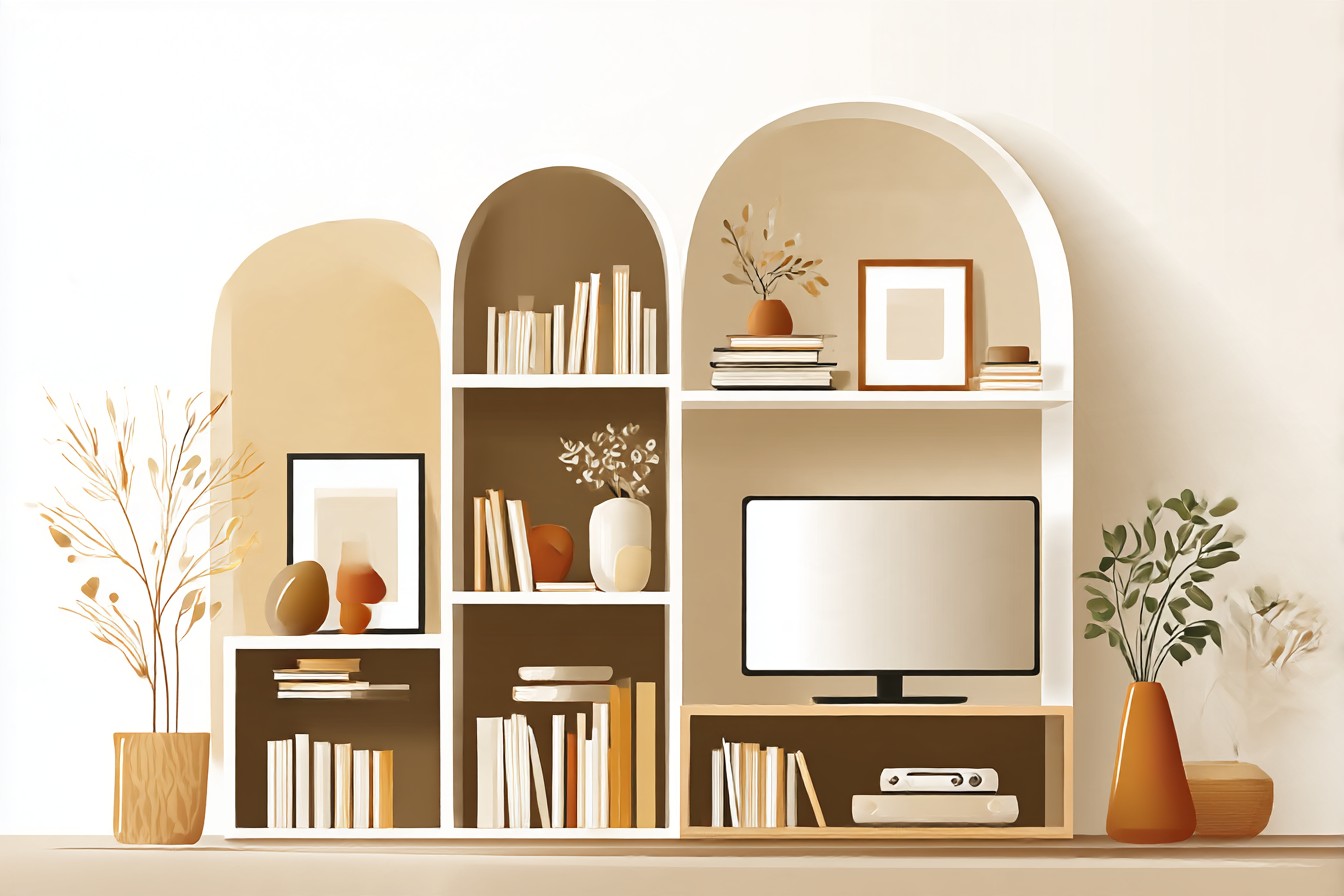
What’s allowed to just sit there being pretty and useless. I got most of it wrong on the first pass, styled a shelf for a camera instead of a Tuesday night, shoved cables into one doomed bundle, bought baskets I couldn’t tell apart from three feet away.
What actually works is less about finding the perfect objects and more about being honest with yourself about what your setup actually needs to hide, and giving that stuff a real home instead of pretending it doesn’t exist. The router needs airflow. The cables need to be sorted by shelf, not bundled into one guilty knot. The baskets need to look different from each other or you’ll be playing the lottery every single night like I did.
And somewhere in the middle of all that function, you get to keep one shelf that’s just yours, a couple of books, something a little empty, a fake plant that will never die on you the way the real one did. It’s not a showroom. It’s not supposed to be. It’s supposed to survive a Tuesday, a controller getting thrown, and a roommate walking in and saying something honest about it, which mine did, and which, annoyingly, made the whole thing better.