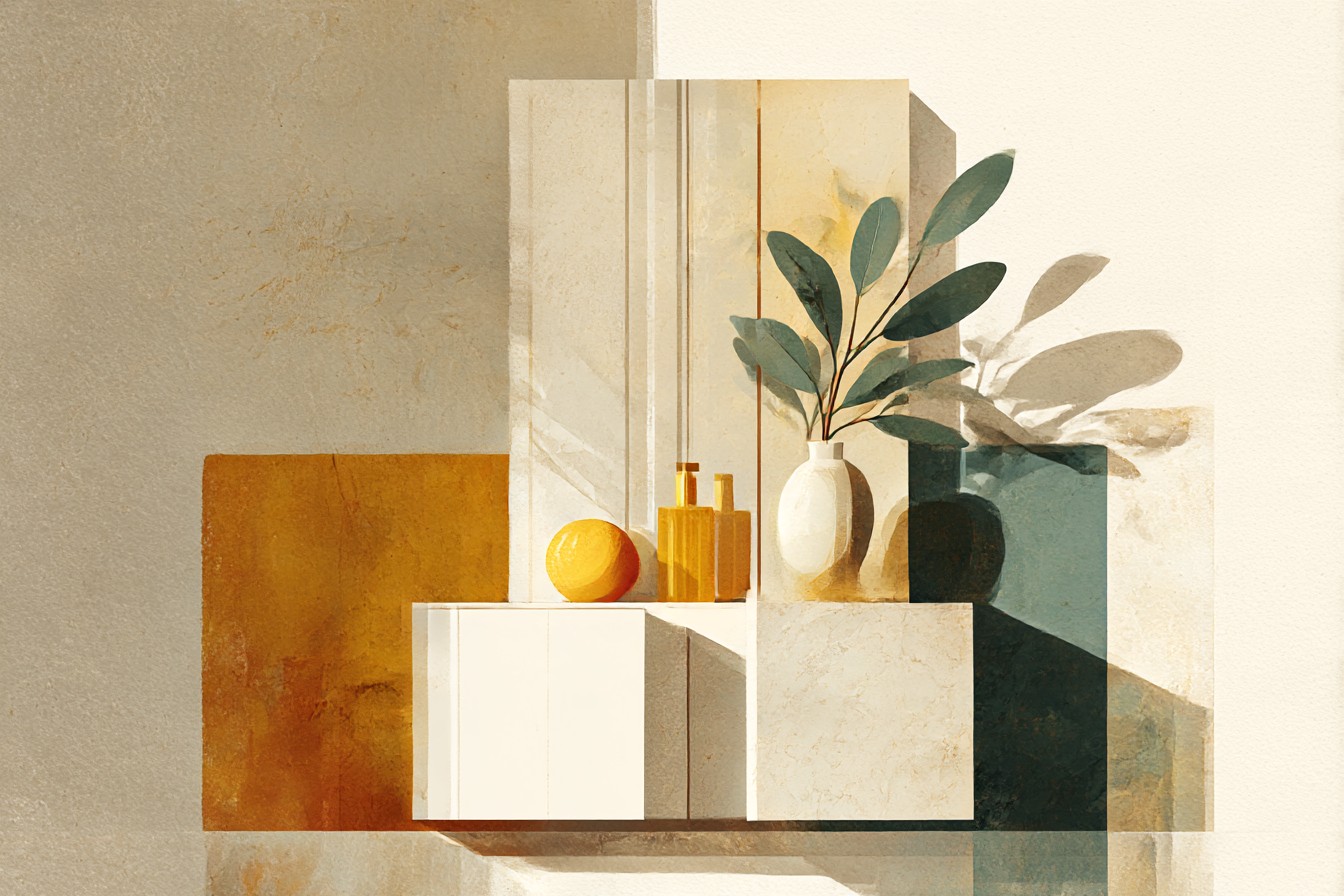
I once spent four hundred and ten dollars building what I can only describe as a shrine. Not to anything in particular. Just three white ceramic somethings, evenly spaced, on top of a secondhand sideboard I’d sanded and repainted over a long weekend, feeling very proud of myself. My sister Cara came over, looked at it for a solid ten seconds, and said, “Is someone getting married here? Did I miss an invitation?” That was the moment I understood I’d built an altar to absolutely nothing. No lamp.

No life. No single thing you’d actually reach for. Just three objects nobody in my apartment could name the function of, arranged with the kind of nervous symmetry you get when you don’t trust your own taste yet.
It took me embarrassingly long to work out that a sideboard top isn’t a display case. It’s a landing strip. It’s the thing your eye hits when you walk in the front door, and if it’s empty it reads as unfinished, and if it’s crammed it reads as a car boot sale, and somehow I managed both of those at different points in the same year, which is its own kind of achievement. I have redone this surface, properly redone it, at least six times since. What I’ve landed on, eventually, isn’t a look. It’s a formula. Height, then something lower and rounder to interrupt it, then something alive or at least pretending to be, then something with an actual job to do, and then, if you’re brave, one object that makes no sense at all and that’s exactly why it works.
That’s it. That’s the whole system. It sounds too simple to be worth writing down, and yet I watch people, myself included on multiple humiliating occasions, skip straight past it and go for either the shrine approach or the total scatter approach, both of which fail for the same reason: nothing on the surface is doing a different job from anything else. A sideboard top that works has variety built into it on purpose, not variety you back into by accident because you couldn’t decide what to buy.
So here’s how I actually think about it now, broken into the pieces that make the formula work, in the order I build them up when I’m starting from a completely bare surface and trying not to repeat my three ceramic ghosts from 2019.
[Top of a Sideboard]
The Lamp That Earns Its Spot
I start with the lamp because everything else gets arranged around it, not the other way round, and because I learned this one the expensive way. I bought a “affordable” table lamp from a mid tier interiors brand for ninety two dollars, brought it home, and discovered the shade was glued at a visible angle, like someone finished the shift at 4:58pm and didn’t check. Ninety two dollars. For a lamp that looked drunk. I want whoever signed off on that quality check to explain it to me directly, and I will wait, genuinely, I have the time.
What a sideboard actually needs is a lamp that’s doing two jobs at once: giving the corner of the room a warm pool of light in the evening, and acting as your tallest anchor point so everything else has something to sit against. Height matters more than style here. I’ve had good luck with a simple ceramic base lamp under thirty five dollars from a big box store that’s outlasted two “premium” ones, including drunk shade lamp, may it rest. If your sideboard sits under a window and doesn’t need evening light, a tall dried branch or a slim vase does the same visual job without the electrical cord you then have to hide, badly, behind a runner.
Skip the lamp entirely and you’ll notice the whole top feels flat, even if every other piece is nice, because nothing is pulling your eye upward. That was half my problem in the shrine years. Three squat objects, all roughly the same height, all fighting for the same visual space, none of them winning.
[Table Lamps for Sideboards]
Something Alive, or Convincingly Faking It
Second piece, always: something with a bit of life in it, actual or theatrical. I went through a fake eucalyptus phase that I’m not proud of. Bought three stems from a discount craft store, put them in a thrifted glass vase, and for about eight months genuinely thought I’d fooled everyone, until my downstairs neighbor Deb, watering her actual plants in the hallway, reached over and touched a leaf and just said “oh” in a tone that told me everything.
Real is better if you can keep it alive, and I say that as someone who has killed three separate pothos plants in the exact same corner, so clearly it’s not about talent, it’s about picking the right thing for the light you’ve got. A single stem of eucalyptus from the grocery store flower bucket, four dollars, dries out beautifully on its own over a couple of weeks and looks intentional the whole time, which is more than I can say for the fake stuff. If your sideboard gets zero natural light, and mine mostly doesn’t, a dried arrangement or even a single dramatic branch in a heavy vase does the job without demanding anything of you.
The point of this piece isn’t decoration exactly, it’s contrast. Everything else on a sideboard top is hard and still, wood, ceramic, metal, glass. One soft, irregular, slightly wild shape breaks that up and stops the whole surface looking like a display in a shop window that’s closing down.
[Vases and Greenery for Sideboards]
You Might Also Like

The Leaning Piece
Third element, and the one I resisted longest because it felt like cheating: something leaned against the wall behind the sideboard instead of hung above it. A mirror, a framed print, even a piece of art you haven’t gotten round to hanging properly. I avoided this for two years because I have a thing about crooked frames, a genuine, slightly irrational thing, born from a rental apartment in my twenties where nothing hung straight no matter what I did, and I associate “leaning” with “given up.”
I was wrong about that, and I’ll say it plainly because Eleanor doesn’t do the soft version of admitting fault. A leaned mirror behind a lamp does something a hung one can’t, it catches the lamp’s light and bounces it back into the room, and it gives you the flexibility to swap it out on a whim without a hammer and a fresh hole in the wall. I’ve got a secondhand arched mirror, thirty dollars from a local resale shop, leaning against the wall behind my current sideboard, angled just slightly, and it’s outlasted three other arrangements around it because the mirror never has to change even when everything else does.
If mirrors feel too obvious, a framed print works the same way, propped rather than hung, slightly overlapping the lamp’s base so the whole thing reads as one composed moment instead of three separate decisions made on three separate shopping trips, which, if we’re honest, is usually exactly what it was.
[Mirrors and Art for Sideboards]
A Tray That Actually Catches Something
Fourth piece, and this is the one that stops the whole surface tipping into showroom territory: something with an actual function. Keys. Mail. The specific hair tie I apparently need four of scattered around my apartment at all times. A tray does this job better than anything else because it draws a visible boundary around the mess, so the clutter looks contained rather than accidental.
I bought a “luxury” marble tray for fifty eight dollars once, brought it home, and within a week it had a hairline crack from nothing more dramatic than my keys landing on it slightly too hard, the way keys land on trays, the way trays exist to be landed on. Fifty eight dollars for a tray that couldn’t survive the one thing trays are for. I replaced it with a seven dollar wooden one from a hardware store’s houseware aisle and it’s taken far worse than my keys since, including an entire spilled glass of water during a dinner party, no damage, no drama.
This is the piece that makes people trust the rest of the arrangement, oddly enough. A sideboard top with nothing functional on it reads like you don’t actually live in the room. One tray, doing an obvious job, tells the truth about the rest of your house.
[Trays for Sideboards]
One Object That Makes No Sense
Last piece, and the one people skip because it feels indulgent: something weird. A ceramic bust with no clear provenance. A brass hand. A rock, genuinely just a rock, that means something to you and nothing to anyone else. I have a small carved wooden bird, badly carved, one wing slightly shorter than the other, that I bought from a stall outside a diner in Vermont for six dollars because the woman selling it looked so hopeful I couldn’t walk past. It has sat on every sideboard I’ve owned since, through four apartments, and it’s the one object guests always pick up and ask about.
This is the piece that stops the surface reading as a formula, ironically, even though it’s the last step of the formula.

Everything else up to this point is doing a job, height, softness, reflection, function. This last piece does nothing except exist, and that’s precisely why it makes the whole arrangement feel like a person lives there instead of a showroom stylist passing through on a Tuesday. Skip it and the surface is competent. Include it and it’s actually yours.
[Decorative Objects for Sideboards]
Final Thoughts
I still think about those three white ceramic somethings sometimes, mostly with a wince, occasionally with something closer to affection, the way you look back at a haircut that was clearly a mistake but at least meant something at the time. What changed wasn’t taste exactly. It was understanding that a sideboard top isn’t one decision, it’s five small ones stacked on top of each other, each doing a different job: height from the lamp, softness from something living, reflection from something leaned, function from something you’ll actually use daily, and one piece that answers to nobody.
You don’t need all five to be expensive, and honestly the cheap ones in my house have outperformed the pricey ones nearly every time, which tells you something about where the money in this industry actually goes. Get the formula right and the objects underneath it barely matter. Get it wrong and no amount of “affordable luxury” marble is going to save a sideboard that looks like either a shrine or a car boot sale, because I’ve built both, on the very same piece of furniture, in the very same year, and lived to tell you about it.