
My sister in law Dana walked into the living room at eight thirty on a Tuesday, looked at the lamp next to my reading chair, and said, “Ben, why are you sitting under a light that makes you look like you’re being interrogated.” I laughed, then actually looked up at it, really looked, and realized she was right. It was a floor lamp I’d bought two years earlier because it looked good in the corner, brass finish, nice tapered shade, the kind of thing that photographs well and does basically nothing else. I’d been reading under it most nights for two years with my book held at a slight diagonal like I was trying to avoid a searchlight, and it never once occurred to me that the lamp itself was the problem.
That’s the thing about reading lamps that nobody tells you when you’re buying one. You shop with your eyes. You stand in a store or scroll a website and you think about whether it matches the side table, whether the shade is the right shape, whether it looks like something a person with taste would own. What you don’t think about, not really, is where the light actually lands once you’re sitting in the chair with a book, at nine at night, tired, one eye already half closed.

A lamp can be beautiful and still be completely useless for the one job you bought it to do, which is let you read a page without squinting, leaning, or giving up and reading on your phone instead, which we all know is worse for you at that hour anyway.
I’ve bought a genuinely embarrassing number of lamps trying to solve this, some of them good decisions, most of them me learning the hard way that a lamp being pretty and a lamp being functional are two completely different purchases that sometimes, occasionally, overlap. My house right now has, and I counted this specifically before writing it down, seven lamps that get used for reading in some capacity, across three rooms and one very confused hallway situation involving a plug that doesn’t reach where I actually wanted it. Some of these have earned their spot. A few are on borrowed time. And a couple taught me things about light color, shade angle, and bulb placement that I wish someone had told me before I spent the money.
[Reading Lamps]
The Floor Lamp That Photographs Well and Reads Poorly
The brass lamp Dana called out is a specific style, an arc or a swing arm floor lamp with a drum or bell shaped shade, the kind that shows up in every “cozy reading nook” photo you’ve ever scrolled past. And I get why, because it looks fantastic standing next to a chair. The problem is the shade. A lot of these shades are designed to diffuse light softly around a room, which is great for ambiance and completely wrong for a book. The light comes down at an angle that either lands on the top of your head, casting a shadow right onto the page, or spreads so wide across the room that the actual page gets maybe sixty percent of the brightness it needs.
I didn’t notice for two years because I wasn’t reading for long stretches, mostly a few pages before falling asleep, which is a low bar for a lamp to clear. It was only when I started actually trying to read properly again, an hour a night, that the squinting became obvious. What actually works in this style, if you want the arc lamp look without the eye strain, is one where the shade tilts or the arm angles the light down more directly over the shoulder, not just down from a fixed height above. I ended up swapping mine for a floor lamp with an adjustable head, still brass, still looks the part, but now the light actually points where my book is instead of generally in the vicinity of my chair.
[Floor Lamps]
Clip On and Bedside Lamps for the Person Who Reads Lying Down
My wife reads in bed most nights, propped up on two pillows, book held at an angle that would break my neck in about four minutes. For years she used the lamp on her nightstand, which was fine until our youngest learned to climb onto our bed at six in the morning and immediately go for anything with a cord. That lamp got knocked over so many times the shade developed a permanent dent, and honestly I was surprised it survived as long as it did.
What actually fixed the bedside reading situation was a clip on lamp with a flexible neck, clamped straight onto the headboard, cord tucked along the frame where small hands can’t get leverage on it. It’s not elegant. Nobody’s photographing our headboard for a magazine. But it points light exactly onto the page at whatever angle she’s holding the book that night, doesn’t take up nightstand space that’s already crowded with water glasses and half read paperbacks, and it’s been climbed on, tugged at, and generally treated as a toy by a toddler without coming loose once. My youngest tried to use it as a handhold pulling himself up onto the bed. It held. He was furious about it, best possible review a lamp’s ever gotten in this house.
[Bedside Lamps]
What Color Light Is Actually Good for Reading
This is the part I got wrong for years without knowing it. I assumed brighter was just better, so I kept buying the highest lumen bulbs I could find and screwing them into whatever lamp was closest, and then wondering why an hour of reading left me with a headache and eyes that felt like they’d been sandpapered.
You Might Also Like

Turns out the color temperature matters more than the brightness alone. Bulbs measured around 2700 to 3000 kelvin give you that warm, slightly yellow light, which is comfortable for a living room but honestly a bit too dim and flat for sustained reading, your eyes work harder pulling detail off the page. Cooler bulbs, up around 4000 to 5000 kelvin, closer to daylight, give you sharper contrast between the text and the page, which is genuinely easier on your eyes over a long stretch, but too cool and it starts feeling clinical, like you’re reading under an exam room light rather than relaxing with a book.
The sweet spot I’ve landed on after way too much trial and error is a bulb around 3500 kelvin, warm enough to still feel like a living room, cool enough that the page stays crisp. I switched every reading lamp in the house to that range over one weekend, and my wife, who reads for at least an hour most nights, noticed the difference within a couple of days without me even mentioning I’d changed anything.
[Bulb Color Temperature]
Table Lamps That Prioritize the Shade Over the Sitter
I have a table lamp on the console behind the couch that I bought purely because the ceramic base looked like something out of a pottery studio, all uneven glaze and a shape that made me stop scrolling. It’s a genuinely lovely object. It is a terrible reading lamp. The shade is tall and narrow, sits high above the bulb, and throws light almost entirely upward and sideways rather than down onto anything below it. If you’re sitting on the couch trying to read, you get ambiance and basically no usable light on the page.
I’ve since learned that shade proportion matters more than I ever gave it credit for. A wider shade sitting lower over the bulb pushes more light down and out toward lap height, which is where your book actually is. A tall, narrow shade, however striking it looks on the shelf, tends to send light up toward the ceiling and out sideways at head height, flattering the room and doing nothing for the reader. I still keep the ceramic one on the console because I like looking at it, but it’s become decor, not a reading lamp, and I’ve stopped pretending otherwise. If you actually want to read on that couch, you need a second lamp with a wider, lower shade doing the real work, which is exactly what I ended up adding next to it.
[Table Lamps]
The Desk Lamp That Finally Stopped the Squinting
I do most of my actual sustained reading at the kitchen table after the kids are down, which sounds less relaxing than it is, mostly because it’s the one spot in the house with a lamp that genuinely gets it right.
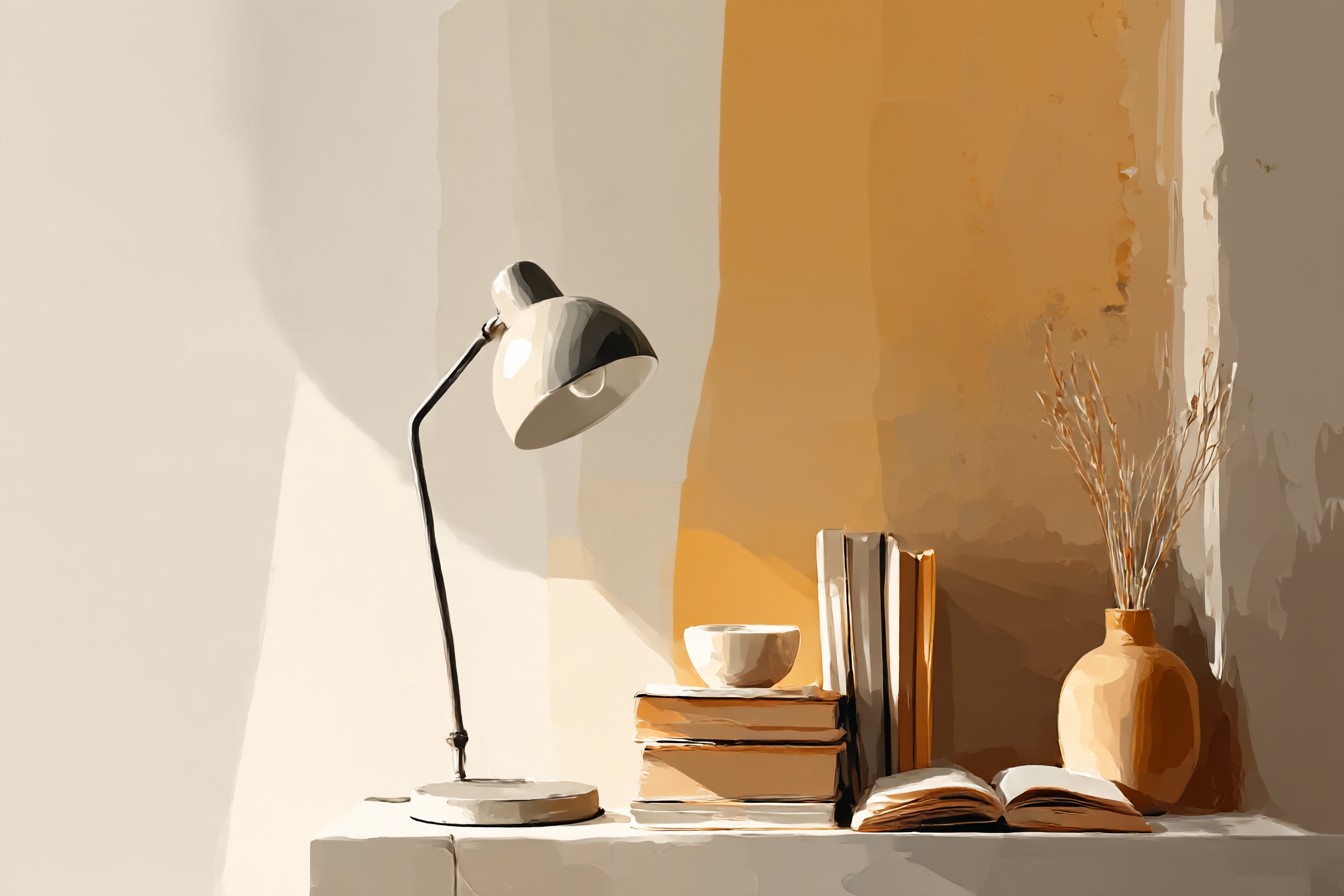
It’s a task lamp with a fully adjustable arm, the kind you’d expect on a drafting desk, and I bought it originally thinking it would live in the home office and never leave. It ended up at the kitchen table because that’s where I actually sit, and it turned out to be the best reading lamp in the house almost by accident.
The adjustable arm means I can pull the light down close and angled directly onto the page, no shadow from my own head, no light wasted lighting up the ceiling or the fruit bowl next to me. It’s not a beautiful object. It’s black metal, a bit industrial, looks like it wandered in from an architect’s studio and got confused about which room it belonged in. But it does the one job I actually need a lamp to do at ten at night when I’ve got twenty minutes before I fall asleep mid page, which is put light exactly where my eyes are working, nowhere else, and let me actually finish the chapter instead of giving up and reading the last three pages on my phone with the brightness turned down, which I did for about a year before I owned this thing.
[Desk Lamps]
Final Thoughts
If there’s one thing two years of buying lamps for the wrong reasons taught me, it’s that a lamp being lovely to look at and a lamp being lovely to read under are separate questions, and you have to ask both. I still own the brass floor lamp, the ceramic table lamp, all of it, because I like looking at them and a house doesn’t have to be optimized within an inch of its life just because I’ve become oddly obsessed with kelvin ratings. But the actual reading, the hour at night where I want to finish a chapter without squinting or giving up, that happens under lamps I chose for function first, looks a distant second.
Check the color temperature before you check the shade shape, honestly, that surprised me more than anything else in this whole process. And if a lamp looks incredible in a room with nobody sitting in the chair, that’s worth noticing, because the real test only happens once you’re actually there, book open, light exactly where you need it or not.

[…] doing different jobs, and letting them look different because of it. A slim, dark, narrow-shaded lamp tucked behind a reading chair, doing close, warm, “don’t wake anyone else up” light. And a taller, paler, […]