
I bought a solid roof pergola for my patio in April, before I’d even ordered the fire pit, because I saw a photo of one online and decided the two things obviously belonged together, the way you decide two throw pillows belong together at 11pm with a glass of wine and zero measuring tape involved. Cedar, tongue and groove roof panels, the kind of thing that photographs beautifully and costs about what I’d budgeted for a decent used car. Two thousand two hundred dollars, if we’re being honest, which we are, because that number is doing a lot of the work in this story.
I set the fire pit underneath it. Not off to the side, not near the edge, dead center, because that’s where it looked best on the patio and I was thinking about the photo, not the physics. First fire I lit, I got maybe fifteen minutes in before I realized the smoke wasn’t going anywhere. It was just sitting up there, under the roof panels, drifting sideways instead of up, pooling against the beams like it had nowhere better to be, which, structurally, it didn’t.
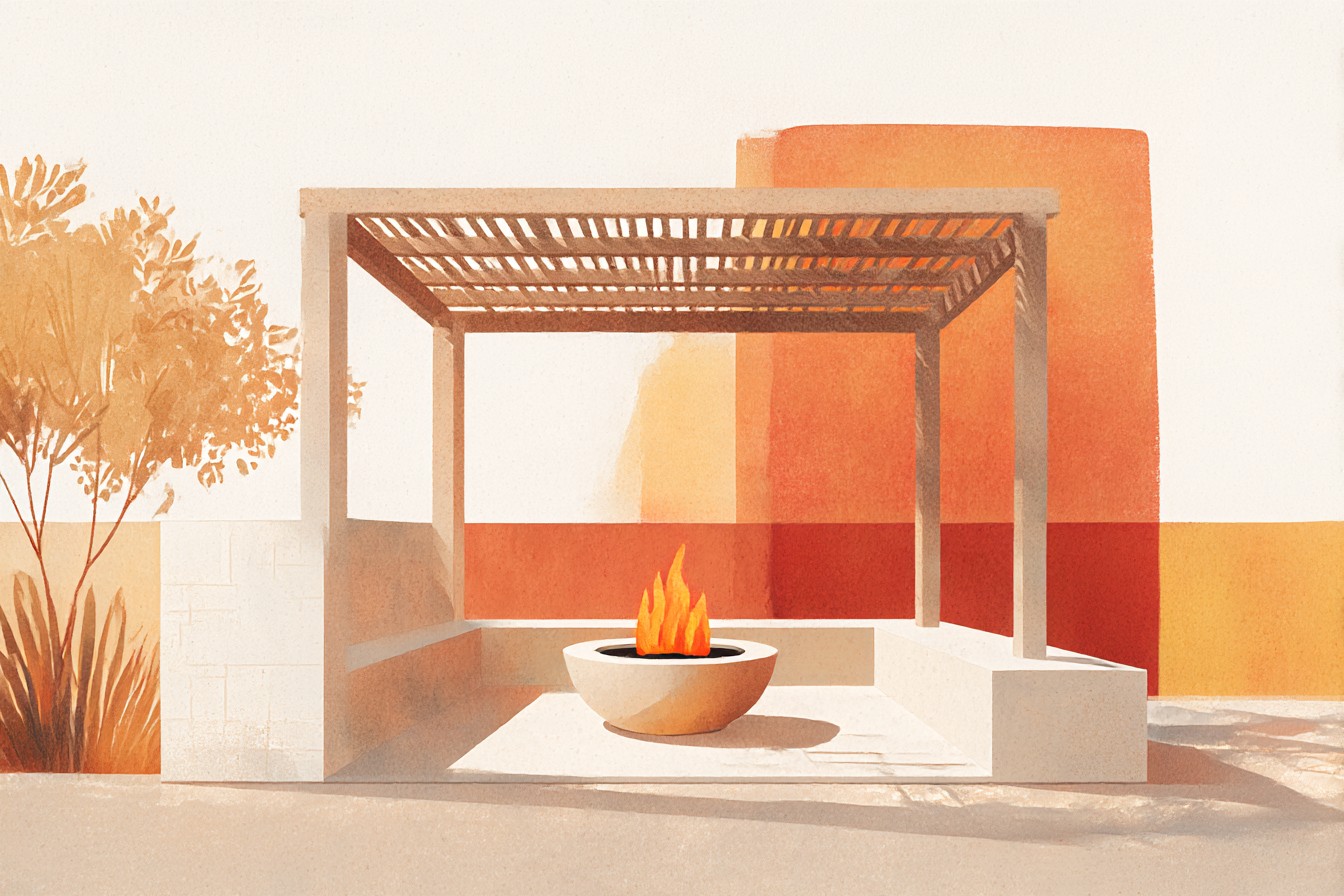
My eyes started stinging. The underside of that beautiful cedar roof picked up a soot stain within one evening that no amount of sanding has ever fully lifted, and I know because I tried, on a Saturday, with a sander I had to borrow, which is its own separate humiliating story I’m not getting into here.
I moved the fire pit two days later. Off center, closer to the open side, further from the roof than I’d originally allowed for, and it’s better now, genuinely usable, but I’d already made the expensive mistake of building the whole thing around a photograph instead of a ventilation plan. On paper, a pergola over a fire pit is a design decision, shade, structure, somewhere for string lights to live. In reality it’s a decision about airflow, height, and how much smoke and heat you’re willing to trap directly above an open flame, and those two things are not the same conversation, even though they get sold to you as one.
So this is me, several months and one ruined ceiling later, actually thinking properly about the different pergola styles people put over fire pits, what each one does to the air above the flame, and where the real line is between “atmospheric” and “actively a bad idea.” Because there is a line. I found it. It’s roughly six feet up, made of cedar, and it still smells faintly like a campfire if it rains.
[Pergolas Over Fire Pits]
Open Slat Wood Pergolas
This is the one I should have bought the first time, and I know that now with the clarity of someone who’s already paid for the lesson. An open slat pergola, the classic style with gaps running between each board rather than a solid roof, is the version that actually gives smoke and heat somewhere to go. The gaps aren’t a design compromise, they’re the entire safety feature, even though nobody selling you the pergola will phrase it that way, because “gaps for ventilation” doesn’t sell as well as “clean modern lines.”
The spacing matters more than I appreciated before I started paying attention to it. A slat pergola with boards spaced two inches apart is doing a genuinely different job than one spaced four inches apart with the same footprint, and if you’re planning to put a fire pit underneath, wider spacing and fewer total boards is the smarter call, not the prettier one necessarily, but the smarter one. I’ve seen people counter that by only firing up on breezy evenings so the smoke gets pulled through regardless of spacing, and sure, that helps, but a pergola shouldn’t need favorable wind to be safe underneath, that’s a plan with a hole in it.
Cedar and redwood are the two woods I’d actually trust here, both naturally more resistant to warping from repeated heat exposure than pine, which is the wood I see most often in the budget kits and which is also, not coincidentally, the wood I’d worry about most directly above sustained flame. None of this means wood pergolas are off the table over a fire pit, mine’s still up, still wood, still standing. It means the open slat version, positioned with real distance from the flame, is doing the job the solid roof one never could.
[Open Slat Pergolas]
Louvered and Adjustable Roof Pergolas
Louvered pergolas, the ones with motorized or hand cranked slats you can angle open or fully closed, get pitched as the best of both worlds, shelter from rain, shade from sun, and airflow when you want it. That’s true, when the louvers are open. It stops being true the second someone closes them, and I’d bet actual money that at some point, on some evening, someone under a louvered pergola with a fire pit going closes the roof because it’s started drizzling and they don’t want to move the party inside.
That’s the exact scenario that worries me, more than the slatted wood pergola does. A louvered roof closed above an open flame turns your patio into a version of an enclosed space, and this is where I stop being casual about it, because carbon monoxide from an open flame or a gas fire pit in a covered or poorly ventilated area is a real risk, not a hypothetical one, and it doesn’t announce itself with a smell the way regular smoke does. You can’t smell carbon monoxide building up. That’s the whole problem with it.
If you’re going the louvered route, and I understand the appeal, rain protection is genuinely useful in a climate like mine where a summer storm can show up with no warning, the louvers need to stay open any time the fire pit is lit, full stop, not partially open, not “mostly open,” open. That’s not me being dramatic for effect. That’s the one rule in this entire piece I’d ask you not to negotiate with yourself on, the way I definitely negotiated with myself about roof panel height back in April.
[Louvered Pergolas]
Solid Roof Pergolas
I’ll just say it. This is the category my own pergola came from, and it’s the one I’d steer you away from if a fire pit is already part of the plan, not because solid roof pergolas are bad structures, they’re often the sturdiest of the three styles and hold up best in wind, but because a solid roof directly above an open flame is trapping smoke and heat with nowhere to go, which is precisely what happened to me on evening one.
You Might Also Like

The failure mode here isn’t dramatic, it’s slow and annoying, which is almost worse. Smoke pools against the underside of the roof, drifts along it, and settles as soot over time, which is the cosmetic problem I dealt with. The less visible problem is heat building directly under solid panels that weren’t engineered with sustained flame exposure in mind, and depending on materials, some solid roofing, particularly polycarbonate panels which show up a lot in the budget solid roof kits, can warp or discolor faster than you’d expect from something marketed as weatherproof.
If you already own a solid roof pergola, like I do, the fix isn’t buying a new structure, it’s moving the fire pit as far from center and as close to an open edge as your patio layout allows, which is what I ended up doing, and running it smaller and shorter than I would under an open structure. I don’t run mine on still nights anymore either. If there’s zero breeze to help pull smoke out from under that roof, I light a couple of candles instead and save the real fire for evenings when the air’s actually moving. Not glamorous. Considerably safer than my April approach, which, again, was no approach at all.
[Solid Roof Pergolas]
Metal Pergolas Versus Wood
I went into this expecting to prefer wood across the board, aesthetically and structurally, and I still mostly do, but the fire resistance conversation genuinely shifted my thinking on aluminum and steel pergolas being the more sensible option specifically for anyone planning a fire pit underneath, even if wood wins on the video call background test, which matters to me more than it probably should given how much of my life happens on camera these days.
Metal doesn’t ignite the way wood theoretically could under sustained, close heat exposure, and it doesn’t discolor from smoke the same visible way either, no soot staining that requires an afternoon with a borrowed sander and a bad attitude. Powder coated aluminum in particular holds up well against both heat and weather, and I’ve seen steel frame pergolas with open slat wood inserts on top, which is honestly the combination I’d go looking for if I were doing this whole project over, metal for the structural frame nearest any real heat, wood higher up and further out for the parts doing the shading rather than sitting close above the flame.
The tradeoff is real though. Metal pergolas read colder, more industrial, less of the soft, established look wood gives a patio, and if the whole point of your fire pit setup is a certain warm, established feeling, swapping to an all metal structure might solve the fire resistance question while creating a completely different one about whether you actually like sitting under it. There’s no clean answer here, cost per year of expected safety improvement doesn’t really settle an aesthetic preference, and I know because I’ve genuinely tried running that math on myself.
[Metal Pergolas]
How High Is High Enough
This is the actual question hiding inside “can you have a pergola over a fire pit,” and it’s the one most listings never answer with a real number, so here’s the one I’ve landed on after doing more reading than any reasonable person should do about roof clearance over open flame: most fire pit and pergola combinations should have a minimum vertical clearance somewhere between seven and ten feet from the top of the fire pit to the underside of the structure, with more clearance needed for larger fire pits, taller flames, or anything running on wood rather than a controlled gas burner where flame height stays more predictable.
Mine sits at just under seven feet now, after I raised the beams during the fix, and that’s on the lower end of comfortable, which I know because on windy evenings I can still catch a faint edge of smoke curling up toward the roofline before it clears out through the gaps. If I were building from scratch I’d go for eight, easily, and I’d rather have a slightly less proportionally elegant structure than one that’s technically fine but gives me zero margin on a bad night.
Height solves the fire and heat side of the risk. It does not solve the ventilation and carbon monoxide side on its own, and I want to be genuinely clear about that rather than let height do more reassuring than it’s earned.

A tall, open structure with good airflow on at least two sides is a completely different risk profile than a tall structure that’s otherwise enclosed by curtains, screens, or walls on three sides, which some people add for privacy or wind protection without thinking through what it does to airflow underneath. If you’ve boxed in the sides, height alone won’t save you, gas fire pits especially can produce carbon monoxide, and an enclosed space traps it regardless of how far away the roof is. Height plus open sides. Not height alone.
[Pergola Height Clearance]
Final Thoughts
If you’re the person who searched “can you have a pergola over a fire pit” and landed here, you’ve probably already pictured the whole setup, the string lights, the smoke drifting off into evening air, the whole scene, and I’m not here to talk you out of it, because I didn’t talk myself out of it either. I’m here to say the version that actually works safely looks a little less like the photo and a little more like a real assessment of slats, height, and airflow before you commit to concrete footings or a two thousand dollar cedar mistake like mine.
Open slat structures with generous spacing, metal where you can manage it structurally near the heat, real clearance measured in feet rather than guessed at by eye, and open sides that actually let air move, that’s the combination that gets you the atmosphere without the smoke stains or the worse risks sitting quietly underneath it. Solid roofs and closed louvers are the two things I’d genuinely reconsider if a fire pit’s already part of the plan.
None of this is me pretending fire pits and pergolas can’t work together, mine does, eventually, after a redesign I shouldn’t have needed. It’s me telling you the ventilation question isn’t optional, and the carbon monoxide risk isn’t theoretical dressing added to make an article sound responsible. Get the height right, keep real airflow on at least two sides, and the whole thing earns its place on the patio instead of just its place in a photo.