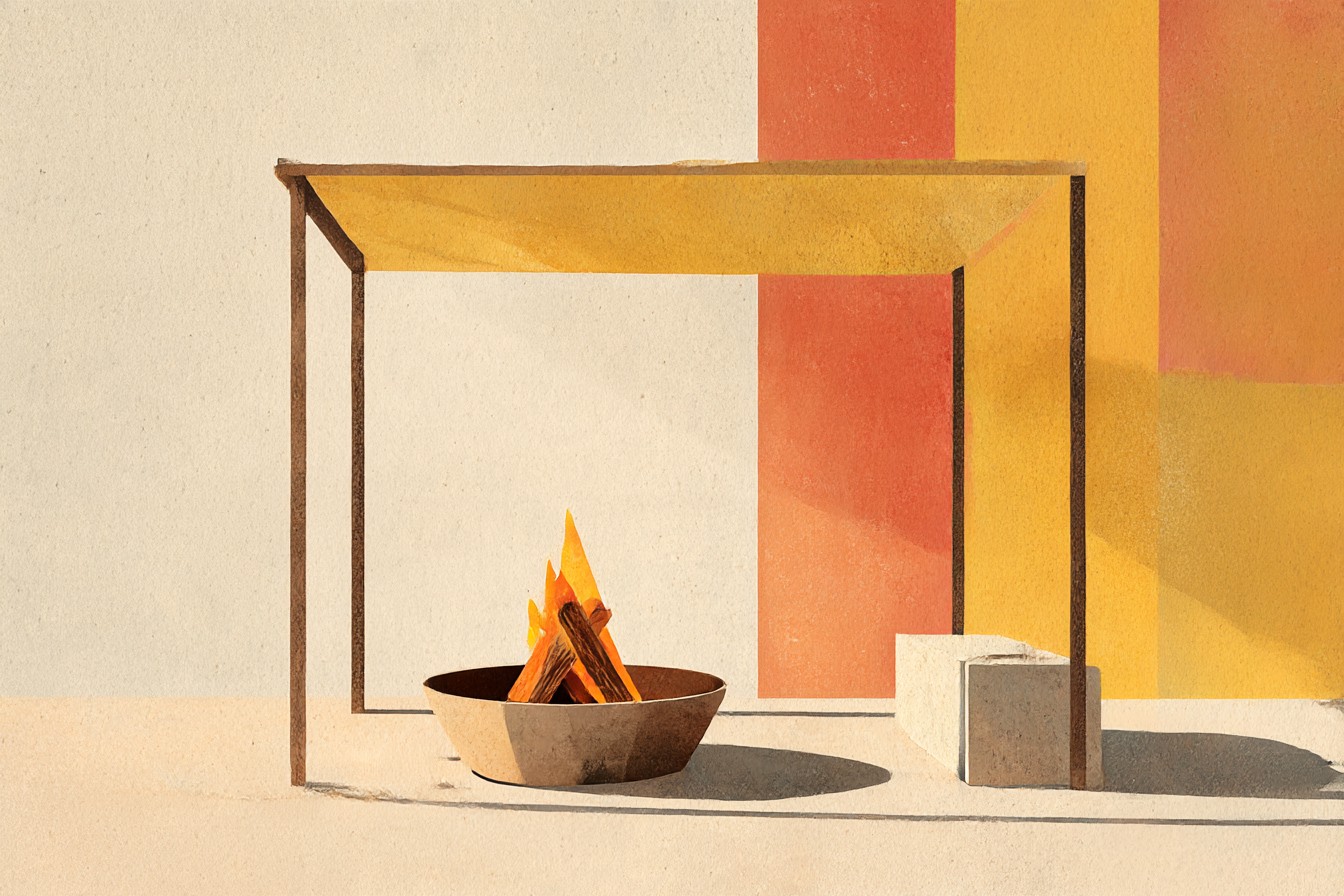
The reputation here is that this is a nothing question. Ask anyone with a covered patio and they’ll wave a hand and say “of course you can put a heater under there, that’s the whole point of the canopy, it traps the warmth.” I believed that too, for years, because it sounds logical. Enclosed space, source of heat, warmth stays put, everybody wins. I bought into it so completely that I put a freestanding propane heater directly under my sister-in-law’s pergola canopy at a birthday thing in October, cranked it, and didn’t think about it again until someone pointed out the fabric above it had gone from cream to a sort of toasted beige in a six inch circle, right at the point where the heat had been hitting it for two hours straight.
That’s what changed my mind. Not a warning label, not a safety pamphlet, an actual scorch mark on someone else’s very expensive shade sail that she’d bought specifically because it matched the cushions. Heat doesn’t pool politely at head height and stay there being cozy.

It rises. Directly. In a straight line, more or less, to whatever is closest above it, and it keeps rising for as long as the heater is running, which on a proper outdoor evening is hours, not minutes.
So no, you’re not automatically fine. And you’re also not automatically doomed, which is the other extreme people swing to once they’ve read one forum post about carbon monoxide and decided every gas appliance under a roof is basically a small bomb. The truth, and I hate how boring truth always is compared to a strong opinion, sits in the middle. It depends on the heater, the height of the canopy, the material it’s made from, and whether you’re treating “covered” as the same thing as “enclosed,” which it absolutely is not.
I’ve now got three different heaters and two different canopy setups at my own place, largely because I kept buying the wrong thing and refusing to admit it until the evidence was undeniable. What follows is what I’ve actually worked out, not what a manufacturer’s manual tells you in six languages and none of them clearly, about which heaters behave themselves under cover, how much clearance you actually want, and where the real risk sits, because it does sit somewhere, and I’m not going to pretend otherwise just to keep this piece cheerful.
[Patio Heaters and Canopies]
Freestanding Propane Heaters
These are the tall mushroom shaped ones, the kind you see outside every restaurant patio in Boston from about September onward, and they put out a genuinely serious amount of heat, which is exactly the problem. A typical one is throwing off somewhere around forty thousand BTUs, straight up, from a flame or a heating element at the top of a pole that’s already six or seven feet tall. Add a canopy at eight feet and you’ve got maybe a foot of clearance between the hottest part of the appliance and the fabric, and a foot is not enough, not even close, whatever the guy at the hardware store told you when he was trying to hit his numbers for the month.
The manufacturers themselves generally want a minimum of two feet between the top of the heater and anything above it, and that’s the minimum, the number they put on the box to cover themselves legally, not the number I’d actually plan around. I’d want closer to three feet if the canopy is polyester, more if it’s vinyl, because vinyl holds heat and discolors faster than you’d think. My own scorched pergola story wasn’t even with the biggest heater I own. It was a mid range one, running on the lowest setting, for about ninety minutes.
The other thing nobody tells you until you’ve lived with one is that these heaters don’t heat evenly, they heat a cone, wider at the bottom, narrower toward the source, which means the actual hot spot on your canopy is smaller and more intense than you’d guess just by eyeballing the whole rig. You can stand under it and feel warm air everywhere and still have one specific patch of fabric taking the brunt of it. If you’re using one of these under any kind of fixed canopy, the honest answer is you need more headroom than the box suggests, and if your canopy sits low, this is not your heater, full stop.
[Freestanding Propane Heaters]
Electric Infrared Heaters
This is the category that actually made me relax a bit, which surprised me, because I went into it assuming electric would just be a weaker, worse version of gas. It isn’t, it’s a different animal entirely. Infrared heaters warm objects and people directly rather than heating the air around them, so there’s less of that rising column of superheated air doing the damage, and a lot of the wall mounted or ceiling mounted versions are specifically designed to sit under a covered structure, sometimes as close as eighteen inches from the surface above, according to the spec sheet, though I still wouldn’t push it that tight myself.
I put one under a solid roofed section of my patio, not a fabric canopy, an actual roof, and it’s been fine for two winters, no discoloration, no drama, and honestly better heat distribution than either of my gas heaters ever managed. But I want to be careful here because I’ve seen brands market these as “totally safe for any covered space” in a way that’s doing a lot of quiet work to avoid saying “as long as you follow the clearance guidance, which varies by wattage, which we’ve buried on page four of the manual.” That’s not honesty, that’s marketing dressed up as reassurance, and I’ve got no patience left for that particular trick after three years of running this site.
If you’re putting an infrared unit under a fabric canopy rather than a hard roof, treat the clearance number on the box as a floor, not a target, and check the fabric periodically for the first few uses, because you’ll feel warmth on your skin and assume the ceiling above you is fine, and it might not be, fabric holds and reflects heat differently than your forearm does.
[Electric Infrared Heaters]
Tabletop and Tower Heaters
I bought a tabletop propane heater specifically because my patio umbrella sits low, maybe seven feet at the canopy’s lowest point, and I’d worked out, correctly for once, that a full size freestanding heater had no business anywhere near it. The tabletop version seemed like the sensible compromise, smaller flame, lower output, sits at table height instead of head height. And it mostly is a sensible compromise, but “smaller” doesn’t mean “irrelevant,” and I think that’s the trap people fall into with this category specifically.
You Might Also Like

A tabletop heater still has an open flame or a glowing element a couple of feet below whatever’s above it if your umbrella or canopy is on the low side, and the same rising heat rule applies, just at a smaller scale. Mine sat under my umbrella for exactly one dinner party before I moved it two feet clear of the pole, because the fabric directly above it had started to feel warm to the touch when I reached up, which is not a subtle warning sign, that’s the fabric telling you plainly that it’s absorbing more than it should.
Tower heaters, the slim freestanding electric ones that look like a column rather than a mushroom, sit somewhere in between. Lower output than a full propane unit, but still a genuine heat source with its own clearance requirements, and I’d treat any manufacturer’s “compact and canopy friendly” language with real suspicion until you’ve checked the actual clearance number yourself, because I’ve seen that exact phrase on a box that recommended thirty inches of clearance overhead, which is not what “compact and canopy friendly” implies to a normal person standing in a store trying to solve a problem quickly.
[Tabletop and Tower Heaters]
Canopy and Gazebo Fabrics
Nobody talks about the fabric side of this enough, and I think that’s because it’s less dramatic than talking about the heater itself, but the fabric is doing half the work of deciding whether this setup is fine or a slow motion problem. Polyester canopies, the kind that come with most off the shelf gazebos, tend to be treated with some kind of water resistant coating, and that coating can degrade or discolor with sustained heat exposure well before the fabric itself would actually catch anything. That’s the scorch mark I got at that birthday party, not a fire, just a coating breaking down under repeated heat, permanently, in a way that no amount of washing fixed.
Vinyl is worse for this specifically because it holds heat rather than letting it pass through, which sounds like it should make it more heat resistant and instead makes it more likely to warp, bubble, or discolor at a lower temperature than you’d expect from something that thick. Canvas and acrylic fabrics, the heavier Sunbrella style ones, handle it noticeably better in my experience, and mine is entirely my own patio, not a lab, so take that as one honest data point rather than gospel.
Retractable canopies bring their own issue, because the fabric sits closer to fully retracted heaters than you’d plan for if you’re not paying attention to where the roller housing actually sits relative to the heater’s hot zone. I will say this plainly because I think it needs saying plainly: if your canopy fabric is thin, cheap, or already showing wear at the seams, that is not the fabric to be testing a new heater under while you work out clearances. Test under something you’re not precious about first. I learned that one the expensive way, and I’d rather you didn’t.
[Canopy and Gazebo Fabrics]
Ventilation and Carbon Monoxide
Right. This is the part I’m not going to soften, because softening it is exactly how people get hurt, and I’ve read enough forum threads of people asking “is it fine though, really” to know the honest answer needs saying without a hedge. Any gas appliance, any open flame, burns fuel and produces carbon monoxide as part of that process, always, that’s just combustion, and carbon monoxide doesn’t care how nice your canopy looks or how romantic the evening is. In open air, it disperses. Under a covered structure with poor airflow, particularly one with solid walls on more than one side, or heavy curtains pulled down against the wind, it can build up in a way that a fabric roof alone does absolutely nothing to prevent.
A canopy is not an enclosure by design, but people turn it into one constantly, zipping up side panels on a gazebo, pulling privacy screens across a pergola, closing a space in specifically to keep the heat from escaping, which is the single most understandable and most dangerous instinct in this entire topic. You want the heat to stay, so you seal the space, and sealing the space is precisely what turns a patio heater from a lovely evening into a genuine risk. Carbon monoxide has no smell, no color, no polite way of announcing itself before it’s a problem, and outdoor rated heaters are outdoor rated specifically because they’re designed to be used somewhere air actually moves.
If you’re using any gas heater under a canopy, I want at least one full side open to real airflow, not a gap, an actual open side, and I want you to know that “it’s mostly open” isn’t the same as “it’s ventilated,” those are two different sentences doing two different jobs. Electric heaters sidestep this specific risk entirely because there’s no combustion, which is the strongest argument I’ve got for choosing electric if your canopy setup is more enclosed than open.
[Ventilation and Carbon Monoxide]
Final Thoughts
So can you use a patio heater under a canopy. Yes, mostly, with real clearance, the right heater for how enclosed your space actually is, and fabric that can handle sustained heat without quietly ruining itself.

Can you use any heater under any canopy without thinking about it. No, and I wish I’d worked that out before I put a scorch mark on someone else’s shade sail rather than after.
The pattern across all of this is the same one, really: heat goes up, it doesn’t negotiate, and the closer your canopy sits to the source, the less margin you’ve got for a bad night’s wind, a longer dinner than planned, or a heater running slightly hotter than the setting suggests. Electric infrared for anything tight or fully covered. Propane for open, airy setups with real clearance. Fabric that’s heavier than the cheapest option in the shop. And genuine airflow, always, not the version of airflow you’ve talked yourself into because closing the sides felt cozier.
I still use my heaters. I still like sitting outside in November with a blanket and something warm two feet away doing its job properly. I’m just no longer the person who assumes a canopy makes that automatically safe, because it doesn’t, it just makes it look safe, and those are very different things to be standing under.