
I was standing on my back porch steps last November, in two coats and the fingerless gloves my mother thinks are ridiculous, dragging our propane patio heater six feet closer to the picnic table because my toes had gone from cold to that specific kind of numb where you stop being able to tell if your shoes are still on. It was nine degrees with the wind chill, my neighbor Dave had wandered over for a beer he was already regretting, and at some point he said, only half joking, “why don’t we just wheel this thing onto the porch.” The porch in question is a three season job my landlord added sometime in the seventies, glass on three sides, a door that doesn’t fully seal, and about as enclosed as a very optimistic tent. I said no immediately, and I said it with more force than the moment probably needed, because I have spent enough years in this particular hundred and ten year old triple-decker to know exactly what happens to fumes in a space that only pretends to be sealed. They don’t leave. They just sit there with you.
Here’s the thing about that question, “can you use a gas patio heater indoors,” it’s a question people ask when they’ve already half decided the answer is yes, and I understand the instinct completely. You bought the heater for outside, it’s cold, the porch is right there, technically it has a roof, technically the door was open five minutes ago.

I get the math. I have done the math myself, standing exactly where Dave was standing, wanting nothing more than to be warm and also seated. But the answer is still no, and it’s not a soft no, it’s not a “well it depends” no. It’s a no because these things are built to burn propane or natural gas in open air, where the carbon monoxide and moisture they produce have somewhere to go, and the second you put a wall and a low ceiling around that, you’ve built yourself a box that fills up with something you can’t see or smell until you’ve got a headache and don’t know why.
I’ve tested a lot of things in this house that claimed to solve a cold problem and quietly didn’t. This is one I never had to test, because I already knew, and I’d rather explain why than let anyone find out the hard way.
[Gas Patio Heaters Indoors]
The Freestanding Propane Ones, the Mushroom Shaped Kind
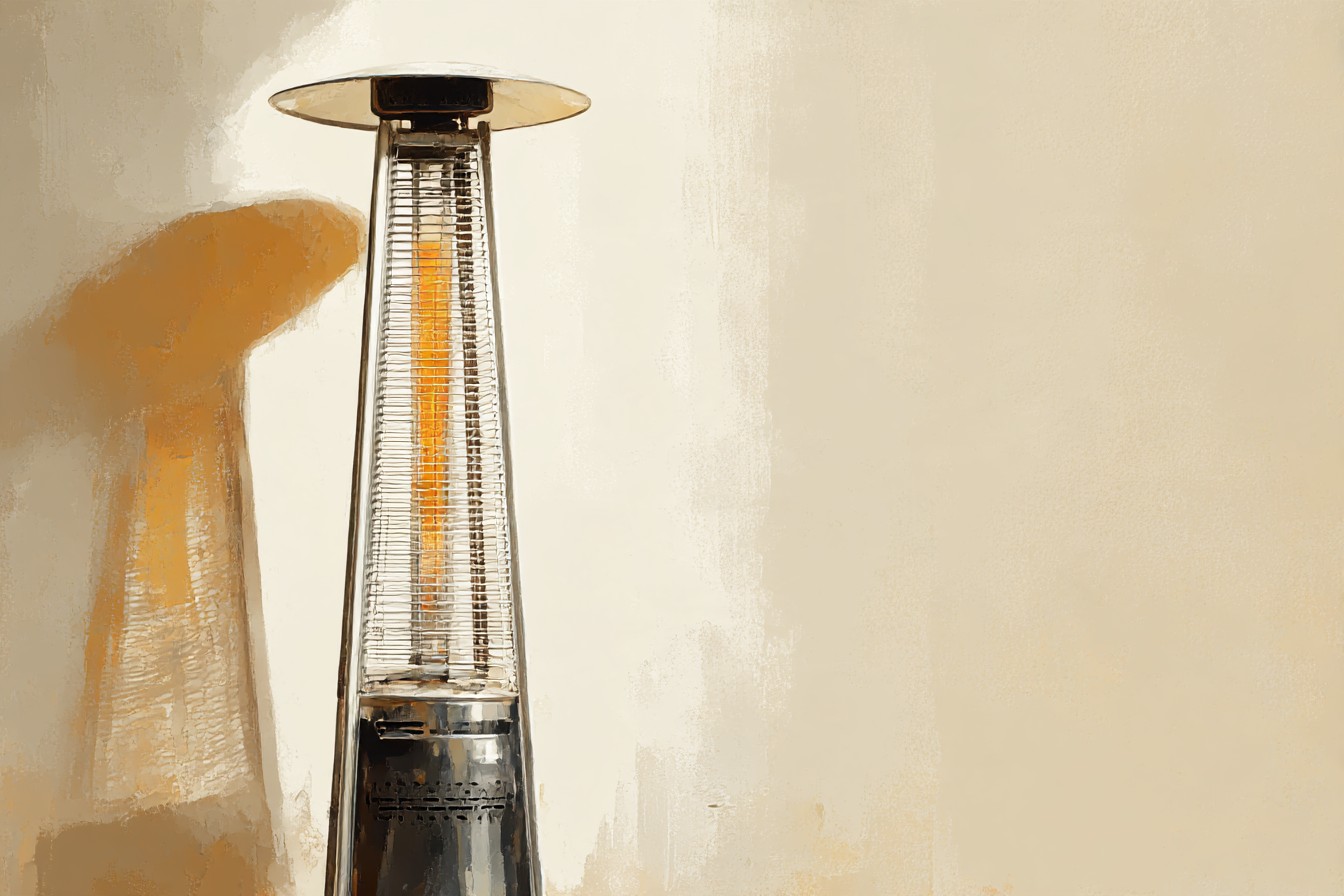
These are the heaters everyone pictures, the tall ones with the little tank hidden in the base, the ones restaurants line up along a patio in October. I own one. It lives outside, under an overhang, and it stays there because that’s the entire design brief for a heater like this, wide open air on at least three sides, heat rising and dispersing rather than pooling. The moment you move one of these into a garage, a three season porch, or even a big enclosed sunroom because it’s “basically outdoors,” you’ve changed the entire equation the manufacturer built the thing around. Propane combustion produces carbon monoxide as a matter of course, not as a malfunction, that’s just what happens when it burns, and outdoors that’s a non issue because it disperses into an enormous volume of moving air. Indoors, even in a big garage with the door cracked six inches, it collects. I know a guy, a contractor Dave actually hired for a roof job, who told me he’d seen a customer’s garage CO detector go off within twenty minutes of running one of these during a Thanksgiving setup gone sideways. Twenty minutes. That’s not a slow leak building over a season, that’s a fast, ordinary result of using an outdoor appliance in a space it was never rated for.
[Freestanding Propane Heaters]
Tabletop Gas Heaters, Because Small Feels Safer
I think tabletop heaters get a pass in people’s heads because they look modest, a little glass tube of flame on a stand you’d put next to a cocktail. Small flame, small risk, surely. It doesn’t work that way. The size of the flame has nothing to do with whether the space around it can handle what it produces, and a tabletop propane heater running in a closed sunroom for two hours can put out enough carbon monoxide to matter, especially if there are two or three of them on a long table, which is exactly how people use them, one per every few guests, all going at once in a room that was rated for candlelight, not combustion. I nearly made this mistake myself two winters ago setting up for a birthday dinner on that same three season porch, three little tabletop heaters, door shut against the wind, and it was only because my carbon monoxide detector is the loud, unreasonable kind that I even thought twice. It went off before anyone sat down. Nobody got hurt, mostly because the alarm did its actual job, but I’ve never set that scene up again without the door properly open the whole time.
[Tabletop Gas Heaters]
You Might Also Like

Built In Natural Gas Heaters, the Ones That Feel More Permanent
Natural gas heaters get treated with more trust than propane ones, I think because they’re often installed by an actual plumber and connected to the house line, which makes them feel like part of the building rather than an appliance you rolled in from Home Depot. That trust is only earned if the installation includes the ventilation it was designed around, and that’s the part people skip when they get creative with placement later. A natural gas heater mounted under a covered, open air pergola is doing exactly what it was engineered to do. The same unit, or the same style of unit, moved to heat an enclosed and glassed in porch addition, is a different appliance in practice even if it’s identical on paper, because the fumes it produces now have nowhere to go but into the room with you. I had an electrician friend of a friend explain it to me once in terms I actually understood, he said think of it less as “is this heater safe” and more as “is this room designed to let the heater’s exhaust leave,” and once you frame it that way the porch question mostly answers itself.
[Natural Gas Fixed Heaters]
The “But My Porch Is Basically Outside” Problem
This is the one I actually fall for, or almost did, with Dave standing right there. Three season porches, screened in additions, glassed sunrooms, they occupy this weird middle ground where they feel outdoorsy enough to justify an outdoor heater and sealed enough to actually trap what it produces. My porch has old single pane windows that don’t fully seat in their frames, which sounds like it would help with ventilation and mostly just means I lose heat in July and trap fumes in December, the worst of both. A space needs real, substantial, permanent airflow, not “the door was open when we walked in,” to safely run any open flame gas appliance, and most three season additions built in the last hundred years in New England were sealed up tighter at some point by someone trying to fix the drafts, which is the opposite of what you’d want here. If you can’t stand in the space with all doors and windows shut and describe exactly where fresh air is continuously coming in and stale air is continuously leaving, it’s not ventilated enough, full stop, and that’s true whether it’s a porch, a garage, or a screened gazebo with plastic sheeting zipped around it for winter, which I’ve also seen, and which is somehow worse.
[Enclosed Porches and Sunrooms]
Electric and Infrared Heaters, the Actual Indoor Answer
If the honest need underneath all of this is “I want a warm porch in December,” the fix isn’t a workaround for the gas heater, it’s a different appliance entirely. Electric infrared heaters produce heat without combustion, no flame, no carbon monoxide, no byproduct you need a room to breathe out. I bought one for that same porch after the tabletop heater alarm incident, a wall mounted infrared panel, plugged into an actual outlet, and it’s been fine through two winters including a stretch in January where the porch thermometer read thirty one degrees and the panel still made it bearable enough to sit out there in a proper coat. It’s not as dramatic looking as a six foot propane mushroom heater with its glowing tube, I’ll admit that, there’s a bit of ceremony missing. But I can run it with the door shut, the windows shut, in a space my house inspector would frankly prefer I not fill with combustion byproducts, and not think about it again until I unplug it in April.
[Electric and Infrared Heaters]
Final Thoughts
None of this is really about the heaters, they’re doing exactly what they’re built to do.
It’s about the room, and whether the room can let the byproducts of an open flame actually leave, which most porches, garages, and enclosed patios simply cannot, no matter how open they feel when the door’s ajar and you’re only nipping in for a beer. I still have the propane heater. It still lives outside, under the overhang, where it’s genuinely good at its job. I also still have the infrared panel on the porch, plugged into the wall, quietly doing a smaller but entirely different job that doesn’t involve a carbon monoxide detector going off mid dinner. If you’re standing outside right now, cold, looking at your patio heater and then at your enclosed porch door, thinking about it the way I was thinking about it with Dave, I’d just ask you to actually picture where the fumes go once that door’s shut. Not where you hope they go. Where they actually go, physically, in a sealed box with you in it. That mental picture has talked me out of it every single time, and it’s free, which is more than I can say for the CO detector I now own three of.