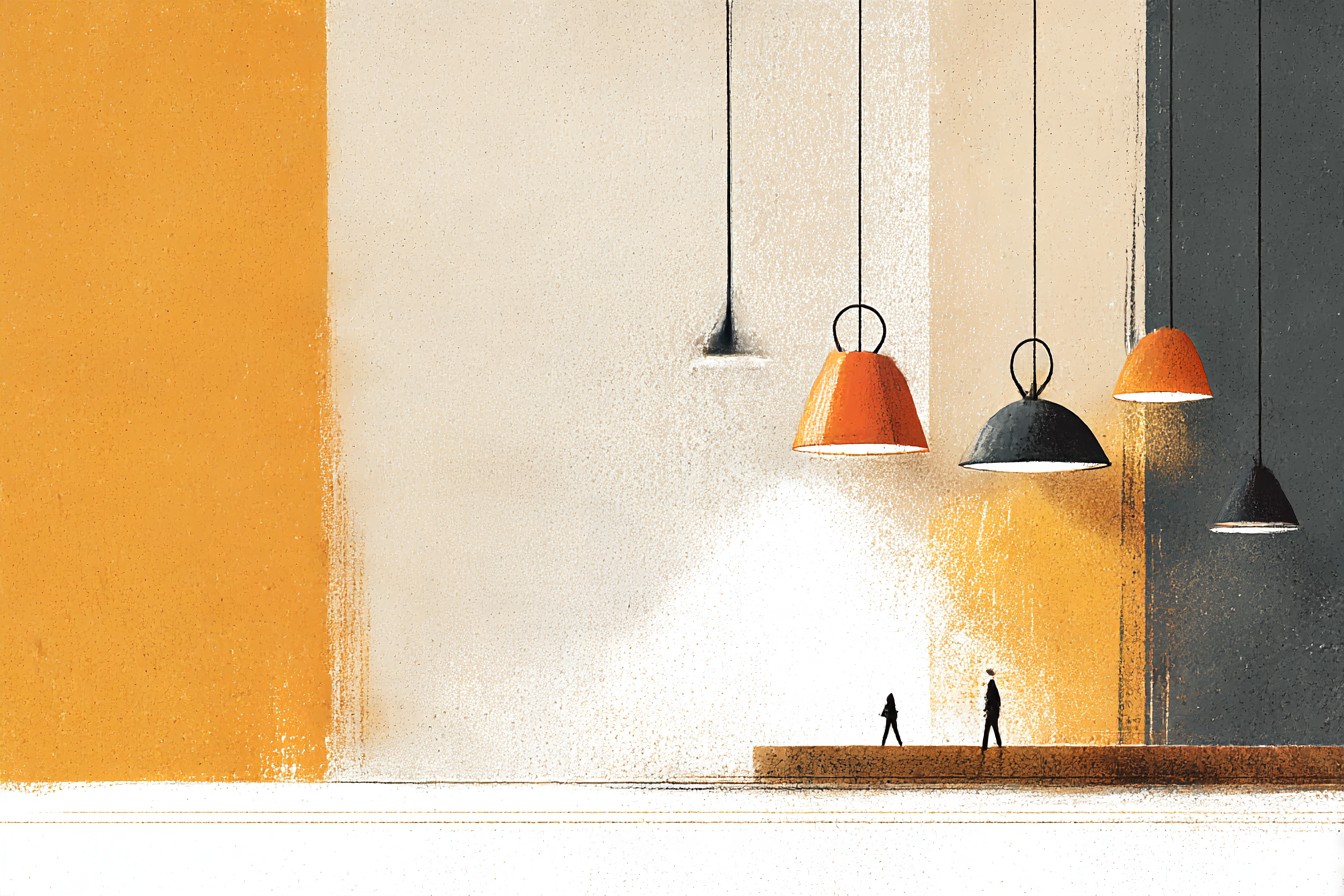
I bought a pendant light for my dining nook that looked exactly right in the photo. Black metal, this big sculptural cage shape, hanging low over a little round table like something out of a restaurant that charges nineteen dollars for a cocktail. My rowhouse in Baltimore is from the 1920s, ceilings are seven foot six in that back room, and I knew that number, I’d measured it for a bookshelf two months earlier, I just didn’t connect it to the light. Hung it myself on a Saturday, stood back, admired it for maybe four minutes, then walked into it face first bringing a bowl of pasta to the table.
Not a graze either. A proper thunk, the kind where you say a word you don’t usually say in front of your own dinner. I readjusted it, raised it two inches, hit it again the following week reaching for the salt.

My friend came over for a birthday thing, six foot one, walked under it once with a beer in each hand and just stopped dead like he’d hit a low branch. He didn’t even swear, just went “oh,” very quietly, the way you do when you’ve understood something about a person’s home you didn’t want to know.
That fixture went back in a box within the month. Cost me forty two dollars secondhand, hung for eleven days, so by my usual cost per year math that’s genuinely one of the worst rates I’ve ever posted, we’re talking something like thirteen hundred dollars a year if I’d kept using it at the rate my forehead was billing me. Terrible investment. Ledger’s bad column, obviously, right up there near the top.
Here’s the thing though. It taught me the one test that actually matters with pendant lights in a low room, and it’s not a rule you read anywhere, it’s a rule you do. You walk under it. Not once, glancing sideways admiring the shade. You walk under it the way you actually move through the room, carrying something, tired, half looking at your phone, the way real life happens in a kitchen. If you clip it even once doing that, it’s wrong, no matter how good it looked in the listing photo.
Low ceilings and pendant lights aren’t automatically enemies. I know that now. But you do have to shop differently, and there’s a handful of directions that actually work in a room that can’t take the tall dramatic stuff, so let’s go through them.
[Pendant Lights]
Semi Flush Mounts, the Boring Answer That’s Actually Right
I resisted these for a long time because “semi flush mount” sounds like something you’d find in a rental you didn’t choose. Fine, functional, zero personality. Turns out that’s snobbery, not information.
A semi flush mount sits close to the ceiling with a short stem, a few inches at most, so you get the shape and warmth of a pendant without the six inch drop that was clocking my friend on the head. I replaced the cage disaster with a semi flush glass globe I found at my regular thrift place, the one on the corner I check every Friday because that’s when the volunteer restocks, sixteen dollars, been up over two years now with zero issues, works out to about two cents a day at this point, which is the kind of math that actually makes me happy instead of the kind that makes me want to lie down.
The trick with these in a low room is not going tiny out of nerves. I did that first, bought a mini flush mount that looked like an afterthought once it was up, like the room forgot to finish getting dressed. Went back for something with more width, less drop, and it filled the space properly without adding height it didn’t have to give. Semi flush isn’t the exciting choice. It’s the one that lets you keep having a pendant light at all in a room where the ceiling said no to the dramatic version.
[Semi Flush Mounts]
Mini Pendant Clusters Over an Island or Table
If you’ve got a kitchen island or a small dining table and a ceiling that’s giving you nothing to work with, three small pendants clustered together does something a single big shade can’t, it adds visual interest without needing that six or eight inch drop a statement pendant demands to look intentional.
I did this over a narrow console table in the hallway, three tiny amber glass pendants I found at three different times, not even matching perfectly, close enough that nobody but me notices they’re not from the same set. Total spend across all three was something like thirty one dollars, spread over about eight months of casual thrifting, which isn’t a number I can turn into a tidy per year figure because I genuinely bought them at random, but I’m calling it a win because I like walking past them more than I’ve liked most things I paid full price for.
The head bump math on these is actually more forgiving. Because each pendant is small, you can hang them a little lower relative to the ceiling than you’d risk with one big fixture, and the eye reads “detail” instead of “obstacle.” The one thing I’ll say, don’t cluster them dead center in a walkway. Mine are over a console against a wall, nobody’s walking through that space, and that’s doing half the work. Put the same cluster over the middle of a narrow hall and you’ve built yourself three separate ways to hurt your head instead of one.
[Mini Pendant Clusters]
Linear Fixtures for Narrow, Low Rooms
Linear pendants, the long bar style ones with two or three lights along a single fitting, are underrated for rooms where the ceiling is low and the space itself is narrow, like a galley kitchen or a long thin dining nook, which describes about half the rowhouses on my street including mine.
You Might Also Like

What I like about them is the fixture runs the length of the table instead of hanging down into it, so the light does its job spread out sideways rather than dropped low in one spot you have to duck around. I put one over my dining table for sixty five dollars from an estate sale two streets over, and it’s been up almost three years now, works out to something like six cents a day, did that math twice because I didn’t believe the first number, still six cents.
The mistake I made buying the first one, and I did buy a wrong one before this one, was picking a linear fixture that still hung too low at the ends, like it had one job and decided to be dramatic about half of it anyway. If you’re going linear in a low room, check the drop length carefully, because some of them are marketed as sleek and low profile and then still come with a twelve inch rod like nobody read the room. Ask for exact measurements before you buy, not just the photo, the photo lies about scale constantly.
[Linear Fixtures]
Low Profile Shades Instead of Bulb Forward Pendants
There’s a whole category of pendant right now that’s just an exposed bulb on a cord, no shade, very industrial, very Pinterest board. In a tall room, fine, does its thing. In a low ceiling room, it’s a hazard wearing a design trend as a disguise, because there’s nothing softening the bottom edge, and an exposed bulb at forehead height is worse than a shade at forehead height, trust me, I’ve done both.
I switched my kitchen fixture from an exposed bulb pendant to a small dome shade, the kind that curves the light downward and covers the bulb entirely, and it dropped the effective hanging point by exactly the same amount as the old one, but somehow feels less dangerous when you clip it, because a rounded metal dome glancing off your head is a very different experience to a hot bare bulb doing the same thing. Learned that the annoying way, obviously.
Cost on this one was fourteen dollars for the dome shade itself, I kept the existing cord and fitting, so I’m not counting a full new fixture price, and it’s been up over a year, which by any math is basically free at this point. The bigger lesson though isn’t the price. It’s that shade shape matters just as much as hanging height when you’re working with a low ceiling. A rounded, closed shade reads calmer and safer in a tight room than anything with exposed hardware, even at the exact same drop.
[Low Profile Shades]
Doing the Actual Head Bump Test Before You Commit
Here’s the part I should have done before that first cage pendant went anywhere near a drill. Measure your ceiling height, then measure the fixture’s total drop including the canopy at the top, then physically stand where the table or island edge will be and hold a broom or a yardstick at that exact final height, and walk under it like you’re carrying dinner. Not glancing at it. Walking under it, doing the thing you’ll actually do six times a day.
Most pendant listings tell you the ceiling height they’re photographed at, which is almost never seven foot six, it’s usually nine or ten feet, so a fixture that looks perfectly proportioned in the photo can hang eighteen inches lower than what your room can survive. I’ve started ignoring the styled photo entirely and going straight to the spec sheet for total drop length, then doing my broom test regardless of what the listing says looks good.
There’s also the shortening trick, which I wish someone had told me on day one. Most pendant cords and rods can be shortened by an electrician or, if you’re comfortable with it, yourself, for not much money, I paid twenty dollars to have mine adjusted once rather than return the whole fixture.

Compare that to the forty two dollars I lost returning the cage pendant entirely, and it’s obvious which is the better move. My mom saw me out there with the broom measuring my own kitchen and asked if I was auditioning for something. I said no, just trying not to concuss myself again, she didn’t fully believe that either was a real hobby but she let it go.
[Head Bump Test]
Final Thoughts
So yes, you can absolutely have pendant lights with a low ceiling, that panicked search bringing you here has a real answer, it’s just not “hang whatever you liked in the photo and hope.” The fixtures that actually work in a tight room are semi flush mounts, small clustered pendants, linear bars that spread the light sideways instead of dropping it down, and shades with a rounded, closed profile instead of anything bulb forward and exposed.
None of that is expensive wisdom, most of what I’ve mentioned here cost under seventy dollars, some of it under twenty, and it’s the testing that actually matters more than the money. Measure the drop, hold a broom at the final height, walk under it the way you’ll really move through the room, tired, hands full, not paying attention. If you clip it once doing that, it’s wrong, full stop, doesn’t matter how good it looked online.
My forehead has paid for this knowledge in installments, four separate incidents by my count, which is a genuinely embarrassing thing to have a running total of, but here we are. That’s the whole trick with low ceilings, honestly. Not avoiding pendant lights. Just doing the walk under test before your face does it for you.




[…] breathe, which sounds like decorator language but means something practical, small bedrooms with low ceilings genuinely look bigger with a light frame because there’s less visual mass sitting at the height where your eye naturally lands. […]