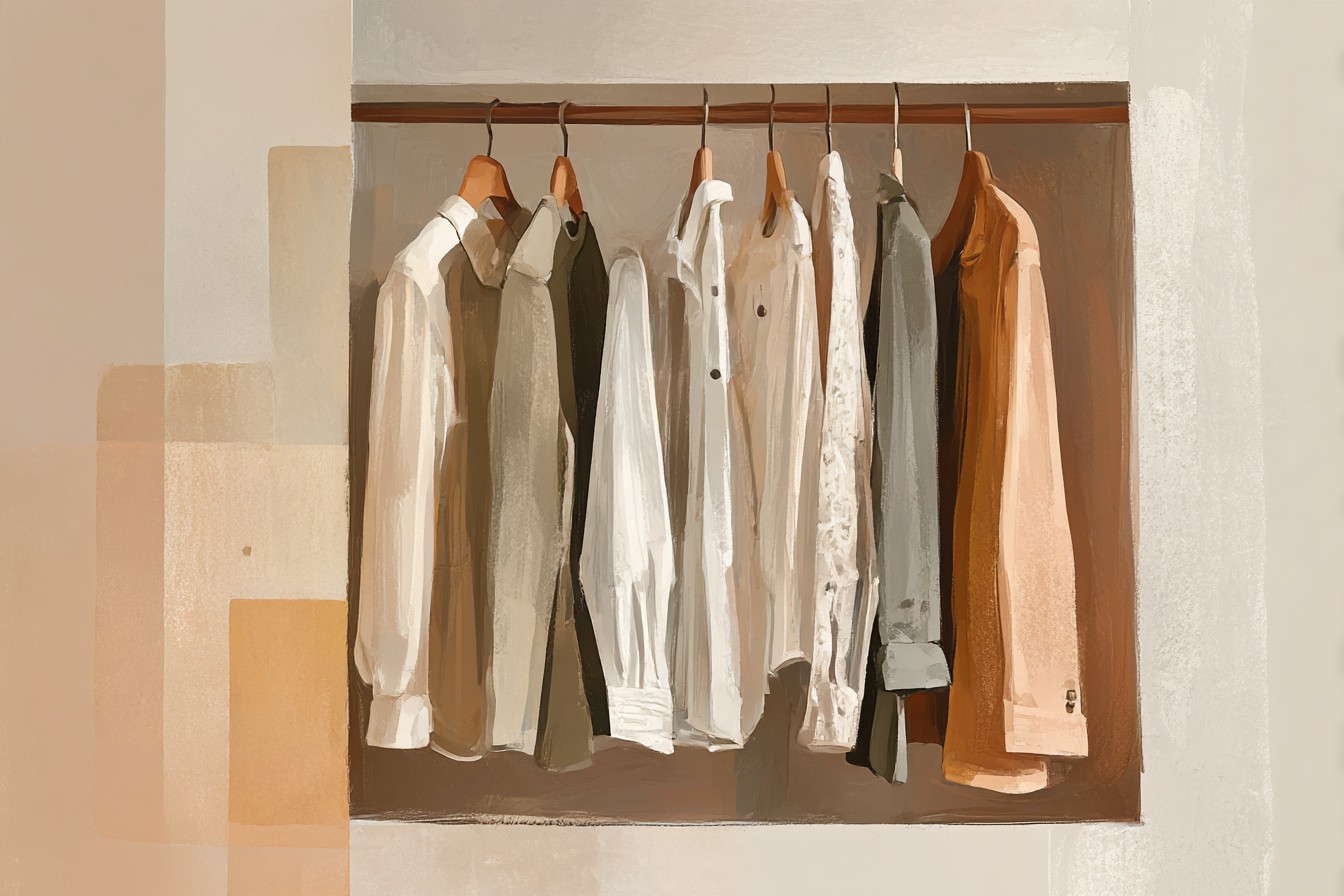
I own eleven shirts I wear on rotation and I probably open that closet door around fourteen times a week, more if laundry’s backed up, which it usually is. And here’s the thing I only noticed recently: about half those times, I get a full lungful of nothing. No smell at all, just cold air and the faint ghost of detergent that gave up somewhere around the second wash. The other half, I get hit with a wall of something so strong it’s basically its own weather system, usually because I panic bought a plug in scent thing eighteen months ago and it’s still going, unregulated, doing whatever it wants in there.
Neither of those is good. A wardrobe that smells like nothing usually means it’s a little damp, a little stale, the kind of closed up smell that isn’t offensive exactly but makes you second guess a shirt you know is clean. And a wardrobe that smells like a candle shop exploded is worse in a different way, because now every sweater smells the same, your cologne can’t get a word in edgeways over the top of it, and honestly it starts to feel less like your clothes and more like someone else’s laundry that happened to end up in your house.
I’ve spent an embarrassing amount of time getting this wrong in both directions.

I’ve had the wardrobe that smelled of literally nothing for two winters running before I worked out the problem wasn’t the clothes, it was the closet itself. And I’ve had the opposite disaster, a hanging air freshener so aggressive that my one good work jacket smelled like artificial ocean breeze for a solid four months, through three dry cleaning attempts, which as far as I’m concerned should be a warning label requirement.
What I’ve landed on isn’t one single fix, because none of them alone does the whole job properly. It’s a handful of small, quiet things, layered lightly, none of them shouting over the others. That’s the actual goal here. Not a wardrobe that announces itself the second you open the door. One that just smells clean and faintly, briefly, nice, and then gets out of the way so your actual perfume or cologne or fabric softener can do its job without a fight.
[Making Clothes Smell Nice in a Wardrobe]
Cedar Blocks and Rings
Cedar was the first thing I tried and I nearly wrote it off completely because the first set I bought did almost nothing. Tiny little cedar balls, the kind that come in a net bag, and I hung them up expecting some kind of transformation. Nothing. I actually thought cedar was a myth, a thing people say works because their grandmother said it worked.
Turns out the issue wasn’t the wood, it was the size and the age. Those little balls had basically no surface area and had probably been sitting in a warehouse for a year losing whatever oil they started with. What actually works is proper cedar blocks, the flat kind you can wedge between hanging clothes, or the rings that slide right onto the hanger itself. And you have to sand them down every few months, which sounds like a chore but takes about ninety seconds with a bit of fine sandpaper and brings the scent right back from nothing to properly noticeable.
The thing I like about cedar is that it’s not trying to be a fragrance exactly. It’s dry and woody and a little sharp, and it fades to almost nothing within a day or two of opening the door, so it never fights with anything else you’re wearing. It also does actual work keeping moths away, which I did not believe until I found evidence of a small moth situation in a box of sweaters that had zero cedar anywhere near it, next to a drawer of wool that had cedar rings tucked in and came out completely fine. That was enough for me. I’m not calling it scientific, but I’m also not risking my one decent wool coat on the alternative.
The blocks live on the hanger rail near my coats and jackets, the stuff that hangs around the longest without a wash. It’s the quietest option in this whole lineup, more of a background hum than an actual scent, and that’s honestly the appeal.
[Cedar Blocks and Rings]
Lavender Sachets
I was skeptical of lavender sachets for years because I associated them with drawer liners at my grandmother’s house, that overwhelming floral hit that clings to everything it touches for a decade. Turns out that’s a dosage problem, not a lavender problem.
The small linen pouches, the kind about the size of a bar of soap, tucked into a folded sweater or laid flat in a sock drawer, do something completely different from what I expected. They’re subtle. You have to actually put your face near the fabric to notice it, which is exactly the point. It’s not perfuming the shirt, it’s just taking the edge off that flat, closed in smell that builds up in drawers that don’t get much airflow.
I made the mistake early on of buying the big sachets, the ones roughly the size of a paperback book, and putting three of them in one drawer at once. That drawer smelled like a spa reception for about six weeks. Not bad exactly, just completely disproportionate to a drawer of t-shirts. One small sachet per drawer is plenty. Two if it’s a deep drawer you don’t open often.
What actually sold me on these was a delivery mishap, of all things. A package sat in my mudroom during a stretch of properly humid Indiana summer weather and came out slightly damp at the corner, and the shirts inside had that faint mildewy tang you get from anything that sits around wet for too long. I threw a lavender sachet in with them overnight before deciding whether to rewash everything, and by morning that smell had mostly gone, replaced with something faint and clean instead. Didn’t fix the humidity problem. Did fix the immediate crisis.
[Lavender Sachets]
Wardrobe Linen Sprays
This is the one I got spectacularly wrong before I got it right. My first attempt at a linen spray was one of those big bottles marketed for bedding, sprayed generously and directly onto hanging clothes because I figured more coverage meant better results. Wrong on basically every count. The spray was heavy, almost syrupy in scent, and it left a faint damp patch on a linen shirt that took two days to fully dry, during which that shirt smelled like a wet dish towel wearing perfume.
You Might Also Like

The fix was embarrassingly simple. Spray it into the air of the closet, not onto the clothes themselves, and do it about ten minutes before you close the door, giving it time to settle rather than land wet on fabric. A light mist across the space, not a direct hit on anything hanging.
The other adjustment was picking something faint to begin with. Anything marketed as intense or long lasting is the wrong category entirely for this job. What works is something almost too subtle to notice on its own, a light cotton or a green tea kind of scent, because its whole job is to sit under whatever perfume or cologne or laundry detergent you’re already using, not compete with it. I made that mistake once with a heavily scented vanilla spray and ended up with a jacket that smelled fine on its own and completely wrong the second I put my actual cologne on over the top of it, two competing scents fighting for dominance on one collar.
Now I do it maybe once every couple of weeks, a light pass through the empty closet with the door open, clothes pushed slightly to one side. It’s the closest thing to actually cleaning the air in there, rather than masking anything.
[Wardrobe Linen Sprays]
Scented Drawer Liners
Drawer liners are the one on this list that solve a problem you don’t notice until it’s gone. I didn’t replace mine for probably four years, which I’m only admitting because it’s relevant to what happened next. Old shelf paper, slightly curling at the edges, doing absolutely nothing scent wise anymore, if it ever did.
I swapped them out for the lightly scented kind, thin paper with a faint printed pattern and barely there fragrance built into the paper itself, and the difference wasn’t dramatic, it was more like a low level correction. Socks and underwear are the drawers that get the least airflow in the whole wardrobe, and they’re also the ones sitting closest to your skin all day, so whatever they smell like matters more than it probably should.
The scent on these liners is genuinely faint, more of a suggestion than a fragrance, and that’s actually the right call for anything sitting directly against clothing for months at a stretch. A liner with a strong scent would eventually transfer that smell into every t-shirt in the drawer, and you’d end up smelling like drawer paper all day, which is a strange and specific way to ruin an outfit.
I replace mine maybe once a year now, which sounds like nothing but genuinely makes a difference over four years of not doing it at all. It’s the least exciting item on this list and probably the one doing the most consistent, boring, reliable work.
[Scented Drawer Liners]
Wool Dryer Balls, Repurposed
This one happened by accident. I had a set of wool dryer balls, plain, unscented, sitting in a drawer near the laundry room, and one evening I added a couple of drops of a light cedarwood essential oil to a few of them before throwing them in with a load, mostly out of curiosity. They came out of the dryer smelling faintly good, and on a whim I tossed two of the oiled ones into my sweater drawer instead of putting them back with the laundry supplies.
Weeks later I still had them in there, and the drawer smelled better than any of my actual attempts at solving the problem on purpose. Wool holds a scent lightly and releases it slowly, which turns out to be exactly the behavior you want from anything sitting in a closed drawer. It’s not a spray that fades in a day. It’s not a sachet that needs replacing every few months. It’s just quietly there, doing very little, for a long time.
The mistake to avoid is going heavy on the oil. I did four drops on one ball once, thinking more was obviously better, and that single ball smelled strong enough to be noticeable from across the room, which then made its way into a sweater that then smelled slightly medicinal for a week. One drop per ball, two balls per drawer, is plenty. It’s a genuinely minor thing to add to a drawer and I honestly wasn’t expecting it to outperform actual purpose built products, but here we are.
[Wool Dryer Balls]
Final Thoughts
None of these things work particularly well as a solo act. Cedar alone smells nice for about a week and then fades to nothing.

A single sachet in one drawer does nothing for the rest of the wardrobe. Spray on its own just evaporates. It’s the layering, light versions of several small things rather than one big loud one, that actually gets a wardrobe smelling clean without smelling like anything in particular.
The bigger lesson, the one that took me embarrassingly long to learn, is that more is never the fix. Every single overdone attempt on this list, the giant sachet, the heavy handed spray, the four drop dryer ball, made things worse, not better. The stuff that actually worked was always the version I almost didn’t bother trying because it seemed too faint to matter.
If I had to keep exactly one thing from this whole list, it’d be the cedar, mostly because it does two jobs at once and needs almost no maintenance beyond an occasional sand down. But the real answer, the honest one, is that it’s the combination doing the work, quietly, in the background, so that when I open that door fourteen times a week, it’s neither empty air nor a wall of fragrance. Just clean. Which was always the actual goal, even if it took me a ruined jacket and a damp shirt disaster to get there.