I’d like to have a word with the woman who spent forty dollars on two pillows in a shade the catalog called “storm cloud” back in 2011, brought them home to a brown leather sofa I’d had for exactly three years, and then spent a solid ten minutes standing in my own living room feeling vaguely seasick. It wasn’t a disaster exactly. Nothing caught fire. But those pillows sat on that sofa looking like they’d been sent to the wrong address, gray on that particular warm chestnut brown reading less like a considered pairing and more like an argument nobody had agreed to have. I returned them within the week, muttering something to the salesperson about “the light in my house,” which was a lie, the light in my house was fine, I had simply bought the wrong gray.
That’s the thing nobody tells you about gray and brown, and it took me the better part of two decades of buying and returning and buying again to actually understand it properly. It isn’t that gray doesn’t work on a brown sofa.
It’s that gray is not one color, it’s about forty of them wearing a trench coat, and the wrong one will make a warm brown sofa look like it’s sulking. I know this because I have now owned pillows in roughly six different grays across three different sofas, which is a number I’m only slightly embarrassed to admit out loud.
This piece is really about that whole business, the gray question first, because that’s the one people ask me most, and then everything that widens out from it, because a brown sofa is not a limitation, it’s closer to a good base coat of paint, patient and willing to take almost anything you put on top of it if you choose with a little care. Rust, blue, cream, pattern, I’ve tried all of it on brown over the years, sometimes on the same sofa within the same year, much to my sister’s visible bewilderment. So let’s start where everyone actually starts, with the color that makes people nervous, and work outward from there.
[Brown Sofa Throw Pillows]
Gray Pillows
Yes. Do gray pillows go with a brown sofa? They do, and I say that as someone who spent one whole autumn convinced otherwise. The trick, and it really is the whole trick, is temperature. My storm cloud disaster was a cool, bluish gray sitting on a warm, reddish brown leather, and the two colors were essentially speaking different languages at each other across my coffee table. What actually works is a gray with some warmth folded into it, the kind paint stores call “greige” when they want to charge you extra for the same tin, a gray that’s been let out in the sun a little rather than kept in a fridge.
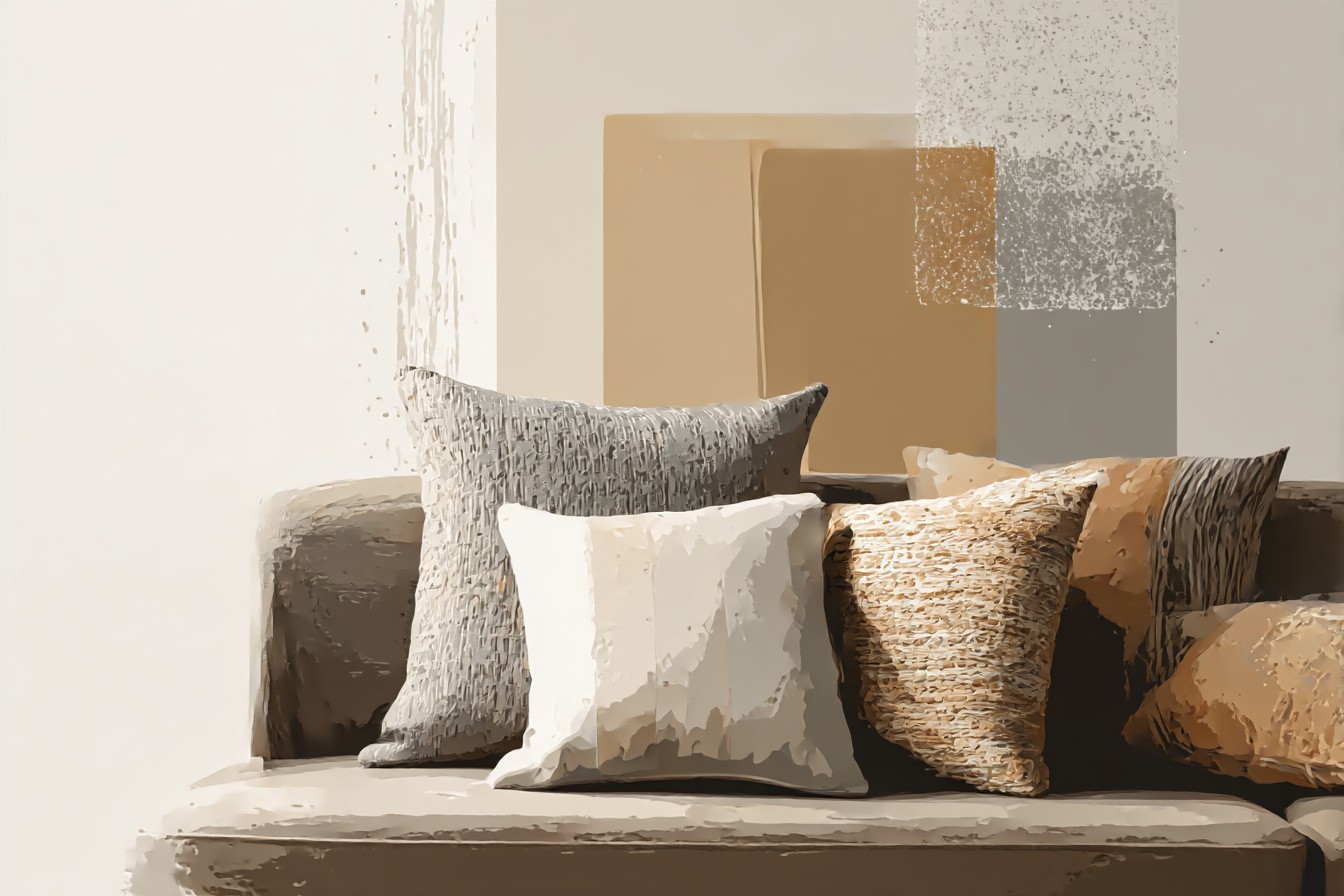
I have a charcoal linen pillow now, the color closer to wet slate than storm cloud, sitting on the same style of chestnut brown sofa that defeated me the first time, and it works because charcoal reads almost neutral against brown rather than fighting it for attention. Lighter dove grays work too, oddly better than the mid tones, because they lean toward cream at a distance and brown loves cream. The one gray I’d still tell you to be careful with is that flat, slightly purple toned gray you find in a lot of budget velvet, the kind that looks fine under store lighting and then turns faintly lavender under a lamp at home. I’ve been burned by that exact fabric twice, which honestly should have been a one time lesson.
If you want the safest possible entry point, go for a gray with texture, a chunky knit or a bouclé, because texture does a lot of the work that color alone can’t, it breaks up that risk of the sofa and pillow looking like two competing slabs. Gray on brown isn’t a compromise pairing. Done with the right undertone, it’s genuinely one of the calmer combinations I’ve lived with in that house.
[Gray Pillows]
Blue Pillows
If gray is the cautious choice, blue is the one that surprised me by how hard it works. I resisted it for years, mostly because I had a navy pillow in the early 2000s that I thought looked sophisticated and my sister took one look at it and said nothing, which from her is a review in itself, and not a flattering one. I didn’t touch blue again for the better part of a decade after that, entirely on the strength of her silence.
That was an overreaction on my part, because blue and brown might be the pairing I’d now recommend most confidently to anyone nervous about their brown sofa looking dated. Navy in particular has a way of making a brown leather or brown boucle sofa look intentional rather than accidental, the kind of pairing you’d find in an old study with good bones, not a rental. Denim blue softens it further, especially in a washed cotton that already looks a little lived in before you’ve sat on it once. Teal is the one I’d handle with more care, it can tip either jewel toned and rich against brown or slightly aquatic and cold depending on the exact shade, and I’ve had both results from what I thought were nearly identical fabric swatches.
What blue does that gray doesn’t is add a bit of drama without shouting. A single deep navy pillow against a lighter cream one on a brown sofa reads considered in a way that’s hard to fake with color alone. I’ve got two navy velvet pillows on the sofa right now, three years old, no visible wear despite a cat who treats that corner as personal property, and they’ve outlasted several other cushions I bought with more enthusiasm and less thought.
[Blue Pillows]
Rust and Terracotta Pillows
Now here’s where I’ll admit to being smug, because rust and terracotta on a brown sofa is the one pairing I got right early and have never once doubted since. It makes sense when you think about it for even a second, brown and rust come from the same family, the same clay and earth and warm undertone, so putting them together isn’t really pairing two colors, it’s more like putting two cousins in the same room and letting them get on with it.
I bought a rust colored corduroy pillow back when corduroy pillows first had their moment, which I’m fairly sure was being marketed as brand new even though I’m equally sure I had a nearly identical one in the late nineties, just in a slightly different orange. I called this a nineties throwback within about four seconds of seeing it in a shop window, which might say more about how much I’ve seen than about the actual pillow. Either way, it’s held up. That pillow has survived two house moves, one incident involving a dropped glass of red wine that somehow left less of a mark than it should have, and it still looks entirely at home against the brown sofa it started on.
You Might Also Like

Terracotta works the same way but softer, more sun bleached, and it’s particularly good if your brown sofa leans more caramel than chocolate, because the two tones sit closer together on the color wheel and the whole thing reads warm rather than busy. Burnt orange is the boldest version of this family and the one I’d use sparingly, one pillow, not four, because it wants to be noticed and four of them noticing at once is a lot for a Tuesday afternoon in your own living room.
[Rust and Terracotta Pillows]
Cream and Ivory Pillows
If I had to recommend one pairing to someone who wanted zero risk and zero decisions to agonize over, it would be cream or ivory pillows on a brown sofa, and I say that fully aware it’s the least exciting sentence I’ll write in this whole piece. Sometimes the safe answer is also the correct one, and I’ve learned to stop apologizing for that.
Cream against brown does something quietly clever, it lightens the whole sofa without changing its character, the way a good scarf lightens an outfit without you having to change the outfit itself. I’ve had a set of ivory boucle pillows on my current sofa for going on four years now, through a full range of seasons and one memorably muddy dog who has never once managed to leave a permanent mark on them, largely because I chose a fabric with enough texture to hide minor sins, a lesson I only learned after an earlier flat ivory silk pillow that showed literally everything, including apparently just existing in a room with sunlight.
The mistake people make with cream is assuming it has to be plain to work. It doesn’t. A cream pillow with a subtle woven stripe or a bit of fringe detail does more visual work than a flat one while still keeping that lightening effect on the brown underneath it. I’d steer away from anything too stark white though, true white against a warm brown sofa can look slightly clinical, like the sofa’s about to be examined rather than sat on. Ivory and cream keep the warmth going, which is really the whole point.
[Cream and Ivory Pillows]
Pattern Mixing on a Brown Sofa
Pattern is where I see the most fear, and honestly, where I used to feel the most fear myself, because a brown sofa already reads as a big, solid, somewhat serious piece of furniture, and putting a busy pattern on top of it feels like it might tip the whole room over. It won’t, provided you don’t do what I did around 2015, which was buy four differently patterned pillows in one afternoon out of pure enthusiasm and end up with a sofa that looked like it had opinions about everything all at once.
What actually works is picking one pattern with some presence, a block print, a kilim style weave, an ikat, and letting it do the talking, then supporting it with one or two solids pulled from somewhere inside that pattern. My current setup uses a rust and cream block print pillow against the brown sofa, with one plain rust pillow and one plain cream pillow either side of it, and it looks deliberate in a way my 2015 four pattern fiasco never managed, despite costing considerably less to put together.
Plaid deserves a mention too, particularly in autumn, because a warm toned plaid pillow against brown leather has a kind of lodge quality that I happen to like a great deal, though I’d keep it to one, maybe two, before it starts reading like a hunting cabin rather than a living room. The general rule I’ve settled on after enough trial and error is that brown can support exactly one properly busy pattern at a time, and everything else in that grouping should exist to make that one pattern look like it was the plan all along, not the accident.
[Pattern Mixing Pillows]
Final Thoughts
So, do gray pillows work on a brown sofa. Yes, provided you pick the gray with some warmth in it and skip the flat, cool tones that made my early attempt such a quiet disaster. But the wider truth, the one it took me a genuinely embarrassing number of years and pillows to land on, is that brown is one of the most forgiving sofa colors there is, and treating it as a problem to be solved rather than a base to be worked with was where I kept going wrong.
Gray brings calm.

Blue brings a bit of unexpected polish. Rust and terracotta lean into what the brown is already doing. Cream lightens it without changing its personality. Pattern, used with a bit of restraint, gives it some life. None of these are wrong choices, and I’ve now made all of them work at different points in the same house, sometimes in the same year, which either makes me indecisive or simply someone who likes her living room enough to keep tinkering with it.
If there’s one thing I’d actually ask you to take from all this, it’s to stop treating your brown sofa like it’s the limiting factor. It isn’t. It’s the one piece of furniture patient enough to sit there quietly while you work out what you actually like, and mine has now outlasted several rounds of my own changing mind, three house moves, one memorable spill, and at least one cat who considers it entirely his. That’s a decent track record for something that’s supposedly hard to dress.