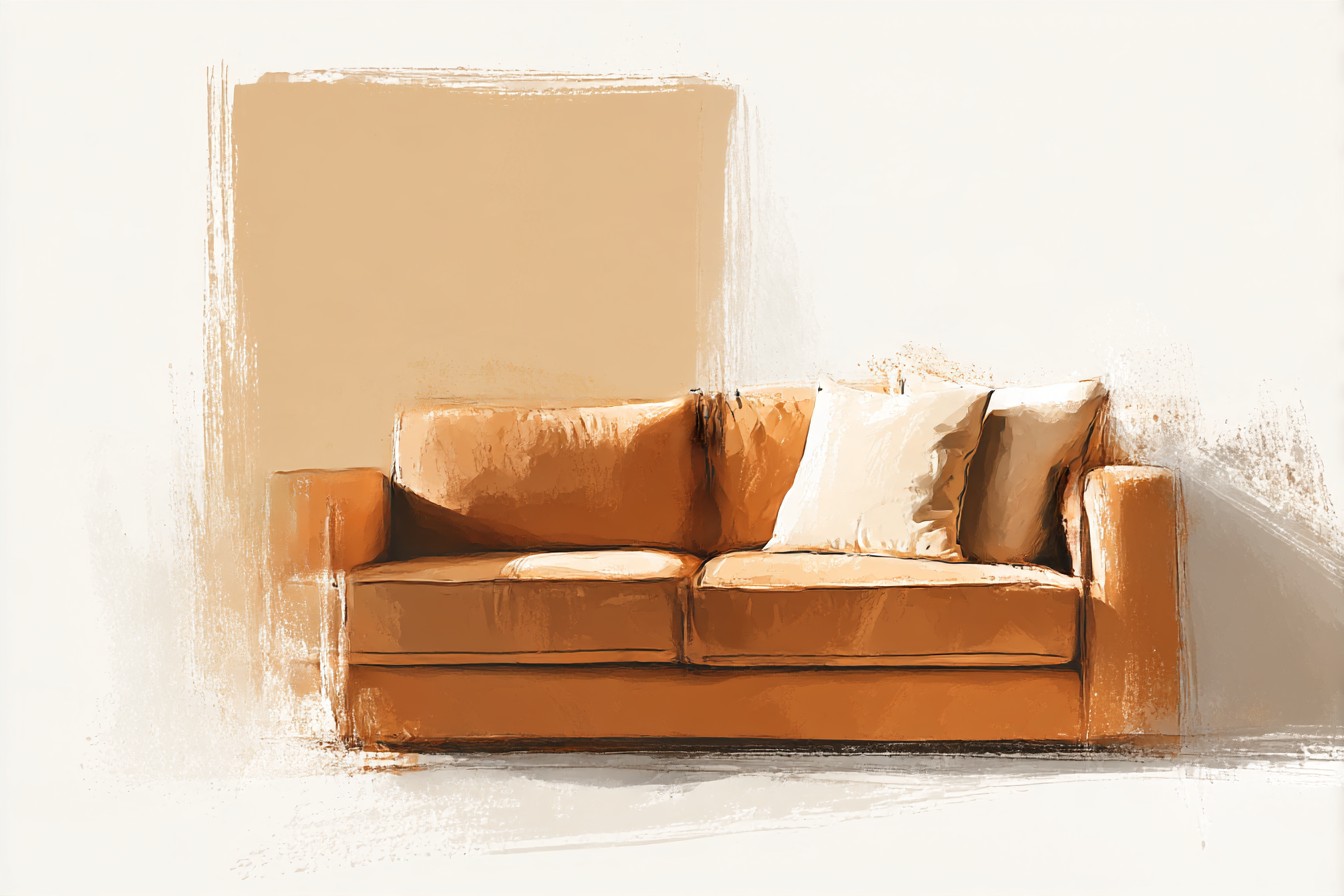
A woman at the fabric counter, maybe thirty years old, tanned the way people who ski a lot are tanned, told me brown sofas were “having a moment.” She said it the way you’d announce a comet was passing, something rare and slightly miraculous. I stood there with a swatch of chocolate velvet in my hand and thought, moment. I have owned no fewer than four brown sofas since 1987. It never left. It just went and sat quietly in the corner for a decade and a half while the rest of the country decided everything needed to look like a paint chip called Agreeable Gray, and now everyone’s acting like it invented itself yesterday.
I’m not cross about it, to be clear, I’m delighted brown’s back, I just find the amnesia funny. Gray had its run.

It ran a long time, long enough that I started to feel like I was living inside a cloud that had given up on itself, and I say that as someone who owned a gray sectional for nine years and defended it loyally right up until the day I didn’t. Brown is warmer, it photographs better in bad light, and it hides a coffee stain a lot more forgivingly than anything described as “greige” ever did. But bringing a brown sofa into a room properly, so it looks intentional and current rather than like something your uncle never got around to replacing, comes down to two things, really, and people tend to get one right and completely botch the other.
The sofa itself has to earn its keep
Not all brown is the same brown, and this is where I think a lot of people go wrong before they’ve even left the showroom. There’s the deep, almost black-coffee brown that reads sophisticated and a bit serious, there’s a warm cognac leather that looks fantastic until it’s cheaply made and starts to shine like a conker within two years, and then there’s the orangey, oak-cabinet brown that belongs firmly in a specific decade I have no interest in revisiting. That last one is the trap. I’d like to have a word with the woman who bought a rust colored leather recliner suite in 1994 convinced it looked “rich.” It looked like a dentist’s waiting room. It did not age well, and neither did my opinion of it, which soured roughly the same amount every year until it finally went to my brother in law’s basement, where I believe it’s still absorbing sports commentary to this day.
You Might Also Like

What keeps brown feeling current now rather than dated is mostly texture and undertone. A cool, grayish taupe-brown boucle or a chocolate velvet reads modern in a way that a shiny, orangey leather simply doesn’t, because the shine and the warmth of the tone together push it straight back to that same waiting room. Chenille and boucle in a muted, almost mushroom brown are doing enormous work right now precisely because they look soft and current rather than heavy and old fashioned, and if you’re choosing between a warm cognac leather and a cooler, deeper brown fabric, I’d say go cooler if your room already leans warm, and warmer if everything else is cold and needs the lift. My sister took one look at a caramel colored leather sample I was considering last year and said, “that’s a handbag, not a sofa,” which from her is basically a formal objection lodged with the committee, and she wasn’t entirely wrong, it did look more suited to a Florentine market stall than a living room.
What you put around it does the rest of the work
Here’s the part people underestimate, the sofa is maybe forty percent of this equation and everything surrounding it is the other sixty, which is a ratio I’ve made up entirely but stand behind completely.

The most common question I get, and the one I think trips people up most, is what color pillows go with a brown sofa, and the honest answer is almost anything except more brown, because that’s when the whole arrangement starts looking like a stack of gravy. Rust, ochre, a deep forest green, or a chalky ice blue against a chocolate or cognac sofa all do something a matching brown pillow simply can’t, they give the eye somewhere to land. If you want pillows that feel properly considered rather than picked at random off a shelf, mix a solid cream linen with one patterned piece that pulls in whatever accent color is already living in your rug or your curtains, and don’t be afraid of texture doing the contrast instead of color, a chunky knit pillow against a smooth velvet sofa reads more current than three pillows in slightly different shades of the same tone.
The coffee table question comes up almost as often, and I’ll say plainly, a brown sofa does not need a brown wood coffee table, in fact I’d argue it usually looks better without one. A pale oak or whitewashed wood table, or even something in black metal and glass, gives the room a break, whereas a matching dark wood table next to a dark brown sofa can tip a living room into looking like a hunting lodge nobody asked for. The same logic carries straight over to the television stand, which people forget is furniture too, not just a shelf that happens to hold electronics, a lighter wood tone or a matte black finish keeps the room from turning into one long stretch of brown-on-brown, and honestly, that’s the whole trick. Brown as the anchor, everything else there to argue with it a little. Get that balance right and it won’t look like a trend at all. It’ll just look like your living room, which, forty years into doing this, I can tell you is the only compliment that actually holds up.