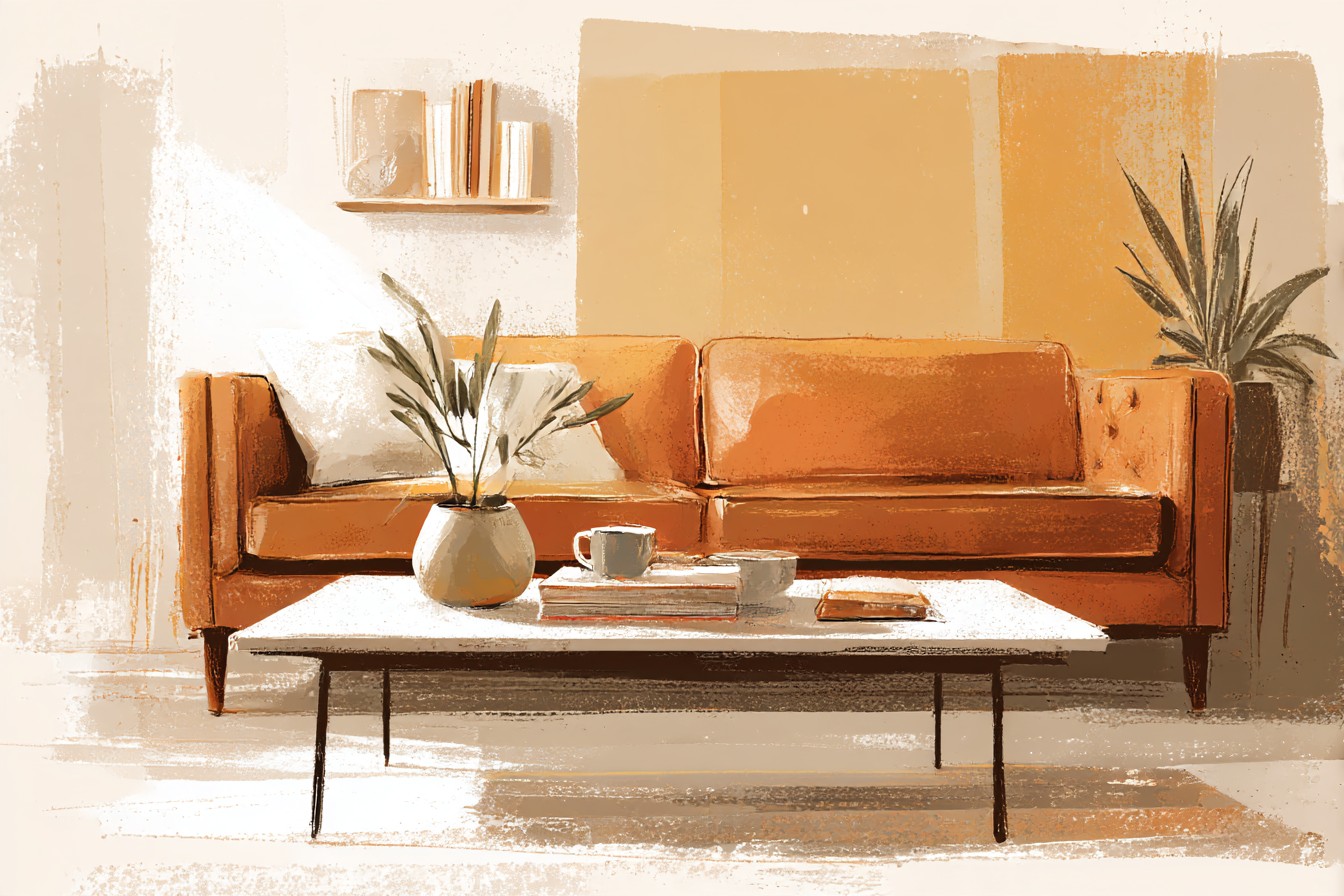
I bought my chesterfield off a guy in Ballantyne who was getting divorced and needed it gone by Saturday, and every single piece I read afterward about styling one said the same thing: keep everything else minimal, let the sofa be the statement, don’t compete with the tufting. I did that. I put a small glass cube of a coffee table in front of it, low profile, barely there, exactly what the internet told me to buy. It looked like a sofa and a side note. The chesterfield is not a piece of furniture that wants to be the only thing anyone notices, it’s a piece of furniture that wants something in the room with enough presence to actually have a conversation with it, and a coffee table that’s trying to disappear just makes the whole setup look unfinished, like you ran out of budget halfway through the room.
That reputation, the “chesterfield is hard to build around, keep it simple” line, isn’t wrong exactly, it’s just incomplete. The sofa has three things going against it if you pick badly: it’s deep, it’s tall in the arm, and the tufting reads as a lot of visual information from six feet away.

A coffee table that’s too small, too low, or too fussy just gets lost in that. What actually worked, once I stopped following the minimal instinct and started thinking about it properly, cost per year of use, scale against the arm height, material weight, was choosing a table with enough physical mass and enough of its own shape to hold its ground next to something that heavy. Not compete with it. Hold ground next to it, which is a different job entirely.
I’ve now been through four coffee tables in front of that sofa across two apartments, which is an embarrassing number for someone who works in finance and is supposed to understand sunk cost. But it means I’ve actually seen what reads as intentional next to a chesterfield and what reads like an accident. Scale first, then shape, then material, in that order, because I got the order wrong myself and paid for it in a table I gave away after four months.
[Coffee Tables That Work With a Chesterfield Sofa]
Low, Long Rectangular Tables
The chesterfield’s arms sit high, rolled and padded, usually somewhere around 26 to 28 inches depending on the maker, and that height does something to a small square table that nobody warns you about: it makes the table look like it shrank in the wash. My first attempt was a 36 inch square coffee table, walnut, nice joinery, genuinely well made. In front of a two seater or an armchair it would have been fine. In front of an 84 inch chesterfield it looked like a footstool that had wandered in from another room.
What actually balanced the sofa was a long, low rectangular table, close to 54 inches, sitting a good four inches lower than the arm height. The length matters more than people think, because the chesterfield’s whole silhouette is horizontal and heavy, the rolled arms extending the line of the seat, and a short table interrupts that instead of continuing it. On paper this is just a ratio problem, table length should run somewhere around 60 to 70 percent of the sofa’s length, and I did actually run that math before I bought the second one, because apparently I’ll build a spreadsheet for a coffee table before I’ll finish my expense report. In reality I bought it because it was the first one that stopped making the room look like a furniture showroom mid delivery.
The trade off is storage and knee room if you sit low and stretch out, a long rectangle eats floor space a round table wouldn’t, so it’s not the right call in a smaller living room where you need to walk around it daily. In mine it worked because the room is long and narrow, and the table’s line just extends the sofa’s line instead of fighting it.
[Rectangular Coffee Tables]
Round Tables for Softening the Grid
Tufting is, structurally speaking, a grid. Diamonds or squares repeated across the whole seat back and arms, and it’s a lot of straight lines and sharp intersections even when the leather itself is soft. Pair that with a rectangular table with hard right angle corners and you’ve built a room out of nothing but corners, which reads as stiff even when every individual piece is comfortable.
A round table breaks that up without softening the sofa itself, which is the part I initially got backwards, I assumed round meant “casual” and chesterfield meant “formal” and the two wouldn’t sit together. They do, because the round table isn’t competing with the tufting’s geometry, it’s contrasting it, and contrast is what makes a room look considered instead of matched in the slightly try hard way that happens when every shape in the room repeats.
The specific one I’ve kept through both apartments is a 34 inch round drum table, pedestal base, no visible legs to clutter the view of the sofa’s own turned feet. Pedestal bases matter more than people budget time for, four spindly legs under a round top next to a chesterfield’s substantial rolled arms just looks underbuilt, like the table’s apologizing for being there. The one time I ignored that advice, bought a round table on three thin metal legs because it was on sale, it wobbled within six weeks of actual use, someone leaning a laptop on it during a work call, and I mean genuinely wobbled, not settled in, wobbled. That one went back.
[Round Coffee Tables]
Glass Top Tables, Used Correctly This Time
I said the glass cube was a mistake, and it was, but the material itself isn’t the problem, the scale was. Glass has almost no visual weight of its own, it reads as absence more than presence, which means next to something as physically dense as a chesterfield, a small glass table just vanishes and leaves the sofa looking like it’s floating in a half furnished room.
You Might Also Like

The fix wasn’t abandoning glass, it was sizing it up and giving it a base with actual substance. My current table is a glass top over a solid brass frame, thick brass, not the thin gold wire stuff that bends if you look at it wrong, and at 48 inches long it has enough footprint that the glass reads as a deliberate choice rather than an afterthought. The brass frame does the job the glass can’t, it gives the table a silhouette you can actually see from across the room, so it holds its place next to the rolled arms instead of disappearing into the rug.
This is the one I’d recommend specifically for anyone doing video calls from that room, which is a genuinely modern problem nobody addresses in furniture writing, but I do a lot of my calls from that sofa and a glass top table doesn’t compete for camera attention behind me the way a busy wood grain sometimes does. It reads clean on screen. It read completely different in person than I expected on delivery day though, more substantial, less “hotel lobby,” which was a pleasant surprise given what I paid.
[Glass Coffee Tables]
Trunk Style and Storage Tables, for the Leather Match
If your chesterfield is leather, and a lot of them are because that’s sort of the whole point of the silhouette, there’s an argument for leaning into the material relationship instead of avoiding it, which felt like a rookie move until I actually tried it. A leather bound trunk style coffee table, the kind with stitched seams and brass corner studs, picks up the sofa’s material language without repeating its shape, since the trunk is a solid rectangular block and the sofa is all curves and rolls.
The practical case here is real, not just aesthetic. A storage trunk gives you somewhere to put the throw blanket, the remotes, the extra cushion nobody sits on but everyone owns, which matters enormously if your living room doubles as the only room, the way my first condo’s did. Cost per year of use goes up considerably when the table is also solving a storage problem you were previously solving badly with a basket that never quite fit under anything.
The one thing to check, and I did not check this the first time, is the stitching quality on the corners.

Cheap versions use a stapled seam that looks fine in photos and starts fraying within a year of actual knees bumping into it. Mine’s held up through one move and one very determined cat, but I paid attention to the seams before I bought, unlike the first coffee table experience, where I paid attention to literally nothing except how it looked on delivery day.
[Trunk Coffee Tables]
Marble and Stone Top Tables for Weight Without Bulk
The chesterfield is a heavy looking piece even when it isn’t physically that heavy, the rolled arms and deep buttoning do a lot of visual work to suggest mass. A marble top table plays into that same register, cool, substantial, permanent looking, without adding the actual bulk a big wood table would.
I went with a round marble top on a black metal base, and the thing nobody tells you about marble next to leather is how much the temperature contrast reads visually even though you obviously can’t feel it from across the room, the cool white veining against warm brown leather does something a matched wood tone never managed. It’s the closest thing in this whole setup to what I’d call, unwisely, a “statement,” except I’m not allowed to use that word so I’ll just say it’s the table guests actually comment on, which the walnut one never was.
Marble is not without cost, and I mean that in the actual financial sense as well as the maintenance one, it stains if you leave a wet glass on it overnight, which I learned from a very specific ring left by an iced coffee during a work from home Friday that never fully buffed out. Sealed marble or a quartz composite solves this if you’re not willing to coast on good habits the way I apparently am not.
[Marble Coffee Tables]
Final Thoughts
If there’s one thing four coffee tables and two apartments taught me, it’s that the chesterfield doesn’t need protecting from the rest of the room, it needs a table with enough scale and enough of its own shape to actually stand next to it. Minimal isn’t the failure mode, undersized is. A long rectangle extends its line, a round table breaks up the tufting’s grid, glass works if you stop treating it like it needs to be small to be tasteful, a trunk plays into the leather instead of around it, and marble matches the weight without matching the bulk.
None of this was really a spreadsheet decision in the end, whatever I told myself while measuring arm heights against table clearances with an actual tape measure on a Tuesday night. I bought the marble one because I liked the way it looked next to the leather when the light hit it around six in the evening, and that’s a completely unmeasurable reason to spend real money on a table, and it’s still the right one sitting there.


[…] started trying to complement it, the rest of the room got a lot easier to furnish, including the coffee table, which is a conversation for its own section. [Charcoal vs […]
[…] taken their coat off, before they’ve said hi properly. Your bookshelf gets a glance. Your coffee table gets studied. It’s basically the opening shot of your whole apartment, and mine spent about a […]