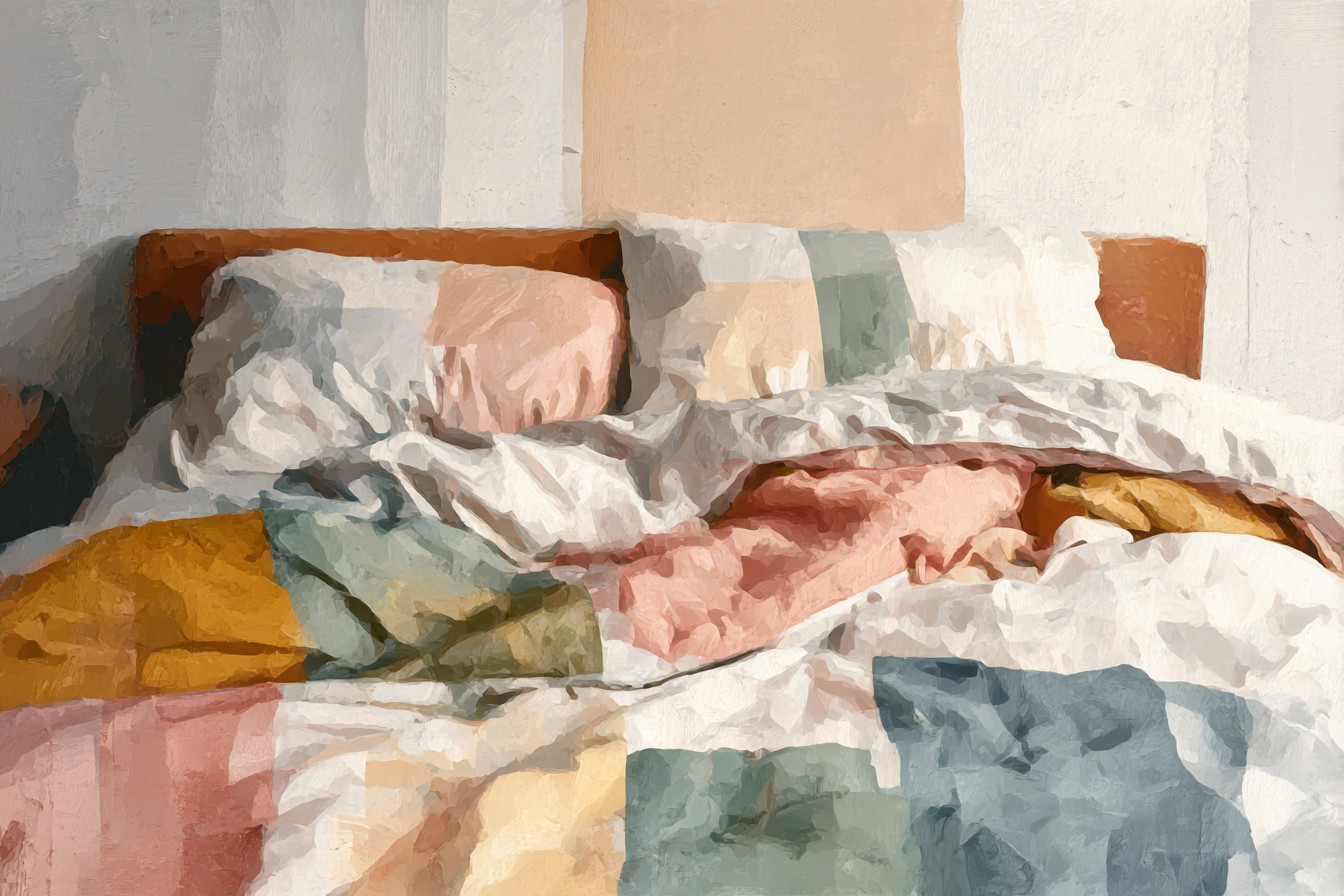
I was stripping the bed on a Tuesday, which is not a day that usually produces revelations, but there I was with the fitted sheet balled up under one arm and the duvet half off the mattress, and for some reason I straightened up and actually looked at the wall above my headboard for the first time in maybe two years. It was blank. Not tastefully blank, not the kind of blank a magazine photographs on purpose. Just blank the way a wall gets when you moved in, hung nothing, told yourself you’d “get to it,” and then simply started sleeping under an empty rectangle of drywall for twenty-four months without registering it once.
That’s the thing about the space above a headboard. It’s the first thing you see when you walk into the room and almost the last thing you ever actually look at, because you’re usually lying underneath it, facing the other direction, or asleep. It does an enormous amount of visual work for a piece of wall nobody consciously studies, and I think that’s exactly why people get it so wrong, either by ignoring it completely, the way I had, or by overcorrecting into something enormous and expensive that they picked in a rush because a friend was coming to visit and the bedroom “needed something.”
I’ve furnished this house three separate times now, across three separate decades, which sounds like either dedication or a serious character flaw depending who you ask, my sister would say the latter, and in every single version of this house that wall above the bed has gone through something different.

A poster held up with the wrong kind of tape in the eighties that took the paint clean off when it fell. A mirror in the nineties that I still think about, mostly with embarrassment. Actual, deliberate shelving eventually, once I stopped assuming that wall had to hold “one nice thing” and started asking what I actually wanted from it. Because that’s really the question, isn’t it. Not “what looks good above a bed” in the abstract, but what you want that particular six or eight feet of wall doing for you, whether that’s light, storage, a bit of drama, or just something to look at besides your own ceiling at eleven at night.
[Bed Headboard Wall]
Large Scale Art
The first instinct most people have, mine included for a long stretch of the nineties, is to go big. One large piece, centered, and done. There’s a logic to it, a single oversized print or painting reads as intentional in a way that three small frames arranged with any hesitation never quite does, and if you get the scale right it can genuinely anchor a room that otherwise has nothing else going on above waist height. I have a large botanical print now, roughly forty by fifty inches, that’s hung above this bed for eleven years, and it’s the one piece of art in the house nobody has ever once questioned.
But I’d like to have a word with the woman who, in 1994, bought a piece of abstract art almost the exact width of her headboard convinced that matching the two would look considered. It did not look considered. It looked like a matched set from a furniture showroom, the kind where the art was clearly bundled in with the bed frame as a package deal, because it more or less was. The rule I eventually landed on, and it took embarrassingly long, is that your art should be wider than your headboard, not the same width and never narrower, ideally by a good six to twelve inches on each side, otherwise the whole wall reads as one flat unit instead of two things in conversation with each other.
The other thing nobody tells you is how much a single large piece depends on being hung too high rather than too low. Everyone hangs art too high out of some vague instinct that height equals grandeur. Above a bed, you want the bottom edge sitting somewhere between eight and twelve inches above the top of the headboard, close enough that they read as a pair, not a piece of art that drifted off and a headboard that got left behind underneath it.
[Large Scale Art]
Wall Sconces
I resisted wall sconces above the bed for years on the grounds that they seemed like something you’d find in a hotel trying too hard to seem boutique, all brass arms and a shade angled at exactly the sort of angle nobody’s arm naturally rests in real life. Then I actually lived without decent light in that spot for about a decade, relying entirely on a bedside lamp that inevitably got knocked over, and eventually understood the sconce wasn’t fashion, it was function that happened to also look nice once installed correctly.
What changed my mind specifically was a pair of swing arm sconces I put in on either side of the headboard, wired properly into the wall rather than plugged in, which meant an electrician and genuine expense and a fair amount of complaining on my part about the cost of something “just for reading in bed.” They’ve been in for nine years now. Not one has flickered, dimmed unevenly, or needed a bulb replaced more than twice, and my sister, who came to stay for a week last spring, took one look at them and said, “well, that’s better than fumbling for a lamp at midnight,” which from her counts as genuine enthusiasm.
The thing sconces solve that art and shelves simply can’t is the actual physical problem of reading in bed without a lamp base taking up your entire nightstand, and without the shadow a ceiling fixture throws directly across your book. Go for something with an articulated arm if you read at all, fixed sconces look tidier in photographs but you’ll be twisting your whole torso around to catch the light within a month, and that gets old considerably faster than the sconce itself does.
[Wall Sconces]
Floating Shelves
Floating shelves above a headboard get treated, by roughly half the people who install them, as a genuinely new idea, and I will admit I called this exact setup a nineties throwback within about four seconds of seeing it in a magazine a few years back, which might say more about how much furniture I’ve watched cycle through than about the shelf itself. We had something almost identical in the house I grew up visiting as a young married woman, thin painted ledges holding a lamp and a couple of paperbacks, and here it is again with better hardware and a higher price tag.
You Might Also Like

That said, I’ve got a pair of them now, oak, about six inches deep, mounted at slightly different heights above either side of the bed rather than perfectly symmetrical, which was a deliberate choice after years of everything in this house being matched to the point of looking like a display rather than a life. One holds a small reading lamp and exactly the book I’m currently partway through, never more than that, I learned the hard way that a shelf above your bed becomes a landing strip for absolutely everything if you let it, receipts, spare change, a hand cream I apparently bought three of. The other holds nothing but a single ceramic dish and a framed photograph, and that restraint is doing more work than the shelf itself.
The one genuine warning I’ll give, and I mean this as an actual warning, not decorating advice dressed up as one, is to check the weight rating and the studs before you load anything heavier than a paperback onto a shelf directly above where your head will be for eight hours a night. I’ve had exactly one incident, a shelf that shifted rather than fell, thankfully, and it was enough of a fright that I now check twice.
[Floating Shelves]
Woven Wall Hangings
I was fully convinced, well into my fifties, that macrame and woven wall hangings were a specific and dated relic of about 1976, something I associated with a particular aunt’s sunroom and nothing else. Then my niece put one up in her first apartment a few years back, natural jute, geometric, nothing like the shaggy cream monstrosities I remembered, and I had to sit with the uncomfortable realization that I’d written off an entire category of object based on one bad decade rather than actually looking at what was in front of me.
I bought one eventually, a smaller cotton weave in a rust and cream pattern, hung slightly off center above the headboard rather than dead middle, and it’s done something a framed print never quite manages, which is soften a wall that otherwise had a lot of hard edges in that corner of the room, the headboard itself being a fairly severe upholstered rectangle. There’s texture involved that changes depending on the light coming through the window, which sounds like the sort of thing a catalog would say and yet here I am saying it because it’s genuinely true in this specific case.
The honest caveat is that these collect dust in a way framed art simply doesn’t, and mine gets an actual light vacuuming with the brush attachment about twice a year, which is more maintenance than I expected to sign up for. If that sounds like too much upkeep for you, I understand completely, but I’d encourage you not to write the whole category off the way I did for the better part of three decades based on one relative’s sunroom.
[Woven Wall Hangings]
Gallery Walls
A gallery wall above a bed is either the best decision in the room or the thing a future version of you takes down piece by piece over a series of Sunday afternoons, and I have done both, in this same house, in two different decades. The first attempt, sometime in the early 2000s, involved eleven frames of wildly different sizes that I arranged with a level of confidence that was not remotely earned by any actual plan, and it looked, to be blunt about it, like a wall that had been attacked rather than decorated.
The version I have now is seven frames, all the same narrow black metal frame, mixed sizes but a consistent one inch white mat throughout, and I laid the entire arrangement out on the floor with painter’s tape marking the wall before a single nail went in, which took most of an afternoon and saved me from at least four unnecessary holes. That consistency in frame and mat is doing almost all the work here, it’s the difference between a considered collection and a wall that looks like the aftermath of several separate decorating opinions that never spoke to each other.
What I’d tell anyone attempting this above a bed specifically is to keep the whole arrangement lower and wider than you think, closer to the headboard than feels natural at first, because gallery walls have a tendency to drift upward and outward until they’ve swallowed half the wall and left the bed looking like an afterthought underneath something much more important than it. The bed’s still the point of the room.

The wall is there to support that, not compete with it.
[Gallery Walls]
Final Thoughts
If I’m honest, no single one of these is the right answer, and I’d be suspicious of anyone who tells you otherwise with total conviction, because the right answer depends entirely on what that room is already doing without your help. A room with good ambient light and no storage wants a shelf. A room where you read every night before sleeping wants a sconce more than it wants anything decorative at all. A room that’s felt cold and unfinished for two years, the way mine did on that Tuesday with the sheets in my arms, probably just wants you to actually look at the wall for once, which is a smaller ask than it sounds.
What I’d say to the version of me stripping that bed, blank wall and all, is that the mistake was never picking the wrong thing. The mistake was the two years of picking nothing at all and calling it minimalism when it was really just avoidance with better lighting. Whatever you put there, a print, a pair of shelves, seven small frames laid out on the floor with tape first, it doesn’t need to be permanent and it certainly doesn’t need to be perfect on the first attempt. Mine wasn’t, twice over, decades apart. It just needs to be something you chose on purpose, rather than a rectangle of wall you’ve simply stopped seeing.