Okay so I currently own four fire pits. FOUR. One of those little tabletop propane ones that looks like a marshmallow toaster, one cheap steel bowl thing from a big box store that rusted within a season, one “smokeless” wood burning one that is absolutely not smokeless, and one I bought specifically because it was on sale and I have never once used it. This is not a flex. This is a problem. I make content for a living, which means every time something trends I buy the thing, film the thing, and then the thing sits in my building’s tiny shared yard until someone from the association slides a note under my door.
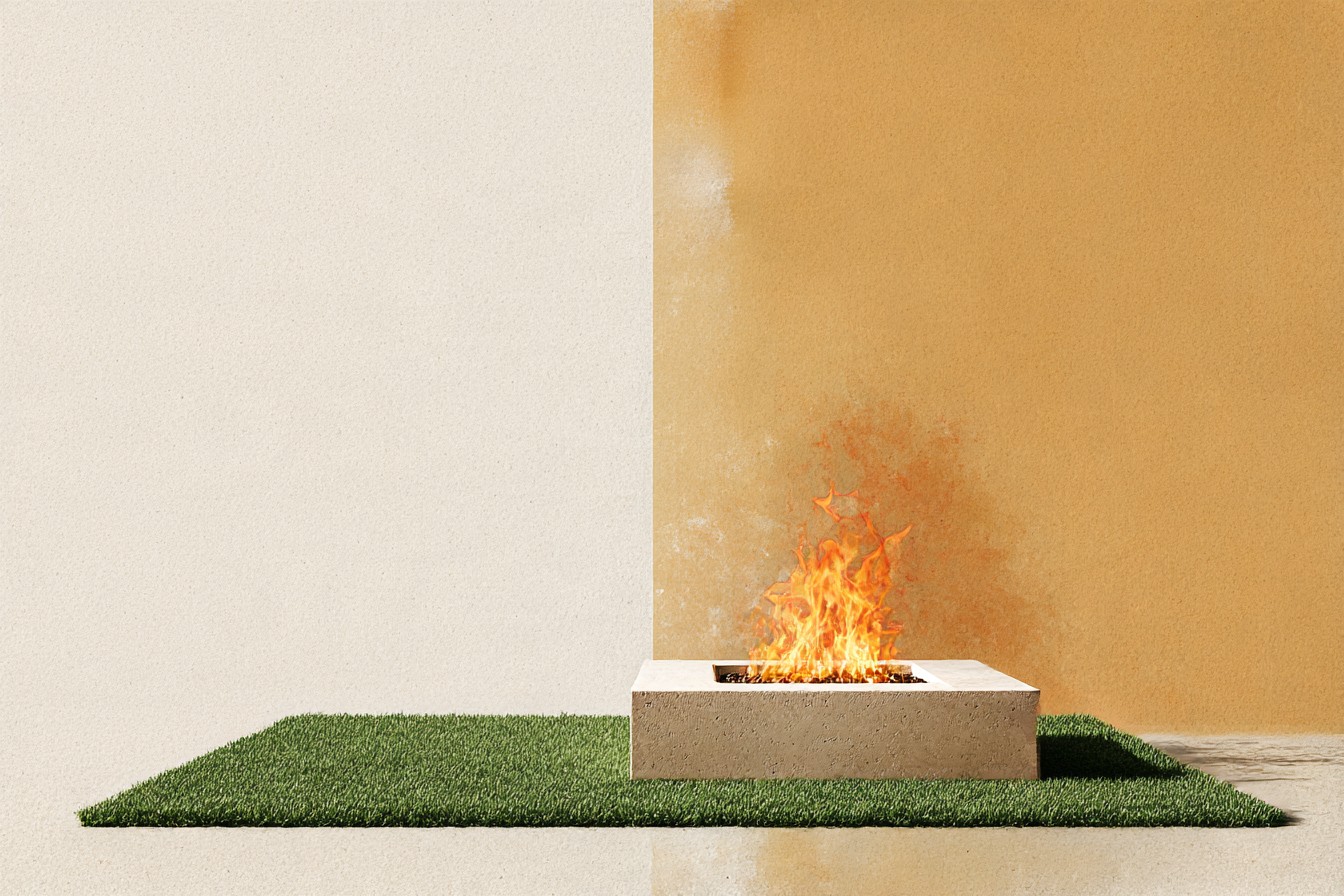
That’s basically how I ended up needing to know, for real, not for a caption, whether you can put any of these near the patch of artificial grass that runs along the back fence.
Because here’s the thing nobody tells you before you install turf, or before you move somewhere that already has it. Fire and plastic grass sound like an obviously bad combination when you say it out loud, and yet I watched no fewer than three people in my own building’s group chat debate this like it was actually up for discussion. Someone said “it’s fine if you’re careful,” someone else sent a fire emoji with no further comment, which honestly could’ve meant anything, and one person just wrote “ask your landlord first,” which, fair, that’s basically my entire personality now that I rent.
So I did what I always do. I stood in the yard, looked at the turf, looked at the fire pit, and thought about it properly instead of just winging it for a video. This piece is me thinking out loud about the actual question, not a safety pamphlet, not a manufacturer’s disclaimer. Just what I’d actually tell a friend standing where I was standing, fire pit in one hand, mild dread in the other.
[Artificial Grass and Fire Pits]
What Actually Happens When an Ember Lands on Turf
Let’s start with the boring but important bit, because I did not understand this until I looked it up mid panic after a spark jumped further than I expected. Artificial grass isn’t grass. It’s plastic. Usually polyethylene or polypropylene blades stitched into a backing, sometimes with a rubber or foam infill underneath for cushioning. All of that is, chemically speaking, basically fuel with good marketing.
An ember from a wood fire can hit somewhere between 700 and 1,000 degrees depending on what’s burning. Polyethylene starts softening well under that, we’re talking closer to 250 to 330 degrees before it distorts, and it can melt or scorch almost instantly on contact with something that hot. It doesn’t need to catch fire dramatically to ruin your yard. It just needs one glowing chunk of ash to land, sit for four seconds, and leave a little crater that used to be a blade of fake grass. I’ve seen the after photos in a landscaping forum I fell into at 1am and it is not subtle. Little black pockmarks, sometimes a full melted patch the size of a dinner plate, occasionally the backing itself warping so the whole section buckles.
The backing is honestly worse than the blades in some ways, because if that goes, you’re not looking at a few damaged strands, you’re looking at replacing an entire section, and turf isn’t cheap to redo. My cousin’s neighbor, not even someone I know well, just a story that got passed to me secondhand, apparently had this happen from a single firework, not even a fire pit, and the quote to fix just that corner was enough that they just left it, slightly melted, forever. Grim.
[Artificial Grass and Fire Pits]
The “Fire Resistant” Label Is Doing a Lot of Lying
This is the part that actually got me heated, no pun intended, because I went shopping for turf once thinking “fire resistant” meant what it sounds like. It does not mean fireproof. It usually means the product meets a specific flammability test, often something like being self extinguishing if a flame is removed, which is a very different promise than “embers can sit on this and nothing will happen.”
Most artificial grass sold for backyards is rated to resist catching fire from something like a dropped cigarette, briefly. That’s a completely different scenario to a fire pit throwing off actual embers for two or three hours while you’re sat there with a drink not looking at the ground the whole time. Cigarette ember, small, brief contact, self extinguishing surface, fine. Fire pit ember, hotter, sometimes bigger, sometimes landing and just sitting there because nobody noticed, that’s the scenario the “fire resistant” sticker was never actually tested for in the way people assume.
I sent a screenshot of one product listing to my building’s group chat just to see what people thought it meant, and every single person read “fire resistant” as “basically fireproof.” Every single one. Which tells me the labeling is doing exactly what it’s designed to do, sound reassuring while meaning something much narrower. So if you’re standing in your own yard right now thinking “it’s fine, mine’s the good stuff,” it’s worth actually finding the product spec sheet rather than trusting the word on the label alone. It usually says more than the marketing does, and it’s usually more honest.
[Artificial Grass and Fire Pits]
Not All Fire Pits Throw the Same Risk
Owning four of these things unfortunately does mean I’ve got opinions on which ones are actually the problem here. A propane fire pit, especially a tabletop one with a lava rock or glass bead top, throws almost no embers. The flame’s contained, there’s no burning wood breaking apart and popping, so the risk to anything nearby is mostly heat radiating outward rather than actual burning material landing somewhere it shouldn’t. Still not zero risk, the base gets hot, but it’s a completely different category of hazard.
Wood burning fire pits are the ones that actually worry me near turf. Wood pops. It spits. Sap filled logs especially will throw sparks a genuinely surprising distance, further on a breezy night than you’d think possible, and I say that as someone who has had to stamp out a stray ember on a wooden deck before, watching it in real time going “oh that’s further than I expected” while lunging for it. That’s wood on wood. Now put that same spark on plastic grass instead and it’s not stamping out an ember, it’s stamping out an ember that’s already started to fuse into the blades.
You Might Also Like

The smokeless ones marketed as cleaner burning still have an open flame and still pop occasionally, they’re just better at directing smoke, not embers. So if turf is anywhere in the picture, propane with a proper base plate is the lower risk option every time, and wood burning is the one where distance and surface underneath matter completely.
[Artificial Grass and Fire Pits]
Reading Your Own Backyard Before You Read Any Guide
Here’s where I think most of these articles, the generic ones, completely miss it, because they treat every yard the same, and no two are. Standing in mine, the actual variables I’d notice are wind, surface, and how close the neighbors’ fence actually is, not some generic safe distance number pulled from a manual nobody reads.
Wind first. A fire pit that’s totally fine on a still evening becomes a completely different object the second there’s a breeze pushing embers sideways instead of straight up. I’ve had a candle behave unpredictably on a windy balcony, a fire pit is that times a hundred. If your yard tends to funnel wind, between two buildings, along a fence line, you already know the spots where it whips through, and that’s exactly where I wouldn’t put anything burning near turf regardless of what the label promises.
Surface matters beyond just turf or not turf. Is the fire pit sitting directly on the grass, or is there already a paver, a gravel patch, decomposed granite, something non flammable underneath it?
A lot of turf damage I’ve read about happened because people assumed the fire pit’s own base was doing the protecting, when actually heat radiates out sideways far more than people expect, scorching turf a foot or two away from the pit itself, not just directly underneath.
And the neighbors. Genuinely the most underrated factor. Close fences, shared yards, anything where embers or smoke could drift onto someone else’s space changes the calculation entirely, and that’s before you even get into whether your HOA or landlord allows open flame at all, which, if you rent like I do, is step one before step anything else.
[Artificial Grass and Fire Pits]
The Workarounds That Actually Hold Up
If you’ve got turf and you’re not willing to give up the fire pit dream, and honestly I get it, there’s genuine middle ground here rather than an all or nothing situation. The most common fix I kept seeing repeated by people who clearly learned the hard way is creating a dedicated non flammable zone. Pavers, a ring of gravel, a poured concrete slab, something that physically breaks up the turf so there’s a buffer of material that simply cannot melt between the fire and the fake grass.
Fire pit mats are the other one, specifically designed heat resistant mats you place under the pit itself, which help with the direct heat and dropped embers right at the base, though they don’t do much for sparks thrown a few feet sideways, so I wouldn’t treat a mat alone as the fix, more like one layer of it.
Distance is the free option, the one that costs nothing except giving up a bit of yard efficiency. Keeping the pit properly back from any turf edge, further than feels necessary honestly, buys you room for wind to do something unpredictable without it mattering.
And a spark screen, the mesh cover that goes over a wood burning pit, cuts down dramatically on embers escaping in the first place, which is honestly the simplest change of all of these and the one I’m most annoyed I didn’t just start with.
[Artificial Grass and Fire Pits]
Final Thoughts
So can you have a fire pit on artificial grass. Directly on it, no, I wouldn’t, not with anything that throws embers, and even propane I’d want a proper base and some real distance rather than trusting the label alone. Near it, with a hard surface underneath, a spark screen, decent distance from the edge, and an honest read of your own wind and neighbors, sure, that’s a completely different, much more reasonable version of the question.
I’m not giving up my fire pits, all four of the unreasonable number of them, but I am finally doing the paver zone I’ve been putting off for two seasons, because apparently that’s what it took, writing eleven hundred words about melted plastic to actually get off my ass and buy the gravel.