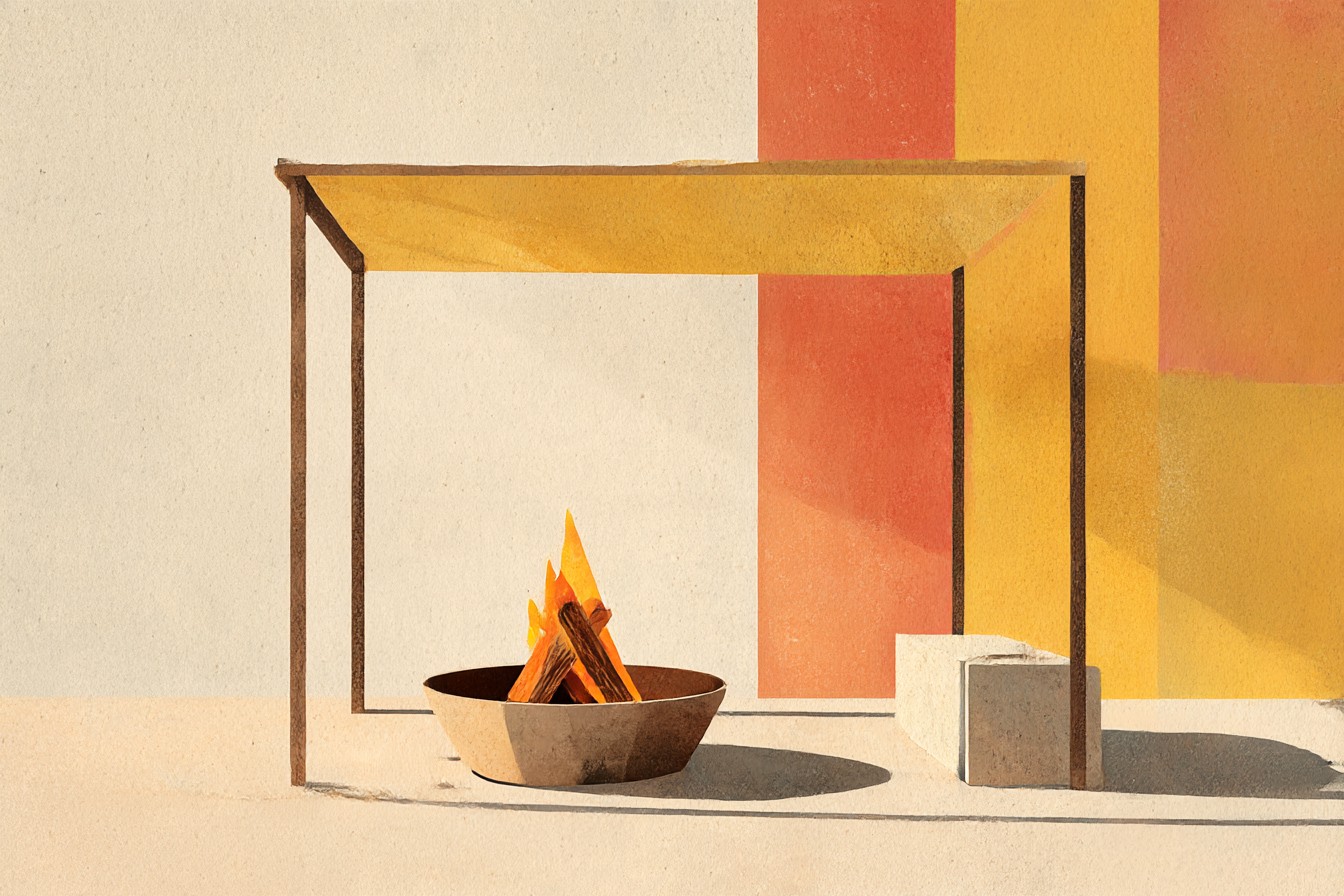
My sister Marnie walked onto my back porch two winters ago, took one look at the little steel fire bowl I’d hauled up from the yard sale on Wheaton Street, glanced up at the retractable awning I’d just had installed that fall, and said, without even putting her bag down, “You are going to melt that thing right off its track.” Not a question. A verdict. Delivered the way she delivers most opinions about my house, which is to say with total confidence and about forty percent of the actual facts.
She wasn’t entirely wrong to worry, and she wasn’t entirely right either, and that gap between those two things is basically the whole answer to whether you can run a fire pit under an awning. Because the honest truth, the one I’ve come to slow, sitting out there on plenty of cold nights since, cocktail going lukewarm in my hand, watching sparks lift up toward that canvas like they had somewhere to be, is that it depends. Not in the wishy washy way people say “it depends” when they don’t want to commit to an answer. It depends on real, measurable, boring things.

How high up that fabric is. What that fabric is actually made of. Whether you’re burning wood or running gas. Whether the space around you can breathe or whether it’s more sealed in than you’d admit if someone asked you straight.
I’ve been digging through estate sales and salvage yards long enough to know that almost nothing outdoors is as simple as the tag on it claims, and awnings and fire pits are no different. A dealer will tell you a canvas is “fire rated” the same easy way he’ll tell you a chair is “1920s” when it’s clearly got particleboard under that veneer. You’ve got to check it yourself. Get up close. Look at the joints, so to speak. Because heat doesn’t negotiate with what the label says, it just goes straight up, and whatever’s waiting for it up there is going to answer for itself one way or another.
So this is me working through it properly, the way I’d tell it to you sitting across the fire, not the pamphlet version. What clearance actually needs to look like, what’s hiding in that fabric overhead, why gas and wood aren’t playing the same game at all, why carbon monoxide isn’t a scare tactic but a genuine thing worth respecting, and what to do if what’s over your head is a pergola or a screened porch rather than a proper retractable awning.
[Fire Pit Under an Awning]
The Clearance Number Nobody Wants to Actually Measure
Here’s the thing about clearance. Everybody wants a rule of thumb, a nice round number they can eyeball from the couch, and I get it, I wanted that too. But the number that actually matters isn’t a rule of thumb at all, it’s whatever the manufacturer of your specific fire pit says in the fine print you skipped, and separately whatever the manufacturer of your specific awning says about heat exposure, and those two numbers rarely shake hands nicely.
Most fire pit manufacturers want somewhere around ten to twelve feet of vertical clearance to any combustible overhead structure, and I want to be honest, when I first read that on the box of a propane pit I bought off a fella at the Sunday yard, I laughed out loud. Ten feet. My awning sat at about eight and a half. I ran it anyway for one evening, told myself the flame was small, told myself I’d watch it close. Found scorch discoloration on the underside of the fabric the very next morning, a soft brownish halo right above where the fire had been, bless it, like the awning had a sunburn in one very specific spot. That was the wood burning insert. Nothing dramatic happened, no drama, no fire department, just a mark that never came out and a lesson that arrived cheap compared to what it could have cost me.
Clearance also isn’t just straight up. It’s outward too, how far the awning extends past the fire pit’s edge, because heat doesn’t rise in a perfect column, it drifts and pools depending on wind, and a breeze off the marsh will push flame and heat sideways into fabric that felt safely out of range five minutes earlier. I measure now. Actually measure, tape measure and everything, feeling a little silly doing it, and I’ve made peace with feeling silly because scorched Sunbrella is sillier.
[Clearance and Awning Height]
What the Fabric Overhead Is Actually Made Out Of
This is where I get properly nosy, because it’s the same instinct that has me checking a maker’s mark on the underside of a dresser before I believe a word the seller’s telling me. Not all awning fabric behaves the same way near heat, not even close, and most people buying a retractable awning are thinking about sun and rain, never once about fire, because why would they.
Cotton duck canvas, the old fashioned kind, actually holds up better than you’d expect in terms of not melting, it can scorch and char, sure, but it doesn’t do the thing vinyl and a lot of synthetic blends do, which is soften and drip and, in a bad enough case, actually ignite and keep burning on its own. Acrylic fabrics like Sunbrella sit somewhere in the middle, they’re treated to resist a lot, water, mildew, sun fade, and they’re genuinely tough, but “resistant to weather” was never the same promise as “safe six feet above an open flame,” and I think a lot of us hear “outdoor fabric” and quietly assume it covers fire too. It doesn’t.
Vinyl and laminated polyester, which shows up a lot on the cheaper retractable and manual awnings, is the one that worries me most, because it can soften at temperatures that aren’t even that dramatic, and once it starts to sag or drip it’s dripping something that’s now on fire onto whatever’s below it, which is you. I found this out the unglamorous way, testing a cheap clip on shade sail I’d bought for a patio umbrella frame, held a lighter near a scrap edge before I put it up, just curious, and it curled and went gooey almost immediately. Never went near a fire pit after that. That scrap piece told me everything the packaging didn’t.
[Awning Fabric and Materials]
You Might Also Like

Gas Fire Pits and Wood Burning Ones Aren’t Playing the Same Game
I used to lump these together in my head, fire is fire, but sitting with both kinds over the years under different kinds of cover has taught me they behave in genuinely different ways once you put fabric or a roofline into the mix.
A gas fire pit, the propane or natural gas kind with the lava rock or glass beads, gives you a flame you can control precisely, dial it down, dial it up, and it produces very little of the drifting spark and ember situation that a wood fire does. That controllability is a real safety advantage under any kind of cover. But gas brings its own conversation to the table, and it’s not about sparks landing on fabric, it’s about what happens to the air in the space you’re sitting in, which I’ll get into properly in a minute because it deserves its own breath, not a rushed mention here.
Wood burning is the one that actually worries me more under an awning, and I say that as someone who genuinely prefers the smell and the crackle and the whole ritual of it, feeding a fire, listening to it pop. Wood throws embers. Unpredictably. A shift in wind, a log settling, a particularly resinous bit of pine I probably shouldn’t have thrown on there, and suddenly there’s a spark traveling further and higher than the flame itself ever did. I’ve had one land on my own sleeve at a friend’s bonfire that had nothing overhead at all, so imagine that same spark with eight feet of fabric waiting to catch it. Under real cover, wood needs a spark screen, non negotiable, the kind that clips over the top of the bowl, and even then I keep the fire smaller than I want it to be, which took some getting used to, because a small fire under an awning is honestly the safer version of a hobby that’s usually about going bigger.
[Gas vs Wood Burning Fire Pits]
The Carbon Monoxide Conversation Nobody Wants to Have Around a Cozy Fire
I’ll be straight with you here, because this is the part of the whole topic that gets glossed over the most, usually right when people are feeling warmest and least like hearing it. An open flame, gas especially but wood too, produces carbon monoxide, and carbon monoxide doesn’t care how charming your evening is going. The risk isn’t really about a fully open patio with air moving freely all around it. The risk climbs the moment you start closing things in, a retractable awning fully extended on three sides with clear vinyl panels dropped down for winter, a screened porch with the screens mostly zipped shut against the cold, a gazebo with heavy curtains pulled around the sides to block wind. That’s when what felt like outdoor space starts behaving more like an enclosed room, and gas appliances especially need actual airflow to burn clean and to let anything they do produce disperse rather than pool at head height where you’re sitting.
I don’t say this to scare anyone off the whole idea, because I still light fires under cover plenty, I just don’t pretend the risk isn’t real anymore, which I did for longer than I’d like to admit. I run a battery powered carbon monoxide detector out there now, cheap thing, sits on the side table, and I leave at least one full side of whatever’s overhead open to actual moving air, not just cracked, actually open. If the wind’s dead still and everything feels sealed in tighter than usual, that’s the night I move the fire pit out from under cover entirely rather than talk myself into it being fine. It’s the one rule I don’t bend, and honestly it’s the one piece of this whole topic where I’d rather sound overly cautious than sound like I waved it away because it was inconvenient to the evening.
[Carbon Monoxide and Ventilation]
Retractable Awnings, Pergolas, and Whatever You’ve Improvised
Not everyone’s working with the same kind of cover, and I think that gets lost when people search this whole question, because “awning” ends up covering everything from a proper motorized retractable fabric awning to a pergola with a canvas top somebody stapled on themselves one Saturday, and those aren’t remotely the same risk. A retractable awning, the good kind, at least gives you the option to pull it back entirely before you light anything, which honestly solves half the problem outright if you remember to do it, and I’ll admit I forget about a third of the time because the whole point of having it was not thinking about it.
A pergola with an open lattice top is a different animal altogether, more clearance built in by design usually, more natural airflow through the gaps, and if there’s a fabric shade cloth draped over it for summer, that’s removable, which I’d remove every single time before a fire goes anywhere near it. A screened porch is the one that catches people out the most, because it feels open, it’s got mesh instead of walls, but mesh still blocks wind movement more than you’d think, and I’ve sat in one on a still July night and noticed the smoke just hanging there instead of clearing, which told me everything I needed to know about how “open” it actually was.
And then there’s the improvised stuff, the tarp rigged over a patio table, the umbrella left up nearby, the shade sail from the pool side dragged over for one evening because rain was threatening.

None of that was ever built with heat in mind, and none of it gets the benefit of the doubt from me anymore. If I can’t tell you what it’s made of, it doesn’t go anywhere near the fire pit. Simple as that.
[Retractable Awnings and Covered Patios]
Final Thoughts
So can you have a fire pit under an awning. Yes, plenty of nights, mine’s sitting out there right now with the cover pulled back and a detector on the side table doing its quiet job. But it’s a yes with conditions attached, the kind you actually have to check rather than assume, clearance measured properly and not guessed at, fabric identified honestly instead of taken on faith from a tag, wood fires kept smaller and screened, gas fires respected for what they do to the air around you rather than just the flame you can see. None of that takes the coziness out of it. If anything, knowing exactly what’s over my head and exactly how far away it needs to stay has made me relax into those evenings more, not less, because I’m not half listening for a problem the whole time. Measure it once, really look at what that fabric’s made of, and then go enjoy the fire the way it’s meant to be enjoyed, slow, a little smoky, and not one bit worried.