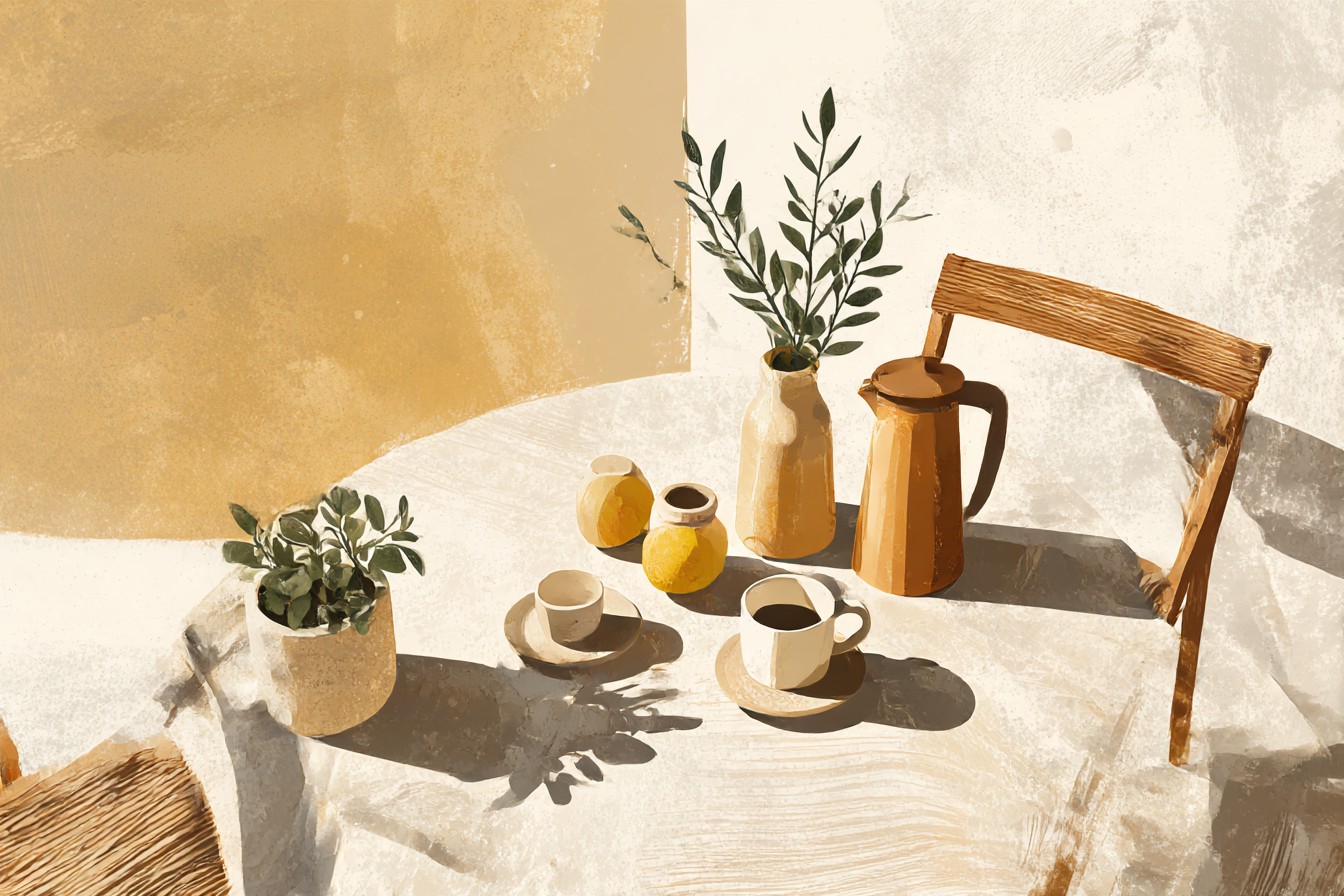
I counted the other day, out of pure nosiness about my own habits, and I go out to that patio table roughly eleven times a day between April and October. Coffee in the morning. Laptop for an hour if the wifi reaches, which it mostly doesn’t, so really it’s just me pretending to work outside for twenty minutes before I give up. Lunch out there most days. A gin and tonic around six that has become so reliable my sister now texts to ask what time she should “coincidentally” arrive. Mail gets opened out there.

Bills get ignored out there. It is, without exaggeration, the hardest working surface on my entire property, working harder than the kitchen counter, and I include the counter I actually cook on in that comparison.
And yet for years I treated my patio table like it was a seasonal afterthought, something to fling a tablecloth over in June and forget existed by October, which is exactly the kind of thinking that cost me a perfectly good wrought iron set to rust back in the early 2000s because I left the cushions out through one wet November convinced “it’s basically covered by the porch roof” was a weatherproofing strategy. It was not. I’d like to have a word with the woman who thought a porch roof counted as protection from Missouri weather, because Missouri weather does not respect roofs, overhangs, or her confidence.
What actually goes on top of a patio table, and what should live there permanently versus what needs to come in and out depending on the month, turns out to be a more interesting question than I expected when I started paying attention to it properly. There’s a difference between what looks good in a magazine spread of somebody’s staged outdoor dining set and what survives an actual season of use, sudden downpours, a dog that thinks the table is a diving board, that kind of thing. Some things need to be out there every single day from April through the first hard freeze. Some things need to disappear the second a forecast turns. And some things I’ve bought, loved for exactly one summer, and quietly retired without ever telling anyone, which I suppose I’m telling you now.
So this is really an inventory of what earns its place on that surface across a full year outdoors, sorted by what it’s actually for rather than by how it photographs, because I’ve learned the hard way that those are two very different lists.
[Patio Table]
The Everyday Layer: Things That Live Out There Permanently
Every patio table needs a base layer, the stuff that stays put from the day you set the table out until the day you bring it in for winter, and mine hasn’t changed dramatically in about fifteen years because when something works outdoors, I genuinely don’t mess with it. A proper weighted umbrella base, the kind that takes actual sand or water rather than the flimsy plastic ones that tip in a stiff breeze, is non negotiable. I went through two cheap ones before I bought a cast iron base in 2011 that has outlasted three umbrellas sitting on top of it and shows no sign of quitting, which tells you something about where the money should actually go.
Then there’s the tabletop itself needing something to protect it, and this is where I finally admit I was wrong about glass. I spent a decade convinced glass topped patio tables were the sensible, easy wipe down choice, right up until a hailstorm in 2016 put a crack straight across one and I stood there in my robe at seven in the morning watching it happen through the kitchen window, completely unable to do anything about it. Powder coated aluminum or a properly sealed teak surface has replaced glass in my life entirely, and neither has cracked, chipped, or given me a reason to stand outside in my robe again.
A lazy Susan or a simple turntable tray earns its spot too, less for looks and more because it stops the daily scramble of passing the salt across a table that’s six feet wide because someone, and I will not name names beyond saying it’s my sister, insisted on the biggest table the patio could physically fit. It fits eight people beautifully and requires the upper body strength of an Olympic athlete to reach the ketchup without one.
[Everyday Layer]
The Weatherproof Essentials Nobody Budgets For
Nobody wants to spend real money on things that are, by design, meant to sit outside and get rained on, which is exactly the mindset that has cost me more replacement candle lanterns than I care to add up. The instinct is to buy cheap because “it’s just going to get wrecked anyway,” and then you’re wrecked right along with it every March when you have to replace the same sad string lights for the third year running.
What’s actually worth spending on: a lantern or two with a genuinely weatherproof finish, not just a nice looking one, because there’s a specific kind of misery in watching a “decorative outdoor” finish bubble and peel after one humid Missouri August. I have a pair of powder coated metal lanterns from 2015 that have taken nine summers of storms, direct sun, and one memorable incident involving a raccoon, and they still look the way they did the day I bought them. Compare that to a set of “weather resistant” ceramic ones I bought in 2019 purely because they were pretty, which lasted one season before the finish crazed like an old dinner plate.
Solar lights have earned a permanent spot too, mostly because I got tired of running extension cords across the patio like some sort of tripwire course for guests. The good ones, the ones with an actual glass or polycarbonate housing rather than a thin plastic shell, will run three or four seasons without fading. The cheap ones from the discount bin fade to a sad gray by August, and I’ve bought that exact disappointment more than once, which is entirely on me for not learning the first time.
A weighted or clipped tablecloth, if you’re using one, needs actual weights or clips, not vibes and hope, because I have chased a tablecloth across the yard in front of neighbors enough times to know that a gust doesn’t care how nice the fabric is. LIFETIME WEATHERPROOF the tag said on one particularly optimistic set of outdoor cushions I bought around 2012, and within eighteen months they’d faded to a shade that had no business calling itself the same color, so I’ve stopped trusting that phrase entirely, on anything.
[Weatherproof Essentials]
Warm Weather Only: The Stuff That Comes Out in May and Disappears by September
There’s a second layer that only belongs out there for the genuinely hot stretch of the year, and knowing when to bring it in is half the skill of keeping any of it looking decent longer than one season. Citronella candles fall into this category, less because they can’t handle a bit of rain, they mostly can, and more because the wax turns to soup the second real heat hits and they’re useless by August anyway if left in direct sun all day.
Pitchers and drink dispensers are a warm weather fixture on my table specifically, the big glass kind with a spigot that I fill with something involving a lot of mint and pretend I grew myself, though truthfully I bought the mint at the store like everyone else. These come in the second the weather turns, because nothing ends a good outdoor drink dispenser faster than one freeze cracking the glass at the base, which happened to a lovely one I owned for exactly one season back in 2018, and I still think about it.
You Might Also Like

Cloth napkins in actual cotton or linen, rather than the paper ones I default to for casual weeknight dinners, come out specifically for the stretch when I’m entertaining more, May through Labor Day roughly, and they go straight into the wash and back into a drawer the rest of the year rather than living outside where humidity will have them smelling faintly of mildew by July, a lesson I learned exactly once and never repeated.
And a proper cushioned tray or trivet for hot dishes matters more in summer than any other season, because that’s when I’m actually cooking things that go straight from grill to table, and a table without something to protect the surface from a screaming hot cast iron pan is a table with a permanent scorch mark, which mine has, right in the center, a souvenir from around 2004 that I’ve simply decided to call “character” rather than admit fault about it every time someone asks.
[Warm Weather Layer]
The Cold Weather Shift Nobody Talks About
Most advice about patio tables stops dead the second summer ends, as though the table itself packs up and goes inside, and mine absolutely does not, not fully, because a St. Louis fall is genuinely one of the better reasons to be outside, cooler air, that particular gold light in the afternoon, and I refuse to give that up just because the calendar says October.
What changes is the layer on top. Out come the citrus scented candles and in comes something heavier, a cast iron fire bowl small enough to sit centered on the table itself, which I resisted buying for years thinking it was a gimmick, and then bought one in 2020 out of sheer boredom and have used constantly ever since, right through into early November most years.

Wool throws replace cotton ones, kept in a lidded bin right by the back door rather than draped permanently outside, because wool left in damp fall air will hold moisture and smell like a wet dog faster than you’d think, and I found that out the hard way with a throw I genuinely loved.
Mugs replace glasses almost entirely by mid October, and I keep a small stack of sturdy stoneware ones in a covered outdoor cabinet specifically for this stretch, rather than hauling them out from the kitchen every single time, because the stack disappearing back inside every night is exactly the kind of small friction that eventually means nobody bothers going outside at all.
And this is the stretch where I finally take the umbrella down and store the cushions properly, not “meaning to get to it” for three weeks the way younger me absolutely would have, because that’s the exact mistake that ruined that wrought iron set decades ago, and I have exactly zero interest in repeating a mistake I’ve already paid for once.
[Cold Weather Shift]
The Decorative Layer That Actually Earns Its Place
I’m generally suspicious of anything on a patio table that exists purely to look nice, because outdoor decor has a way of becoming outdoor clutter the second it stops being useful, but there are a small handful of things I keep out there year after year purely because they’ve never once made me regret the space they take up.
A simple galvanized metal tray, the kind sold for about twelve dollars at every garden center in America, has done more work in my outdoor life than almost anything I’ve spent real money on, corralling salt and pepper, sunscreen, a citronella candle, whatever’s currently living on the table, into one movable unit I can pick up entirely when rain’s coming rather than making six separate trips. I called it a nineties throwback the first time I saw one back at a garden show, which might say more about how much I’ve seen over the decades than about the actual tray, because it turns out this exact idea has been quietly right the whole time.
A small potted herb, basil in summer, a hardy rosemary that survives right into November, sits center table more for the smell when you brush past it than for looks, and it’s the one piece of “decor” that’s also functional, since I’m usually pinching leaves straight into whatever I’m cooking.
Everything else, the seasonal runners, the little painted signs, the string of fairy lights shaped like something novelty I bought once at a garage sale, gets rotated in and out depending purely on mood, and none of it matters nearly as much as getting the functional layer right first.
[Decorative Layer]
Final Thoughts
If there’s a single thing three decades of patio tables has taught me, it’s that the table itself is almost never the problem, it’s what you do and don’t leave sitting on top of it through a full year of actual weather that determines whether the whole setup still looks decent by the time you’re dragging the umbrella back out next spring. Buy the weatherproof lantern instead of the pretty one. Bring the cushions in before the forecast tells you to, not after. Trust the galvanized tray over your own instinct that it’s somehow beneath you.
None of this needs to be complicated, and most of it isn’t expensive, it just needs someone to have already made the mistake so you don’t have to. I’ve made most of them. The rusted iron set, the cracked glass tabletop, the tablecloth chasing itself across the yard in front of people I’ll be seeing again at Thanksgiving. Consider this the shortcut past all of that, straight to eleven trips a day out to a table that’s actually ready for whatever season you’re currently in.