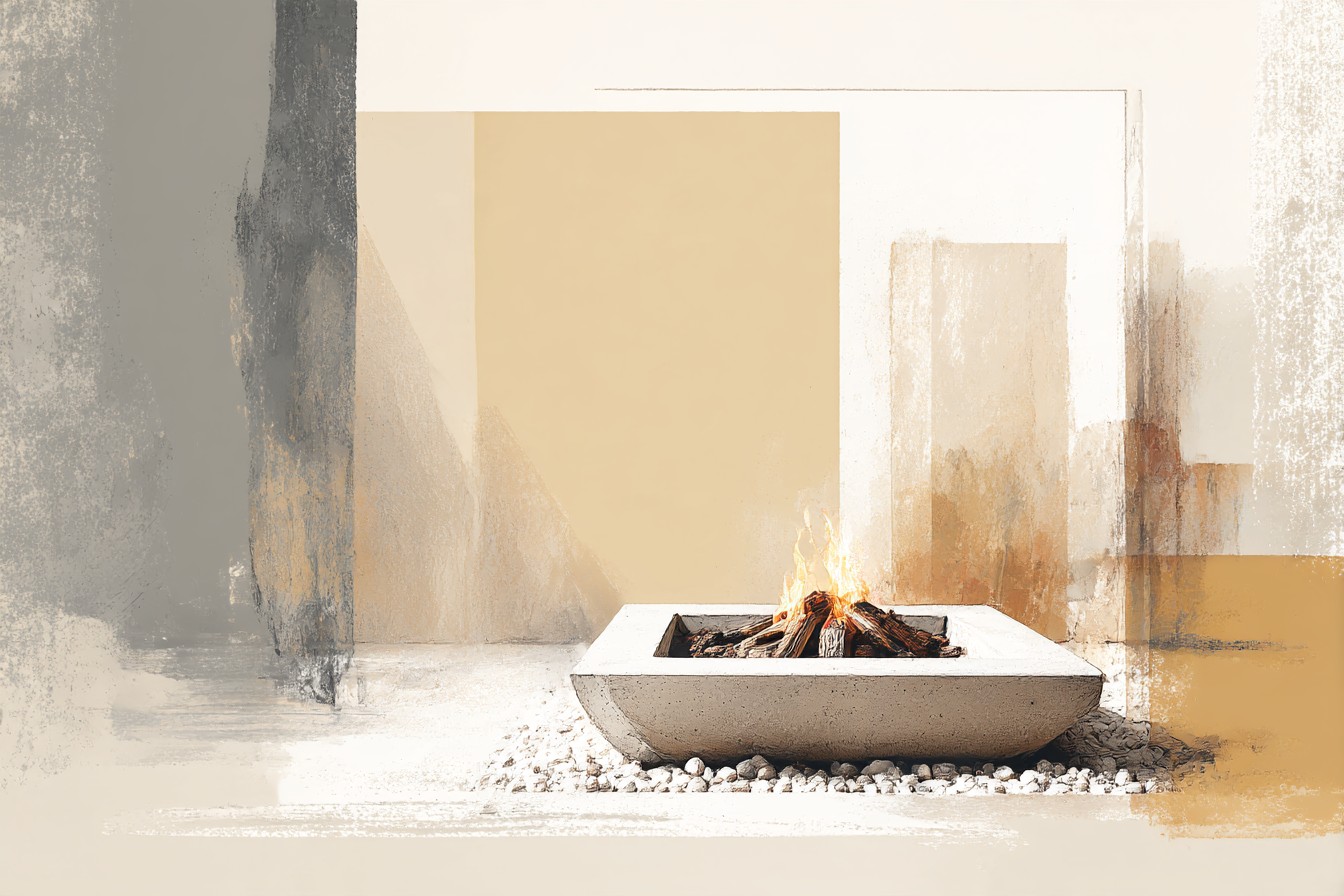
I think about my fire pit more than is probably normal for a grown woman with a real job. Four nights a week, minimum, March through November, I am out there with a glass of something and a dog who thinks the flames are for her personal entertainment. That is a lot of hours logged next to a thing that, if I am honest with myself, I built wrong the first time and got lucky about.
Here is the actual question people ask me, usually leaning over my fence with a beer in hand. Can you use concrete for a fire pit. And my honest answer, the one I would not give you in a store because nobody in a store wants nuance, is yes, and also please slow down, because concrete and fire have a complicated relationship that most folks find out about the hard way, which usually means a loud crack at ten at night and a chunk of something landing near your shoe.
The short version, the one worth remembering even if you forget everything else in this piece, is that ordinary concrete holds moisture the way an old sponge does, quietly, in every little pore, even after it looks bone dry to you. Heat that concrete up fast, the way a real wood fire does, and that trapped water turns to steam faster than it can escape.
Steam wants room. Concrete does not want to give it any. Something has to lose that argument, and it is usually a piece of your fire pit, flying off with more force than you would think a garden feature capable of. It is called spalling if you want the proper word for it, though I have also heard it called “the pit just popped at me” by a neighbor of mine named Dale, who found this out standing about four feet too close.
So this piece is not a list of pretty concrete fire pits for you to admire from a safe distance, though there will be some of that too, because bless it, some of them really are gorgeous. It is more me walking you through the different ways concrete shows up in a fire pit, which ones I trust, which ones nearly got me, and what I would actually build or buy if I were starting over in my own backyard tomorrow.
[Concrete Fire Pits]
Poured Concrete Fire Pits
I built one of these myself the first spring I owned a house with actual dirt attached to it, and I want to be upfront that I did it wrong. I mixed a standard bag mix, the kind meant for a garden path or a fence post, poured it into a ring form I’d knocked together out of scrap wood, let it cure a couple weeks, and figured I was done. Lit a fire that first cool night feeling very pleased with myself. About forty minutes in, there was a crack like a knuckle popping, except the size of a dinner plate, and a piece of the inner wall came away and landed in the coals.
Turns out standard concrete is rated for compressive strength, for holding weight, not for withstanding direct high heat with moisture still working its way out of the mix. It can take months, sometimes longer, for a poured slab to fully dry all the way through, not just on the surface where it looks and feels dry to your hand. Build a fire pit out of it and fire it up too soon, or ever really, and you are gambling on whether that moisture has fully left the building.
What I’d actually do now, having learned this the loud way, is either use a poured concrete surround as decoration around a proper metal fire bowl, never as the thing the flames touch directly, or use refractory concrete specifically, which is a different animal entirely, made to handle repeated high heat without holding onto water the same way. If someone at the store cannot tell you whether what they’re selling is refractory rated, that is your answer right there. Walk on.
[Poured Concrete Fire Pits]
Salvaged Concrete Fire Pits
Now this is where my actual heart lives, if I am being honest, because I have spent a decade going through salvage yards for chairs and dressers, and it turns out old concrete vessels show up in those same yards more often than you’d expect. Washtubs, old planters, even a chunky concrete mixing trough I found behind a stack of identical cinder blocks at a yard outside Pooler that I’d nearly written off from the gate.
I got that trough home, scrubbed it out, put a little gravel in the bottom, and lit a fire in it feeling like the smartest woman in Chatham County. Twenty minutes later, hairline cracks running up the side, then a small chunk gone, same story as my poured pit, just a different vessel telling me the same lesson. That trough had probably spent forty years outdoors soaking up rain and groundwater like it was its job, which it kind of was, and no amount of scrubbing was going to dry that out before I set a fire in it.
So here is my actual rule now, hard won. Salvaged concrete is wonderful for the look, for the surround, for the thing your eye lands on, but I never let old, unknown concrete take direct flame anymore. I use it as the shell and drop a steel fire ring or bowl inside it, which gives me the aged, weathered look I actually went hunting for in the first place without betting my eyebrows on whatever that concrete has been quietly absorbing since the Carter administration.
[Salvaged Concrete Fire Pits]
Prefab Concrete Fire Pit Kits
The stacked block kits, the kind you see at the big home stores with the interlocking curved pieces that build up into a ring, these are a different situation entirely, and I want to give them their due because they solve the problem in a genuinely sensible way. Most of them are not asking the concrete to be the fire chamber at all. They use the blocks purely as a retaining wall, dry stacked, no mortar, with a steel insert or fire ring doing the actual job of holding the flame and the heat.
You Might Also Like

I helped a coworker put one of these together two summers back, an afternoon project, no tools beyond a level and some patience, and the thing has held up fine through plenty of use since. The blocks stay cool enough to sit near because they are one step removed from the fire itself, and because they are manufactured rather than salvaged, you are not carrying decades of unknown moisture history into the build. That matters more than people think.
My only real gripe is that some of the cheaper kits skimp on that inner liner, or sell it as a separate accessory you have to know to look for, and I have seen folks stack the blocks, drop wood straight inside, and light it without ever adding the actual fire rated component the kit was designed around. Read the box twice. If there is no mention of a steel liner or fire ring included, assume there isn’t one, and go find one separately before you light anything.
[Prefab Concrete Fire Pit Kits]
GFRC and Concrete Look Fire Pits
This one surprised me the first time a dealer explained it to me properly, standing at his stall going through a fire bowl I’d assumed was solid poured concrete because it looked exactly like it. GFRC, glass fiber reinforced concrete, is thinner, lighter, and made with additives that change how it handles moisture and heat compared to the standard stuff. A lot of the sleek, modern looking fire bowls you see now, the ones with the clean lines and the smooth matte finish, are actually GFRC rather than traditional poured concrete, built specifically with fire pits in mind.
I own one of these now, a low round bowl I picked up because it looked like poured concrete but weighed about a quarter of what my old trough did, which should have tipped me off immediately that something different was going on underneath. It has taken two full seasons of regular fires without a single crack, and I have been rougher on it than I should probably admit, including one night I built a fire embarrassingly larger than the bowl was designed for because a friend brought too much wood and neither of us wanted to say so.
If you love the concrete look but do not love the idea of gambling with an unknown pour, this is genuinely the smarter buy, and I say that as someone who usually prefers the real, aged, provenance having thing over the manufactured lookalike.
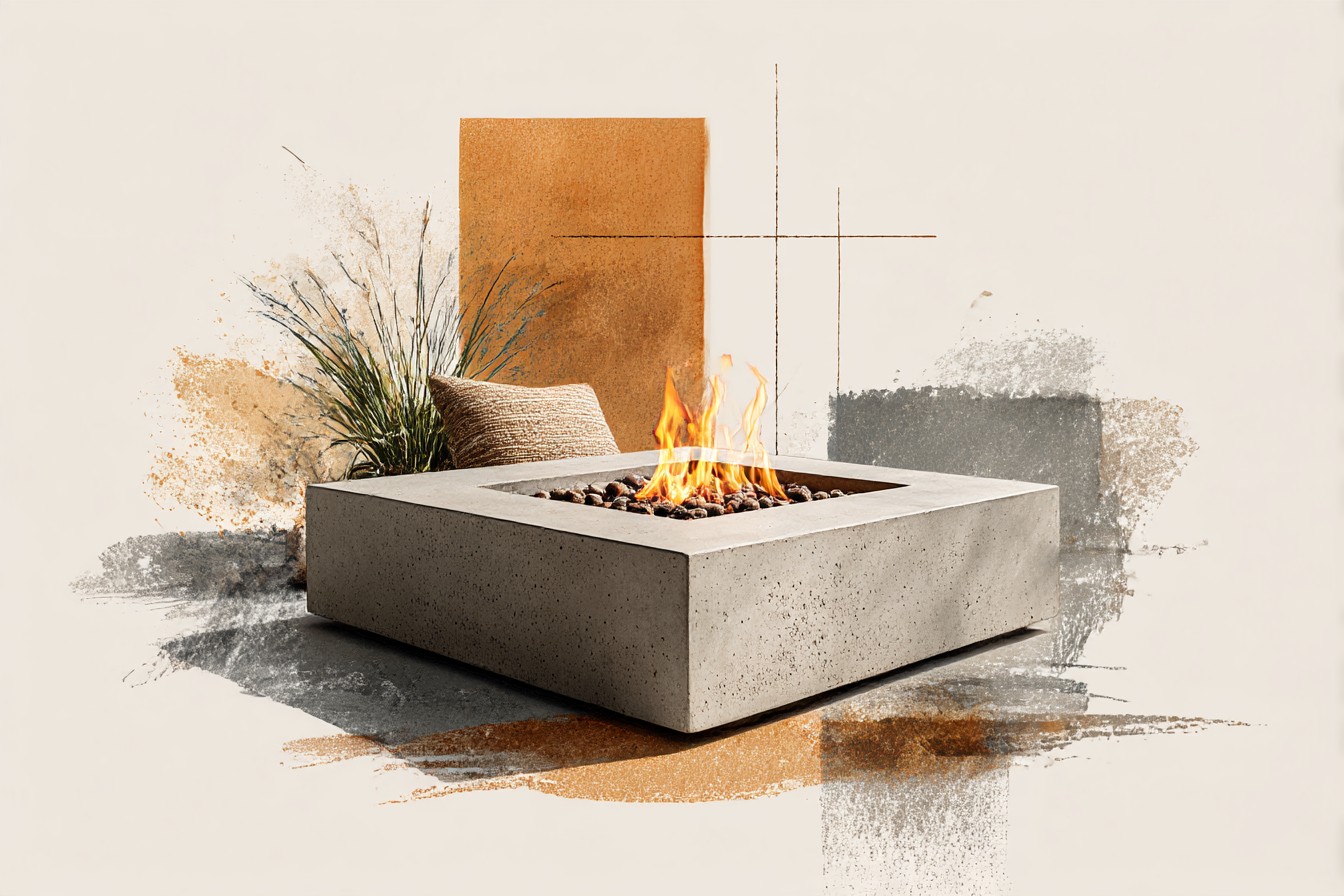
Sometimes the lookalike is the actually sensible choice.
[GFRC and Concrete Look Fire Pits]
Steel Lined Concrete Fire Pits
If you take one practical thing from this whole ramble, let it be this section, because this is what I would actually build in my own yard again tomorrow, no hesitation. Concrete surround, whatever shape or salvage find or poured design makes your heart happy, with a proper steel fire ring or bowl insert doing all the actual work of containing the flame.
The steel takes the direct heat and handles the expansion and contraction fires demand of a material. The concrete stays back a step, doing what it does best, which is looking good and holding its shape and giving you that solid, grounded feel a fire pit ought to have. I finally rebuilt my original backyard pit this way after the popping incident, and I will tell you, seeing the whole thing come together, old trough shell around a proper insert, no cracks, no drama, felt like the one time all week I’d actually gotten something right on the first real attempt.
Elevate it slightly off bare ground too, a few inches of gravel or a paver base underneath, because ground moisture wicking up into concrete from below is just as much a culprit as rain from above, and it is the kind of thing nobody thinks to mention until it has already ruined an evening.
[Steel Lined Concrete Fire Pits]
Final Thoughts
So can you use concrete for a fire pit. Yes, with an asterisk the size of a dinner plate, which coincidentally is about the size of the piece that came off my very first attempt. The material itself is not the villain here, trapped moisture is, and once you understand that one fact, every decision after it gets a lot easier to make.
I still love the look of concrete more than almost anything else I put in a backyard, the weight of it, the way it ages, the fact that a good salvaged piece carries forty years of somebody else’s life before it ever gets to mine. I am just done letting it take direct flame without a steel buffer between the two of them. That one change, more than anything fancy or expensive, is what actually keeps a fire pit safe through years of regular use rather than one dramatic, cracking, slightly singed evening you tell people about for years afterward, the way I still tell people about mine.



[…] because the risk here is genuinely different, not just a matter of degree. Cinder block and concrete block are not fired clay, they’re a cement based product, and cement can hold moisture inside its structure in a […]