I have measured the distance between my fire pit and my deck railing four separate times this summer, with an actual tape measure, standing there in my socks like a woman conducting a very small, very specific safety inspection nobody asked her to run. Four times. Not because the number changed. Because I didn’t trust myself to have gotten it right the first three.
That’s roughly how often I use the thing too, once a week from May through September, sometimes twice if the weather’s being generous, which in Boston it rarely is. So we’re talking about a piece of equipment I light, sit around, and then anxiously stare at, on a wooden structure attached to my house, dozens of times a year. At some point that adds up to enough exposure that “is it safe to put a fire pit on a deck” stops being a hypothetical Google search you do once before buying one and becomes a question you should honestly be re-asking yourself every single season, because decking degrades, fire pits get replaced with bigger ones, and your own habits get lazier the more comfortable you are.
I typed that exact phrase into Google at eleven at night about three years ago, half convinced I was being paranoid, half convinced I was about to read something that would ruin my whole plan for the summer.

What I actually found was a mess of forum posts, some genuinely useful, some written by people who seemed to think a fire pit on composite decking was basically arson with extra steps. The truth, once I stopped doom scrolling and started thinking properly, sits somewhere in the middle and it’s less mysterious than it looks. It comes down to three things, really. What flies out of the fire. How far it is from things that burn. And whether you’ve got a way to put it out fast if something goes wrong. Everything else is detail dressing on top of those three questions.
So that’s what this is. Not a lecture, I promise, I’m not your homeowners insurance agent. Just an honest walk through the actual risk, the actual gear that reduces it, and the actual mistakes I’ve made along the way, including one where a spark landed on my dog’s bed and I did not notice for an embarrassingly long time.
[Fire Pit Safety]
The Mat Underneath Is Doing More Work Than You Think
Here’s the thing nobody tells you when you buy your first fire pit: the fire itself is rarely the problem. It’s the sparks that jump the rim while you’re not looking, the little embers that pop off a log and land somewhere you weren’t watching because you were busy arguing about whether marshmallows go on before or after the fire’s properly settled. Those embers are small. They’re also hot enough to scorch composite decking and set actual wood decking smoldering without you noticing for a good ten or fifteen minutes, which is exactly long enough for a small problem to become a genuinely bad one.
This is where a proper fire pit mat earns its keep, and I mean a real one, rated for the job, not a doormat you had lying around that you’ve decided counts because it’s technically fireproof adjacent. I ran a wood burning fire pit directly on my composite decking for one summer with nothing underneath it because I was certain, absolutely certain, that the pit’s own base kept enough distance. It didn’t. I ended up with a faint scorched ring about the size of a dinner plate that I now strategically cover with a planter, permanently, because replacing composite decking boards is not a Saturday project, it’s a whole weekend and an argument with your budget.
A mat rated for high heat sits under the pit and catches what escapes, the embers, the ash, the occasional log that shifts wrong and rolls further than it should. It won’t save you from genuine neglect, nothing will, but it buys you the margin that a single stray spark actually needs to not become a scorch mark or worse.
[Fire Pit Mats]
Propane Changes the Whole Conversation
I resisted propane fire pits for years, and I want to be honest about why, because it wasn’t a safety reason, it was a snobbery reason. I thought a wood fire was the “real” version and gas was for people who wanted the aesthetic without the commitment. That opinion did not survive contact with actually living on a deck.
A propane or natural gas fire pit produces a controlled, contained flame with no burning logs to shift, split, or throw embers when they collapse. There’s no ash to manage, no popping sap, no rogue spark launching itself six feet because a piece of wood had a pocket of moisture in it. For deck use specifically, this matters enormously, because the single biggest variable you can’t fully control with a wood fire is what the wood decides to do while it’s burning. Gas takes that variable off the table almost entirely.
That doesn’t mean gas pits get a free pass to sit wherever you like, they still throw real heat, and cheap ones with thin housings can transfer more of it to the surface underneath than you’d expect, which is its own quiet risk nobody markets on the box. But comparing the two honestly, if you’re specifically asking “is this safe on my deck,” a gas pit removes a whole category of danger that a wood one simply cannot.
I switched two summers ago. I still miss the smell, genuinely, there’s nothing gas replicates there. But I don’t miss checking the deck boards at midnight with a flashlight, and that trade has turned out to be worth more to me than the smell ever was.
[Propane Fire Pits]
A Screen Isn’t Optional, It’s the Cheapest Insurance You’ll Buy
If you’re running a wood fire on a deck at all, a spark screen isn’t a nice extra, it’s close to mandatory, and I will die on this hill. It’s a mesh dome that sits over the flame and physically stops embers from launching out sideways, which is exactly the failure mode that causes most deck fires, not the fire itself, the bit that escapes it.
I didn’t own one for the first year I had a fire pit, because it felt like an accessory for people who worried too much, and then a friend of mine, Callum, came round for a fire and a log spat an ember clean across his shoulder while he was mid sentence about something completely unrelated. It didn’t burn him, he was wearing a jacket, but it burned a small hole straight through the sleeve and he was, understandably, not thrilled. I bought a screen the next morning.
You Might Also Like

Here’s what actually matters when picking one. It needs to fully enclose the fire, not just sit loosely over the top, gaps at the base defeat the entire point. It needs to be sturdy enough that a log rolling against it doesn’t just knock it over, because a fallen screen is worse than no screen, it gives you false confidence right up until it doesn’t. And it needs a handle you can actually use without getting close enough to singe your eyebrows off, which sounds obvious until you’re holding one at ten at night trying to add another log.
Nine dollars for a flimsy version that buckles the first time a log leans against it is not a safety product, it’s a prop. Spend properly here. This is not the corner to cut.
[Spark Screens]
Getting the Flame Off the Deck Surface Entirely
There’s a category of fire pit that solves the deck problem almost by design, and it took me embarrassingly long to notice it existed, given how obvious it sounds once you say it out loud. Elevated fire pits, the kind that sit up on proper legs rather than a low flat base, put more distance between the flame and the decking than a squat bowl-style pit ever will, and that distance is doing quiet, unglamorous, extremely important work.
Radiant heat drops off fast with distance, faster than people assume, so even a few extra inches between the fire and the boards underneath can be the difference between a scorch mark and nothing at all. Combine that with a mat underneath and you’ve genuinely stacked two separate layers of protection rather than relying on one and hoping.
I’ll admit the aesthetic sold me before the safety logic did, if I’m being properly honest with you. The elevated ones look better on a deck, less like a hazard, more like furniture that happens to be on fire in a controlled and attractive way. But the safety case turned out to be just as strong as the visual one, which almost never happens, usually you’re trading one for the other. Here it’s not really a trade.
If you’re deck-only, never planning to move the pit to grass or gravel, an elevated design earns its keep twice over. Higher off the surface, generally a smaller contact footprint, and it forces you to think about clearance in a way a low flat pit lets you conveniently ignore.
[Elevated Fire Pits]
The Water Bucket Is Not Optional Either
I want to say something plainly, and I want it to land the way it’s meant to. If you cannot extinguish your fire pit in under thirty seconds, you should not be running it on a deck. Full stop. Not a maybe, not a “well it’s probably fine,” an actual full stop.
That means a hose within reach, or at minimum a full bucket of water sitting right there, not in the garage, not “just inside,” right there beside the pit for the entire time it’s lit. I also keep a small fire extinguisher rated for the job in the cupboard nearest the door, and I checked its date properly last spring after realizing mine had quietly expired two years earlier while I’d been assuming it was fine because it was still sitting there looking official.
A garden hose left coiled thirty feet away doesn’t count, by the way. Neither does “I’ll just go fill the kettle.” The whole point of having water close by is that it’s close, immediately, before a small problem becomes a genuinely frightening one. I’ve had exactly one moment where a gust caught the fire wrong and threw sparks further than I expected, and the only reason it stayed a non-event is that the bucket was sitting eighteen inches from my foot and I didn’t have to think, I just moved.
Buy the extinguisher. Fill the bucket. Do it every single time, not just the times you remember to.
[Fire Safety Kits]
Final Thoughts
So, is it actually safe to put a fire pit on a deck? Yes, with real conditions attached, and none of those conditions are complicated once you strip away the forum panic. Put something underneath it. Keep it further from the railing and the house than feels strictly necessary, because your sense of “far enough” is worse than you think it is. Screen your sparks if you’re burning wood.
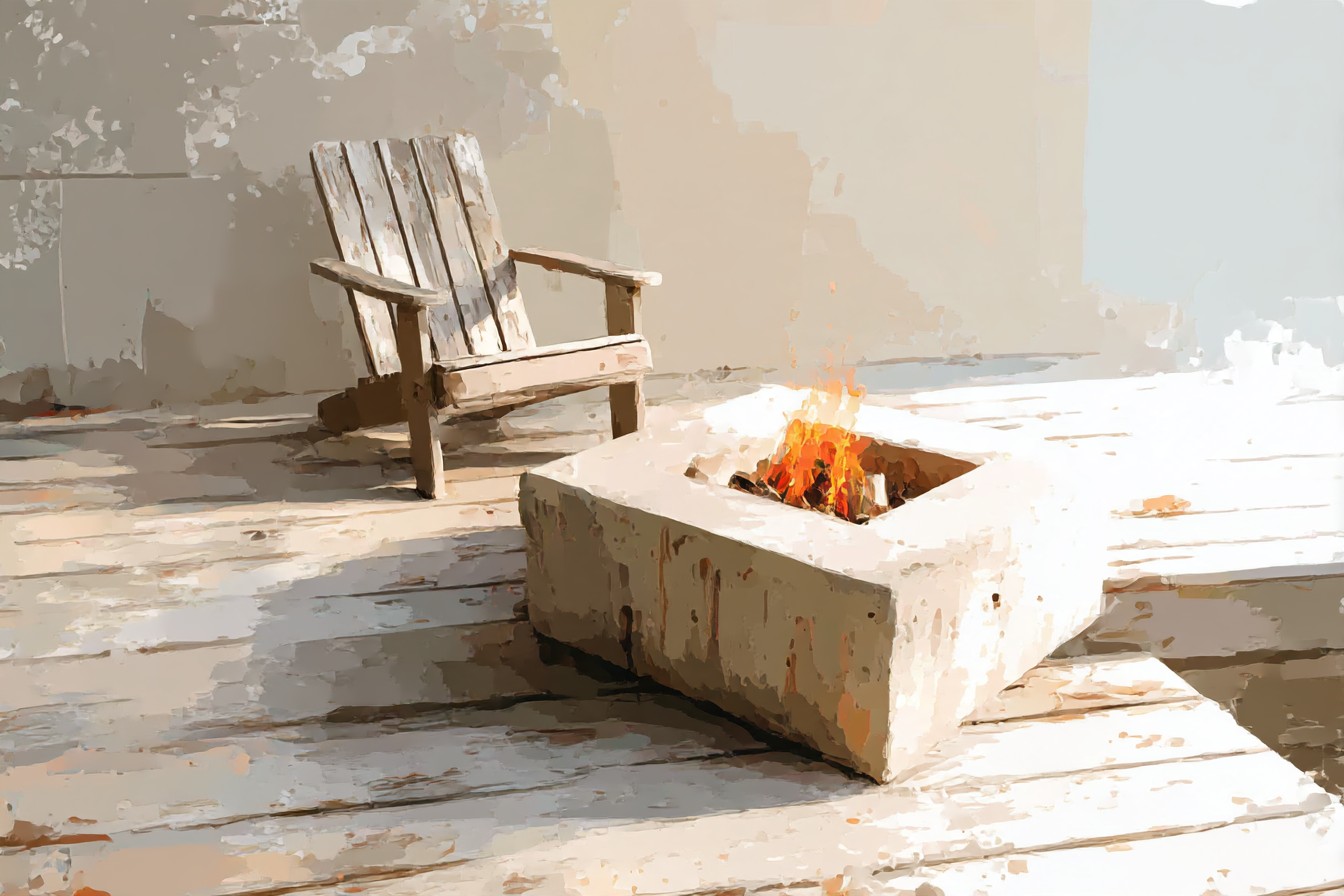
Consider gas if you want a chunk of the risk removed before you’ve even lit anything. And have water close enough to touch without standing up properly.
None of that requires spending a fortune, and none of it requires giving up the actual point of the thing, which is sitting outside in October with a blanket and a drink, watching a fire do what fires do. I still run mine most weeks. I still check the distance more than any reasonable person should. But I’ve stopped treating that checking as paranoia and started treating it as maintenance, the same way you’d check smoke detector batteries or clean out a dryer vent, unglamorous, easy to skip, genuinely the whole reason nothing’s gone wrong yet.
The mistakes I’ve made along the way, the scorch mark, the melted sleeve that wasn’t even mine, the expired extinguisher I only found by accident, all of them were avoidable with about twenty dollars of gear and slightly more attention than I was giving it at the time. That’s really the whole lesson. Fire pits aren’t dangerous on a deck. Being casual about them is.