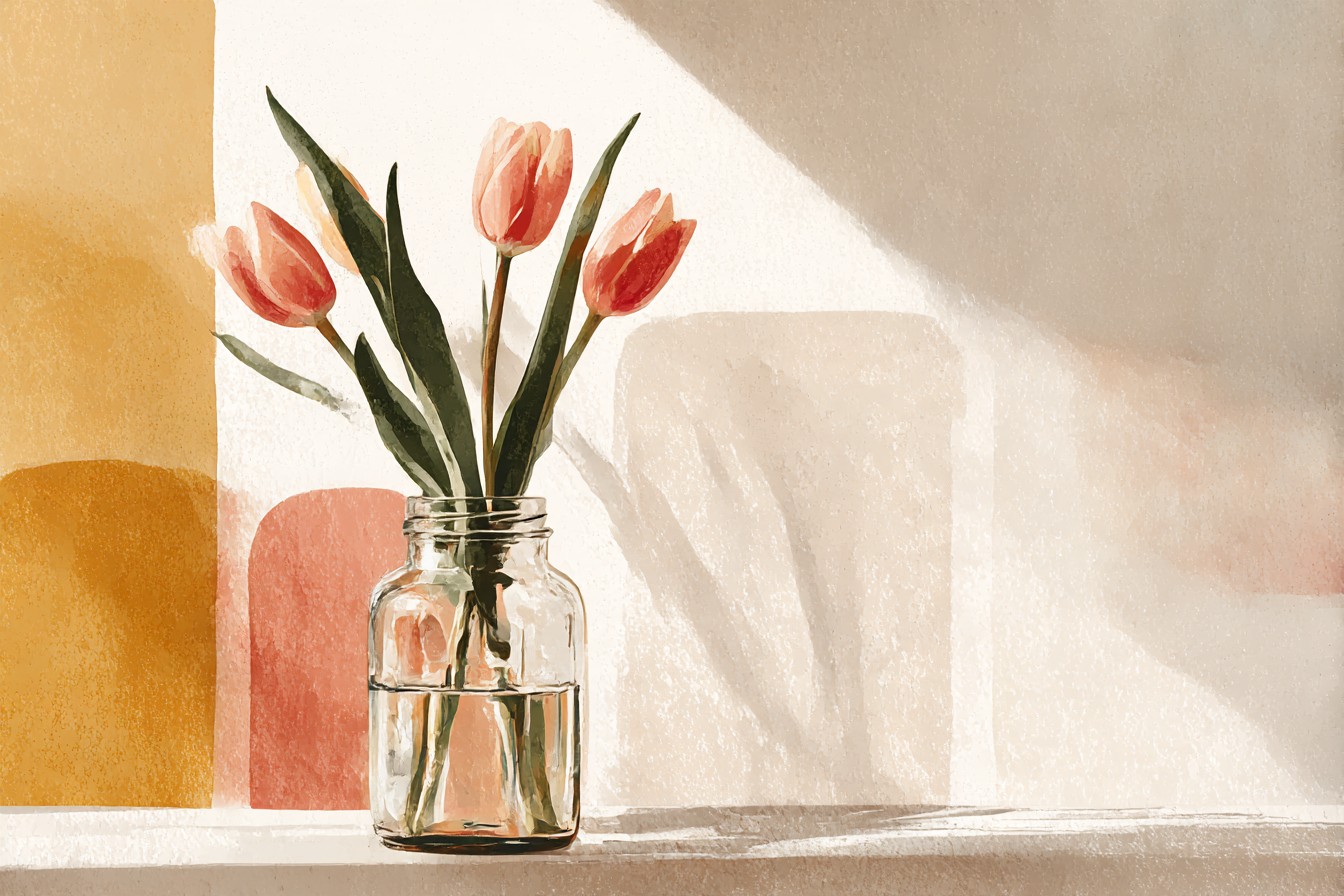
I bought a bunch of tulips from the guy who sets up outside the hardware store on Layton every March, back when Milwaukee is still gray sludge and everyone’s desperate for something with actual color in it. Got home, grabbed the nearest thing that could hold water, which happened to be an old pickle jar I’d been meaning to use for wood screws, filled it with hot tap water because that’s what came out of the faucet first, and dumped in a spoonful of sugar because somebody on the internet told me sugar was the secret. Stems went in crooked. Didn’t cut them. Didn’t think about it twice.
By the next morning those tulips had flopped over the side of the jar like they’d been out drinking. By day three the water had gone the color of weak tea and there was a smell coming off it that reminded me of a gym bag left in a truck bed for a week.

I dumped the whole thing, felt a little defeated by a bunch of flowers that cost me eight bucks, and figured tulips just weren’t built to last.
Turns out I’d approached the whole thing backwards, which is embarrassing to admit for someone who spends his working life thinking about how things are actually put together before deciding whether they’re any good. I treated it like a design problem, pick a nice vase, stick the flowers in, done. It’s not a design problem. It’s a construction problem, same as anything else that has to hold weight, resist gravity, and not fall apart under conditions it wasn’t built for. Tulips keep growing after you cut them. They bend toward light. They drink unevenly. The water they’re sitting in either helps that process or actively works against it depending on what’s in it and how often you touch it. Once I started thinking about it that way, the whole thing got a lot less mysterious and a lot more like assessing a job before I quote for it.
This isn’t really about buying a fancier vase, though shape matters more than people think. It’s about a handful of specific habits, the kind of thing you do without noticing once you’ve done it enough times, that decide whether your tulips make it to day nine looking upright and decent or day three looking like something you should apologize to.
[The Vase Habit That Keeps Tulips Fresh]
What Actually Goes In the Water
Everyone’s got a theory. Penny in the bottom for the copper. Aspirin crushed up because it’s supposedly antibacterial. A splash of vodka. A capful of soda. I’ve heard grown adults defend all of these with total confidence and none of them do what people think they do, at least not reliably enough to matter.
Here’s what’s actually happening in that water, broken down the way I’d break down a joint before deciding if it’s doing its job. You need three things handled. Food, because the flower’s cut off from the plant that used to feed it. Acidity, because water that’s too alkaline makes it harder for the stem to actually pull water up through itself, which is the whole point. And something to stop bacteria from setting up shop, because bacteria clog the stem’s internal plumbing faster than almost anything else, and that’s usually why tulips go limp before they even wilt.
That little paper packet that comes taped to the flowers from the grocery store, the one everyone throws away without opening, does all three of those jobs at once. Use it. If you don’t have one, a teaspoon of sugar and a couple drops of household bleach in a quart of water does a rough version of the same thing, sugar for food, bleach to keep the bacteria count down. Skip the penny. Copper in the amount one penny gives off does basically nothing, and I say that as someone who respects a good bit of scrap metal doing real work elsewhere in the house.
The water itself matters too. COLD, not hot, not lukewarm, tulips actually prefer it cooler than most people assume, and it slows down how fast they open up and flop outward, which for tulips is basically the beginning of the end.
[What Goes In the Water]
Vase Shape: Narrow Necks and Why They Matter
Tulips don’t stop growing once you cut them, which nobody warned me about the first dozen times I bought them. They can gain close to an inch after they’re in water, and they bend toward whatever light source is nearest, which in most kitchens means they start leaning sideways within a day, reaching for a window like they’ve got somewhere better to be.
A wide mouthed vase gives every one of those stems total freedom to do that. Nothing’s holding them in position, so they splay outward, cross each other, and eventually flop over the rim like they’re trying to escape. It’s the same reason you don’t build a shelf with no support running through the middle of a long span, given enough time and enough weight, everything finds the path of least resistance, and the path of least resistance for a tulip stem is sideways.
A vase with a neck narrower than its body works like a collar. It physically restricts how far each stem can travel, holds them close together near the top, and the tulips end up standing more upright even as they keep growing and getting heavier over the following days. It’s lateral support, plain and simple, the same principle as a stretcher rail keeping table legs from splaying under load. You’re not fighting the growth, you’re just giving it fewer directions to go.
If all you’ve got is a straight sided vase, you can rig something with clear tape across the top in a rough grid, which looks ugly for about a day until the leaves cover it, but it does the same structural job. Cheap fix, works fine, I’m not precious about it.
[Vase Shape]
Base Weight and Stability
Tulip heads get heavier as they drink, and by day four or five a full bunch of a dozen stems is carrying a decent amount of water weight up top, all of it working against whatever’s holding the whole arrangement upright. I learned this the hard way with a skinny dollar store bud vase that had a base about the size of a coffee mug bottom trying to support flowers leaning at increasingly dramatic angles. Came downstairs one morning to find the whole thing tipped over on the table, water everywhere, one tulip head bent at an angle that wasn’t coming back.
You Might Also Like

A base that’s too small for the height it’s supporting is an accident waiting to happen, same rule as a workbench with legs set closer together than the top surface, which my dad would take one look at and call unsafe before you’d even finished building it. Rough rule I use now, the base diameter should be somewhere around a third of the vase’s total height, more if the vase is tall or the flowers are a big bunch. Heavier glass at the bottom, or a ceramic vase with real weight to it, sits lower on the table and resists getting knocked or leaned over.
This matters more than people think because tulips are heavy relative to how thin their stems are, unlike something like a rose where the stem’s doing more of the structural work itself. The vase has to compensate for a plant that’s basically all top and not much bottom.
[Vase Stability]
The Daily Habit: Water Changes and Recutting
This is the part nobody wants to hear because it’s not glamorous, it’s maintenance, same as resealing a deck or checking the joints on a chair every couple years instead of waiting for it to collapse under someone at Thanksgiving.
Change the water every two days. Not when it looks cloudy, before that, because by the time it looks bad the bacteria’s already been working on those stems for a while. Dump it completely, rinse the vase, refill with fresh cold water and another small dose of preservative or the sugar and bleach combination if that’s what you’re running with.
Every time you change the water, recut the stems. About half an inch, at an angle, under running water rather than in the air. Cutting underwater matters more than people believe, it stops an air bubble from forming and getting sucked up into the stem, which blocks water uptake as effectively as a kink in a hose. I ignored this for years and couldn’t figure out why some bunches lasted ten days and others gave up after four, and it came down almost entirely to this one habit.
Pull off any leaves that end up sitting below the waterline. They rot fast, and rotting leaves in standing water are basically a bacteria factory working against every other thing you’ve done right. This one’s easy to miss because tulip leaves are broad and tend to slump down into the water on their own without you noticing until the water’s already gone cloudy again.
[Daily Habits]
Where You Put It: Temperature and Light
Placement does more work than people give it credit for. Direct sun through a window looks nice for a photo but it speeds tulips through their whole lifecycle in about half the time, same as leaving anything organic in direct heat. They’ll open fast, look spectacular for about a day, then blow past their best and start dropping petals while you’re still admiring them.
Keep them somewhere cool, out of direct sun, away from radiators or heating vents, and definitely away from the fruit bowl. Ripening fruit gives off ethylene gas, and tulips are genuinely sensitive to it, it pushes them toward wilting faster than almost anything else in the house. I didn’t believe this until I put a vase next to a bowl of bananas going soft on the counter and watched that bunch fade a full three days ahead of an identical bunch sitting on the other side of the kitchen.
Some people put tulips in the fridge overnight, which sounds excessive but actually works, it slows the whole process down and can buy you an extra couple of days if you’ve got somewhere to keep them and don’t mind the routine. I don’t bother most weeks, but if I’ve got tulips I actually want to last through a weekend with people over, I’ve done it, and it’s a small effort for a decent return.
[Placement and Temperature]
Final Thoughts
None of this requires spending real money on a fancy vase.

The pickle jar disaster that started all this wasn’t a vase problem, not really, it was hot water, no cutting, sugar with nothing to back it up, and a spot on the counter that got afternoon sun. Every one of those was a habit, not a purchase.
If I had to rank what actually moves the needle, it’s the water changes and the recutting first, by a wide margin, then the shape of the vase for keeping stems upright as they grow, then the base weight so the whole thing doesn’t end up on the floor, then placement out of sun and away from fruit. Get those four things roughly right and eight dollars of tulips from a guy on a street corner will hold up for well over a week, which felt impossible to me for a long time.
I still think about flowers the way I think about furniture, what’s actually load bearing, what’s just there for looks, what fails first under real conditions instead of ideal ones. Turns out tulips reward exactly that kind of attention. Not fussy attention, just consistent, slightly boring maintenance done on a schedule instead of once and forgotten. Cut them right, change the water before it needs it, give the stems something to lean on that isn’t each other, and keep the whole arrangement somewhere cool. That’s the entire job. No vase in the world does that work for you if the habits around it are wrong.