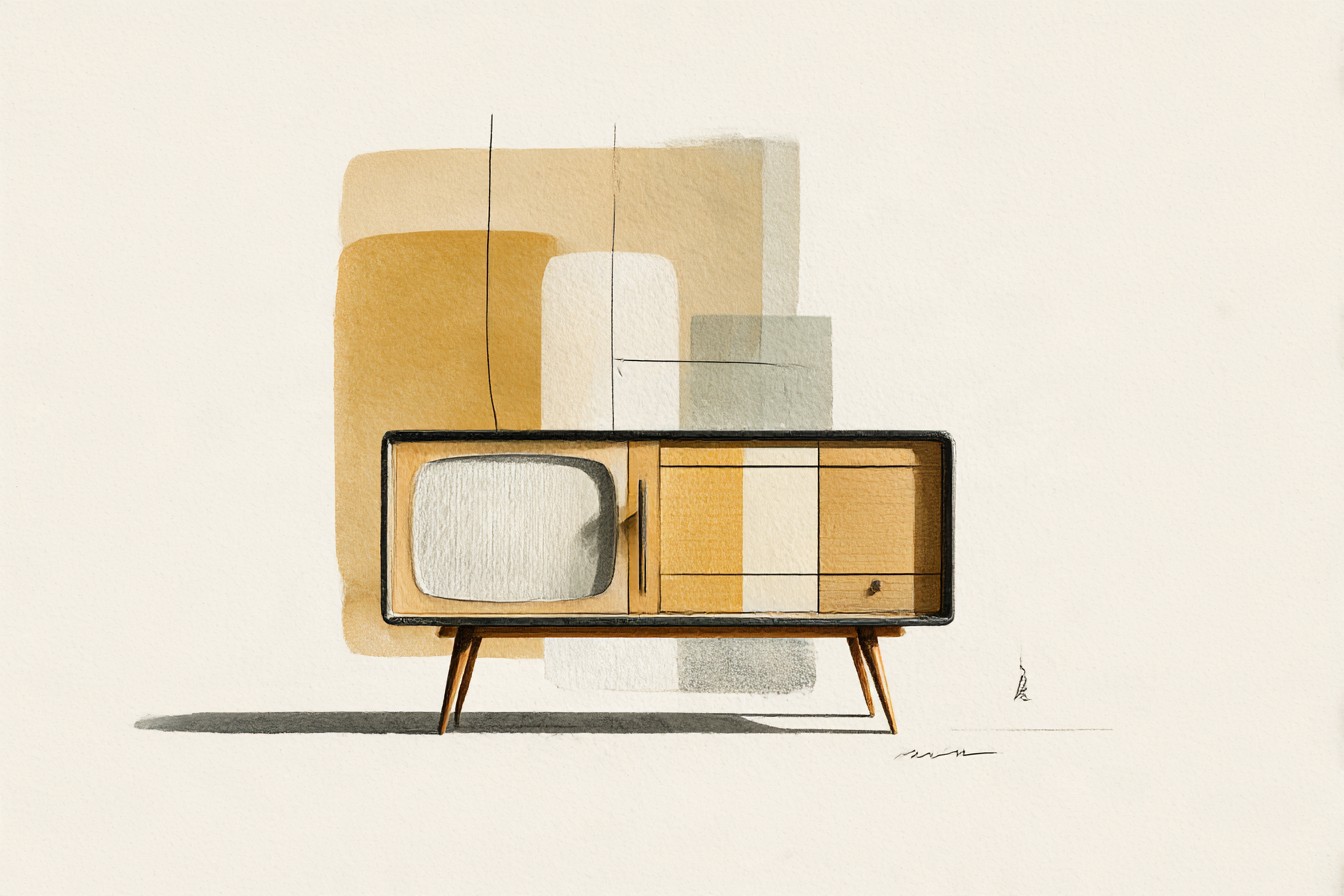
I own six floating TV stands. Not six television sets, not six living rooms that need filling, six actual console units built or marketed under that particular name, and three of them have never once been mounted to a wall in their working lives. I counted them properly before sitting down to write this, expecting to stop at three or four and feel smug about it, and instead I got to six and had to sit with that for a minute. Six is a number that requires an explanation, not a shrug.
Here is roughly how it happened, across a house I have furnished and refurnished three separate times since the eighties, if you count the year we gutted the family room and I temporarily lost my mind over shiplap. The first floating stand came in around 2011, a walnut veneer piece from a furniture outlet off Manchester Road, bought specifically because the wall it was meant for was original plaster and lath, and I could not bring myself to drill four separate holes into a wall that old on the strength of an Allen key and a YouTube video. So it sat on the floor.

It has sat on the floor for thirteen years. The second one went into the basement, where the wall is cinderblock and mounting anything into it properly means a hammer drill I did not want to rent for a single Saturday afternoon. It sits on the floor too, and it is a slightly different animal, which is really what this whole piece is about.
Because here is the question I get asked more than any other about these things, usually by someone standing in a showroom holding a tape measure and looking faintly betrayed: can you actually put a floating TV stand on the floor, or are you just supposed to pretend the ground doesn’t exist. The honest answer is it depends entirely on what you bought, and whether the person who designed it ever imagined it there.
[Floating TV Stands]
Wall-Mounted Floating Consoles
The true floating stand, the one that comes with a cleat bracket and a diagram showing you exactly which studs to hit, was never designed with the floor in mind at all. Its whole structure assumes a wall doing the heavy lifting. The back is often unfinished particleboard, because nobody who engineered it thought you’d ever be looking down at it from above, and the underside carries the mounting hardware, visible slots and reinforced blocks that were meant to disappear against drywall, not sit exposed under a lamp’s glow. Set one of these on the ground instead, which is exactly what I did with my 2011 walnut piece, and the proportions go slightly wrong. These stands are usually designed to hang around sixteen to twenty four inches off the floor, at a height that reads as intentional and light. Down at ground level, that same silhouette reads as a very long ottoman that lost its cushion somewhere. Mine still has the mounting slots visible along the top back edge, and every single person who’s ever crouched down to plug something into the outlet strip behind it has asked what they’re for.
[Wall-Mounted Floating Consoles]
Floor-Set Floating Stands
Then there’s the version that was genuinely built to sit on the ground and still look like it’s floating, and this is the one that actually answers the question properly. The trick is a recessed base, sometimes called a plinth, set back several inches from the front face of the unit so a shadow falls underneath it and the eye reads that shadow as a gap rather than a foot. I bought one of these two years ago for the family room specifically because I’d learned my lesson with the walnut one, and it works. The base is painted matte black, deliberately, so it disappears into its own shadow even with the afternoon sun coming straight through the window behind it, which is the exact light condition that made the visible feet on cheaper versions look obvious in a showroom I won’t name. There’s an unexpected upside too. Because the whole thing rests on the floor rather than cantilevering off a wall bracket, it can carry more weight without anyone worrying about pulling the anchors out of drywall, which is a strange twist for a design whose entire reputation is built on looking delicate.
[Floor-Set Floating Stands]
You Might Also Like

Toe-Kick Console Tables
My sister redid her kitchen four years ago and got very evangelical about something called a toe-kick, the recessed strip along the bottom of cabinetry that lets the whole run of units appear to float a half inch above the floor. Furniture makers borrowed the same idea and ran further with it, and it’s a step up from the shallow plinth trick in the previous section. Instead of a couple of inches of recess, you get a deeper cutback, sometimes three or four inches, and the shadow it throws is dark enough to read as a real gap even in a bright room with the overhead lights on, which is where the shallower versions tend to fall apart under scrutiny. I have one in walnut veneer in the current living room, bought from a shop here in St. Louis rather than online, and it’s the only one of my six stands that a stranger has ever crouched down to inspect out of genuine confusion about whether it’s actually resting on the floor at all. It is. It just doesn’t want you to notice.
[Toe-Kick Console Tables]
Leg Kit Hybrids
Some manufacturers, to their credit, seem to have anticipated that not everyone renting an apartment is going to be allowed anywhere near a stud finder, and they sell the same stand two ways, either with a wall bracket or with a small leg kit that clips onto the same mounting points. I bought one of these hybrid versions during a stretch when a family member was renting and the landlord’s lease had language about wall damage specific enough to make anyone nervous. With the legs attached, it stops being a floating stand in any meaningful sense and becomes, functionally, a low console table with skinny metal feet, which is a perfectly fine piece of furniture but not the one pictured on the box. The trade off shows up in stability too. A centered single leg design can wobble slightly if you put a heavier television off to one side of the unit, because the weight distribution the designer assumed for wall mounting doesn’t hold once you’ve swapped the bracket for four small points of contact with the carpet.
[Leg Kit Hybrids]
Improvised Floor Conversions
And then there’s the one nobody selling these things wants to talk about, which is propping a genuinely cantilevered wall stand up on bricks, wood blocks, or whatever’s lying around, because you’ve decided you’re mounting it later and later never comes. I’ve seen a listing online claim a LIFETIME FLOATING GUARANTEE on a unit with four visible plastic feet screwed into the bottom, which is the kind of sentence that makes you wonder if anyone in that company has looked at their own product.

The cantilever design relies entirely on tension against a wall bracket to counteract the weight pulling forward, and propping the back end up on something loose on the floor doesn’t recreate that at all. It recreates a see saw with a television on the heavy end. I would not do it with anything holding a screen worth replacing, and I say that as someone who did exactly this for about six months in 2011 before finally admitting my walnut stand needed to just live as a floor piece rather than a half hearted floating one.
[Floor-Set Floating Stands]
Final Thoughts
So can you put a floating TV stand on the floor. Yes, obviously, gravity doesn’t care what the marketing copy says. Will it look like it was meant to be there is the actual question, and the answer depends entirely on whether the thing was engineered with a recessed base or a leg kit in mind, or whether it’s a cantilevered piece you’re quietly resting on the carpet and hoping nobody looks too closely at the mounting slots. I’ve now got six of these things across one house, which tells you I’ve made every version of this mistake at least once and eventually bought my way to the right answer, which is really just admitting I should have read the base design more carefully before checking out three separate times. The floor set ones with a proper plinth are the only category I’d buy again without hesitation. Everything else is either a compromise I made peace with or a lesson I paid full price to learn.