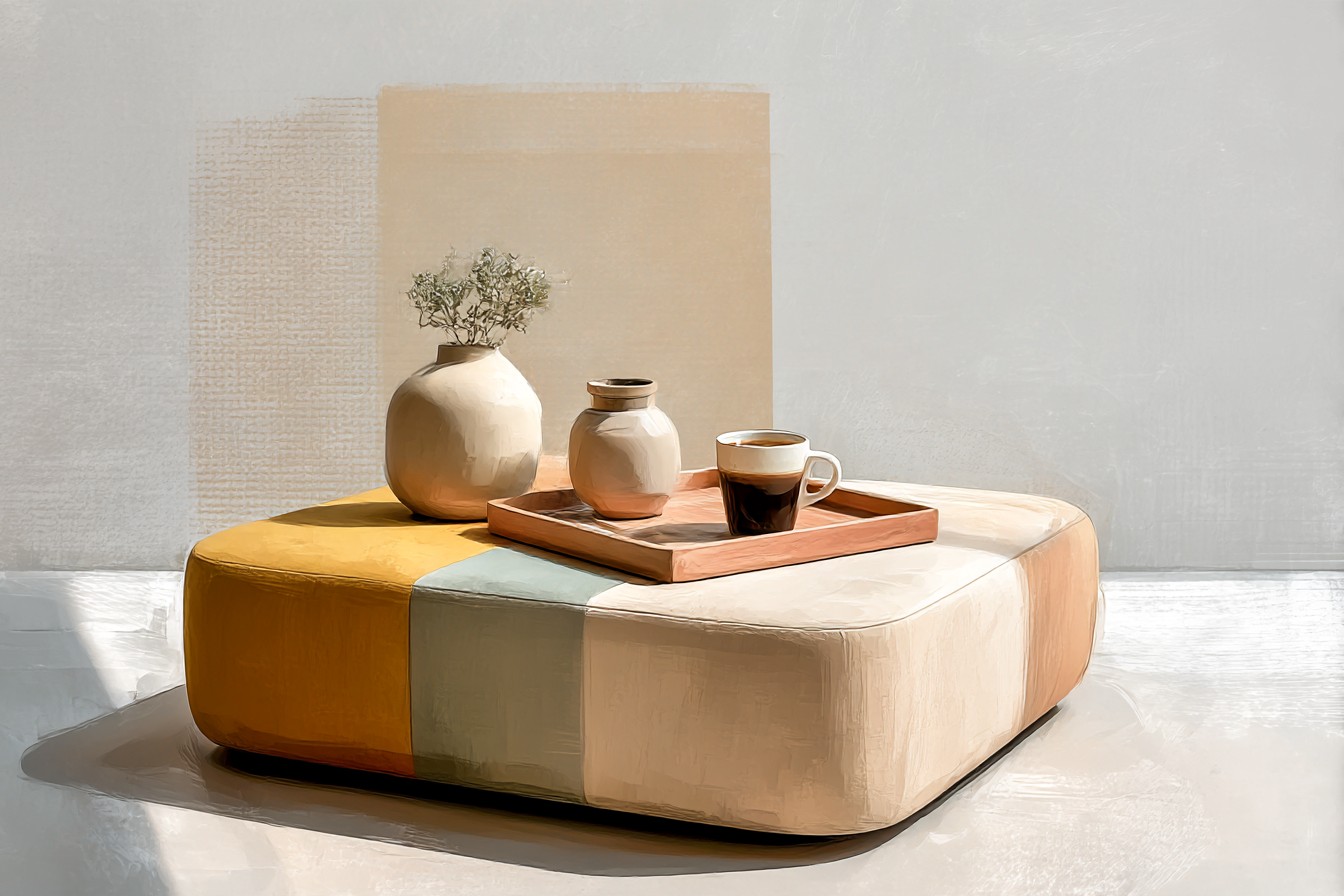
I was reaching over to set my coffee down on the ottoman in my living room last Tuesday, mid text, not even looking, the way you do with an actual coffee table, and the mug went straight into the cushion at an angle that should not be physically possible for a flat surface. Half the coffee soaked into the linen slipcover I’d washed exactly twice since buying it. The other half found the gap between the ottoman and the rug and just kept going. My laptop was six inches away and somehow spared, which felt less like good luck and more like the universe deciding I hadn’t learned my lesson hard enough yet.
Here’s the thing nobody tells you when you swap a hard coffee table for an ottoman: it is not a coffee table. It looks like one, it gets photographed like one, every interiors account on the internet will show you a big round pouf with a stack of books and a candle on it looking completely serene. What they don’t show you is the fifteen minutes before that photo where someone balanced those books on a surface that gives slightly under weight, at an angle, while holding their breath.

A tabletop is rigid. It does not compress when you lean a hip against it. An ottoman top, even the firm ones, the boxed and piped upholstery jobs that promise structure, has give. Put a candle on give and eventually the candle tips. Put a mug on give and eventually you’re me, on a Tuesday, mopping linen.
I’ve owned three ottomans used as coffee tables over the years, in three different apartments, and I’ve made every mistake available before landing on the actual fix, which is boring and obvious and which I ignored for way too long: the soft top isn’t the coffee table, the tray on top of it is. The ottoman is furniture. The tray is the surface. Once I stopped treating those as the same object, everything got easier, my coffee stayed where I put it, and my apartment stopped looking like a show home nobody’s allowed to touch.
This is going to get specific, because vague ottoman advice is exactly what got me into the linen situation in the first place. Round ones, storage ones, leather ones, the pairs people cluster together instead of buying one big piece, and the trays that actually make any of it functional. All of it, measured against what the listings promised versus what showed up at my door.
[Ottoman Coffee Table]
Round Tufted Velvet Ottomans
The first ottoman I bought as a coffee table replacement was a round tufted velvet piece, 36 inches across, labeled as a “generous centerpiece for open plan living.” My apartment is 640 square feet. There is no open plan living happening here, there’s a living room that also has to be a dining room on Thursdays when I have people over, and I measured the space between my sofa and the media unit before I bought it, which is the only reason it didn’t end up wedged in like a cork.
Velvet tufting looks incredible in photos and is an absolute liability with anything that condenses. Iced drinks sweat, the moisture sits in the seams around each tufted button, and if you don’t catch it fast you get a ring that’s genuinely harder to lift out of velvet than out of most hard finishes, because you can’t just wipe it, you have to blot and pray. I learned this with a glass of iced tea and a Saturday afternoon I didn’t get back. The button divots that make tufted ottomans look so good are also little moisture traps, which nobody puts in the product description.
What actually works here is treating the rounded top as a display surface and nothing else unless there’s a tray on it. Stack of three or four hardback books, a low ceramic dish for keys, that’s fine, it’s not carrying weight that shifts. The second you want to put an actual drink down, you need a rigid tray that spans at least two of the tufted rows so it doesn’t rock. I use one that’s 20 inches across on my 36 inch ottoman, which sounds like a lot of dead space around the edges, and it is, but a smaller tray on a domed tufted surface just tips.
[Round Tufted Velvet Ottomans]
Storage Ottomans With Lift Tops
I had a client last year who wanted a coffee table that could also swallow her toddler’s toys, and I steered her toward a storage ottoman with a hinged lift top, labeled 34 by 34 inches, which I measured myself before it left the showroom because I’ve been burned by listed dimensions before. It was accurate, for once, genuinely square, which felt like a small miracle given how often “square” turns out to be a rounding error.
The lift top on a storage ottoman is usually a padded panel over a wood or MDF base, which means it’s actually more rigid than a standard upholstered ottoman top, and that’s the good news. The bad news is the hinge. Every drink or decor item on that surface has to come off before anyone opens it for the toys, the blankets, the extra remote nobody can find. In her house that meant the tray came off the top roughly four times a day, and within three weeks the felt pads on the underside of the tray had scuffed a visible ring into the fabric where it sat.
If you’re going this route, get a tray with a lip or a shallow rim so lifting it on and off doesn’t slide the glassware sideways, and consider a tray with cork or rubber feet rather than felt, which grips the fabric instead of grinding against it every single time. I switched hers after the scuff mark, and the difference was immediate. It’s a small fix, it’s not exciting, but it’s the kind of thing you only learn after you’ve already put the felt-pad tray back on top a hundred times.
[Storage Ottomans With Lift Tops]
Leather and Faux Leather Ottomans
I resisted leather ottomans for years because I had one bad faux leather pouf in my twenties that cracked at the seams within eight months, went stiff, then split along a stitch line like it had been waiting for a reason. I blamed the material for a decade before I actually bought a proper full grain leather ottoman two years ago and realized the problem had never been leather, it had been the word “faux” doing a lot of unearned work on a listing.
You Might Also Like

The real thing behaves completely differently. It doesn’t compress the way upholstered tops do, so a tray sits flatter and steadier, and it’s the most forgiving surface in this entire piece for actual spills, because leather wipes clean in a way fabric simply cannot. I’ve set down a glass of red wine directly on the leather itself, no tray, out of pure carelessness, and wiped it off with a damp cloth and had zero mark to show for it twenty minutes later. I wouldn’t recommend making a habit of it, but it’s the one ottoman type on this list where skipping the tray for thirty seconds isn’t a crisis.
Where leather falls down is heat and scratching. A hot mug left too long can leave a faint dull patch, and keys or a phone case with a metal edge will mark the surface permanently if you’re not paying attention. So the tray still matters here, not for spill protection the way it does with velvet or linen, but for keeping sharp and hot things off a surface that otherwise handles almost everything else beautifully. I own one leather ottoman now, which is exactly enough, and I say that as someone who has never in her life stopped at exactly enough of anything else in this category.
[Leather and Faux Leather Ottomans]
Ottoman Pairs and Clusters
The trend of pushing two or three smaller ottomans together instead of buying one large piece looks great in every photo I’ve ever seen of it and is, in practice, an exercise in constant micro adjustment that nobody mentions. I tried this in a client’s studio apartment, two round ottomans, 24 inches each, pushed together to create a 48 inch surface roughly matching what a single coffee table would offer.
The gap between them is the issue nobody photographs. Even pushed flush, there’s a seam, and that seam moves every time someone brushes past, sits down heavily on the sofa, or a dog decides the space between two soft objects is somewhere to investigate. Within a week her pair had drifted nearly four inches apart from where they started, which meant the “combined surface” was actually two separate surfaces with a four inch drop-zone in the middle where a candle very nearly went over.
The fix, and I’ll admit I should have thought of this before the candle incident rather than after, is to treat the cluster as two separate small surfaces rather than one shared one, each with its own coaster or small tray, and to accept that nothing spans both unless you’re using a single large tray heavy enough to hold them in place by weight alone. I did this in the end, one substantial wooden tray across both, and it worked, it stopped the drift completely because the tray itself weighed enough to act as an anchor. It’s not the aesthetic the original photos promised, but it’s the one that survives actual daily use, and given the choice between pretty and functional at 8pm on a Tuesday, I will take functional every time.
[Ottoman Pairs and Clusters]
Trays Made for Ottomans
I’ve spent this whole piece being fairly hard on the ottomans themselves, so let me be plain about the one category that consistently gets it right: trays built specifically for round or square ottoman tops, which are a genuinely different product from a generic serving tray and worth treating as such rather than an afterthought bought separately at the last minute.
The good ones have a slight lip, enough to stop a glass sliding on an uneven or tufted surface, a base wide enough to cross at least two tufted rows or the full width of a lift top panel, and feet or a rubberized underside that grips fabric instead of scuffing it the way felt does over time. I measure every tray I recommend against the actual ottoman it’s going on, not the other way around, because a tray sized for “most coffee tables” assumes a flat rigid surface, and an ottoman top is neither of those things by default.
Once you’ve got the right tray, styling the top gets genuinely simple. A tray for drinks and daily use near the sofa end, a stack of books or a low bowl directly on the upholstery at the far end where nobody’s setting anything wet down, and that’s it, that’s the whole system. I keep a small ceramic dish for my keys directly on the fabric because it’s light and dry, and everything with actual liquid content lives on the tray without exception now.

It took one ruined mug of coffee and a damp Tuesday to teach me that, and I’d rather pass the lesson on than watch someone else learn it the same way.
[Trays for Ottomans]
Final Thoughts
If there’s one thing I’d want anyone to take from all this, it’s that an ottoman being soft isn’t a flaw to fix, it’s just a fact to plan around. The mistake I kept making across three apartments wasn’t buying the wrong ottoman, it was expecting an upholstered surface to behave like a rigid one without doing anything to bridge that gap myself. A tray isn’t a compromise on the look, it’s the part of the setup that actually makes the rest of it work, the books, the candle, the drink you set down without thinking twice.
Measure your own ottoman before you buy a tray for it, the way I wish I had the first time, because a tray sized for “standard coffee tables” and one sized for your actual 34 inch tufted top are not interchangeable, no matter what the listing implies. Pick the ottoman type that suits how you actually live, leather if you’re clumsy with drinks like I clearly am, storage if you need it to earn its keep, round or paired if the room genuinely calls for it. Then treat the tray as non negotiable rather than decorative.
My ottoman still has a faint shadow near one seam where that first coffee spill never fully lifted out. I look at it sometimes and it’s fine, honestly, it’s just proof I learned the lesson the hard way instead of the easy way. Buy the tray first. Everything else about living with a soft coffee table gets easier after that.

[…] split, because she thinks anything pretty gets to live on top permanently, and I think a dressing table needs an occasional category that comes and goes, plus a hard no category that goes in the drawer and […]