
I own fourteen light bulbs in my bathroom right now. Not fourteen fixtures, fourteen actual bulbs, because at some point I decided that four different vanity bars each needed their own temperature situation and I never went back and fixed it. Two above the mirror are a warm 2700K I bought in my first apartment because the box said “cozy” and I was twenty four and thought cozy was a personality trait I wanted my bathroom to have. Three more, added later in a fit of “I can’t see my own face properly,” are a stark 5000K daylight bulb I found on clearance at the hardware store on Eastern Avenue, the kind of white that makes you look freshly arrested. The rest are a mismatched middle ground I’ve been meaning to standardize for actual years. My bathroom, lit honestly, looks like three different rooms depending which switch you hit, and I did the math on that recently, roughly $46 spent on bulbs over about six years to end up with a bathroom that gaslights me every morning about what color my own skin is.
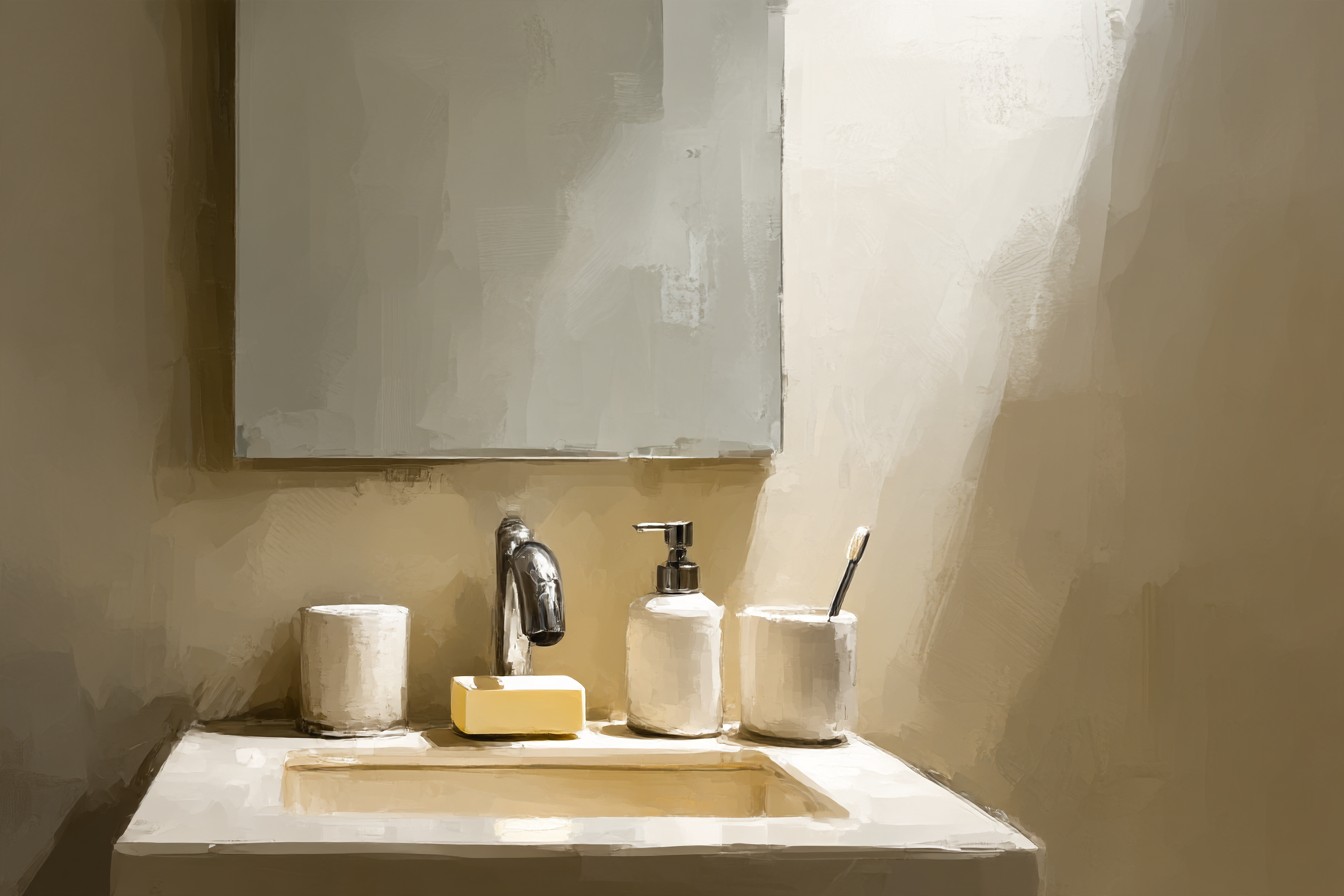
That’s $7.67 a year to look inconsistently unwell in my own mirror, which even by my standards is a bad return.
Here’s the thing nobody explains properly when you’re standing in the lighting aisle squinting at Kelvin numbers like they mean something to your actual life: bathroom lighting temperature isn’t really about taste, it’s about function, and different parts of a bathroom genuinely want different temperatures doing different jobs. A mirror where you do your makeup or shave wants one kind of light. A tub you’re trying to relax in at 9pm wants a completely different one. Most of us just screw in whatever’s cheapest at the store and then wonder for years why we look either jaundiced or like a hospital patient depending on the bulb, without ever connecting it back to that one number printed in tiny font on the packaging.
So I’m breaking down the temperature question the way I wish someone had explained it to me before I’d spent that $46 finding out the hard way, room by room, job by job, because that’s genuinely how you should be picking this, not by vibe, not by whatever’s on sale, but by what you’re actually doing under that light.
[Bathroom Lighting Temperature]
The Warm End, 2700K to 3000K
This is the “cozy” end of the scale, the one that made teenage me feel like I was buying ambiance instead of infrastructure. Anything in the 2700K to 3000K range throws a yellowish, amber tinted light, the same family as a standard old school incandescent bulb, and it’s genuinely lovely if what you want is a bathroom that feels like a spa rather than a processing center.
The problem, and I learned this slowly and expensively, is that warm light lies to you about color. Skin looks flushed and golden under it, which is flattering right up until you step outside into actual daylight and realize your foundation is three shades too orange and nobody told you. I wore the wrong concealer for what I’d estimate was four solid months because my bathroom mirror was lit like a candlelit dinner and I genuinely believed I looked fine. Nobody said anything. I found out from a work photo.
Where 2700K to 3000K earns its keep is anywhere you’re not doing precision work. Over a soaking tub, on a dimmer near the door, in a half bath that’s mostly for guests and hand washing, warm light is doing you a favor, it’s forgiving, it feels expensive even when the bulb cost $4, and it makes a small tiled room feel less like a lab. I still run one warm bulb in my hallway sconce that spills into the bathroom doorway, purely because at 11pm I do not want daylight white interrogating me while I’m brushing my teeth half asleep.
Just don’t put your only light source in this range if you’re also expected to apply makeup, shave close, or genuinely evaluate what your skin is doing. That’s the mistake, using the cozy light for the job that needs the honest one.
[Warm Ambient Lighting]
The Middle Ground, 3000K to 3500K
This is where most of my bulbs have quietly ended up over the years, not through any brilliant plan, more through returns and replacements landing me in the middle by accident. Soft white, sometimes labeled “warm white” depending on the brand, which is its own small crime against consistent labeling, sits in that 3000K to 3500K zone and it’s the closest thing to a safe default this whole category has.
It’s warm enough that it doesn’t feel clinical, cool enough that it doesn’t lie about your skin tone quite as dramatically as full 2700K does. If you only want to buy one type of bulb for the whole bathroom and never think about it again, this is honestly the one I’d tell you to grab, and I say that as someone who owns four different temperatures purely because I never followed my own advice.
I did eventually run the numbers on just replacing everything with matched 3000K bulbs, one consistent temperature throughout, and it came to about $22 for six bulbs at a decent brand, which works out to under four dollars a bulb and probably a decade of not having a bathroom that looks like three separate rooms stitched together. I still haven’t done it. I’ve got the bulbs sitting in a drawer, bought in a moment of resolve, uninstalled for eight months now, which tells you everything about the gap between my ledger and my follow through.
If you’re starting from scratch rather than inheriting my chaos, this middle range is the boring, correct answer for general bathroom lighting, ceiling fixtures, overheads, anything that’s not specifically doing detail work at the mirror.
[Soft White Bathroom Lighting]
You Might Also Like

Daylight and Cool White, 5000K to 6500K
Here’s my clearance bulb era, the one where I marched home with three 5000K bulbs and screwed them into my vanity bar convinced I was finally going to fix my makeup problem. And I did, actually, it worked, that’s the annoying part. Daylight bulbs in the 5000K to 6500K range are the closest artificial approximation to actual midday sun you’ll get in a bathroom, and if you’re doing anything that requires accurate color, makeup, skincare, shaving close enough to see every patch you missed, this is the temperature that stops lying to you.
The tradeoff is that it can feel harsh, almost sterile, if it’s your only light source in the room. My bathroom under all three of those bulbs at once looks less like a home and more like somewhere you’d get a flu shot. I’ve since dialed it back to running the daylight bulbs on their own switch, isolated to just the mirror bar, so I get honest color exactly where I need it and can kill it the second I’m done getting ready.
Cost wise these aren’t dramatically different from soft white, maybe fifty cents more a bulb for the good ones, but I will say the cheap 5000K bulb I grabbed on clearance for $3 developed a slight flicker within about five months, which is the kind of thing that makes you paranoid you’re going blind before you realize it’s a two dollar problem. Worth spending the extra bit here specifically, this is not the temperature to cheap out on, your eyes are doing close work under it every single day.
[Daylight Bathroom Lighting]
Tunable and Dimmable Bulbs
I resisted these for a long time on pure principle, the principle being that a bulb that changes color temperature felt like the kind of thing you’d buy right before it stopped being supported by an app and became landfill. I was wrong, mostly, and I’ll say that plainly because admitting it is the whole point of keeping a ledger.
Tunable bulbs let you shift between warm and cool, sometimes with a switch, sometimes with an app, sometimes with a little remote that inevitably ends up lost behind the toilet within a month, don’t ask how I know. What they actually solve is the exact problem I’ve been describing this whole article, the fact that your bathroom wants to be warm at 9pm and honest at 7am, and buying two separate sets of bulbs to manage that is what I did for years like an idiot.
I put two tunable bulbs into my vanity bar about four months ago, replacing two of my mismatched originals, and they were $24 for the pair, which stung a little going in. Working it out properly, though, that’s basically replacing what would’ve been two separate bulb purchases anyway, warm ones and daylight ones, and I only have to buy the set once. Call it $6 a year if they last the four years they’re rated for, and so far, touch wood, no flicker, no app nonsense, the switch does it fine without me opening a single application. That’s going in the good column. Buy number six for the year, and it’s a relief after buy number five, which I am still not ready to discuss.
[Tunable Bathroom Lighting]
CRI, the Number Nobody Mentions
Temperature gets all the attention because it’s the big number on the box, but there’s a second number, usually smaller, sometimes not printed at all, that matters just as much and nobody warns you about it. CRI, color rendering index, tells you how accurately a bulb shows true color rather than just what temperature it’s aiming for. Two bulbs can both say 3000K and look completely different in practice if one has a CRI of 90 and the other’s sitting at 75.
I found this out the annoying way, buying a bargain bin 3000K bulb that technically matched the temperature of my other fixtures but somehow made everything look slightly grey and flat next to them, like it was the same photo but with the saturation dragged down ten percent.
Checked the box afterward, no CRI listed at all, which in hindsight was the warning sign I ignored because it cost $2.50 and I was in a hurry.
Anything above 90 CRI is genuinely worth the extra dollar or two, especially anywhere near a mirror. It’s the difference between makeup that looks right in the bathroom and right everywhere else too, rather than just right under that one specific bulb. I’ve started actually checking this number before temperature now, which has slowed down my hardware store trips considerably and mildly annoyed whoever’s queuing behind me while I read the fine print on a bulb box like it’s a phone contract.
[High CRI Lighting]
Final Thoughts
If I’m boiling fourteen mismatched bulbs and one long overdue lesson down into something useful, it’s this. Warm light near the tub, honest daylight light at the mirror, something in the soft white middle for everywhere else if you don’t want to think about it too hard, and check the CRI number before you check the price. That’s genuinely the whole system, no app required, though the tunable bulbs are a decent shortcut if you want one fixture doing two jobs instead of buying twice.
My bathroom is still not fully fixed. Those four 3000K bulbs are still sitting in a kitchen drawer eight months after I bought them with great intentions, and I’ll probably install them the week after I finally publish this, which would be exactly my luck. But at least now when I flip the switch and get judged by my own reflection, I understand why, and I know which of the fourteen bulbs is lying to me and which one’s telling the truth. That’s worth more than the $46 it took to learn it, even if my ledger’s going to make me say that number out loud for a while yet.




[…] everything skews slightly gold, which is exactly why my foundation situation happened. If your only bathroom light source is soft white, you will apply makeup that looks perfect in that light and unhinged in every […]