I own seven mirrors right now, in a condo with exactly one vanity, and I want to be honest that four of them are currently stacked against the wall of my guest closet like some sort of shrine to indecision I never intend to explain to anyone who opens that door looking for a spare towel. Seven. For one bathroom. That is not a design philosophy, that is a purchasing pattern, and if I brought that pattern into a meeting as a spending trend I would flag it as a problem before I’d even finished the slide.
Here is how it happened, because it did not happen all at once, which somehow makes it worse. The vanity itself I bought with real conviction, white shaker style, quartz top, the kind of purchase I’d actually built a case for, cost per year of expected use, resale value if I ever sell the place, all of it. Reasonable.
Then I got to the mirror, which I assumed would take fifteen minutes online, and instead took four months and several returns because nothing I ordered looked the way it did in the product photo once it was hanging against actual white shaker cabinetry in actual Charlotte daylight, which is a very different light than whatever they’re photographing these mirrors in. One came in matte black and read as almost navy against the white. One arrived in a gold I can only describe as the color of a hotel elevator button, not the good brass, the cheap one. One was the right shape and the wrong size, too small, so it sat on that big white expanse like a stamp on an envelope, technically present, doing nothing.
The real issue, the thing nobody tells you before you start, is that “what color mirror goes with a white vanity” is not actually one question. It’s five questions wearing a trench coat. It depends on your hardware finish, your wall color, whether your bathroom gets good natural light or the kind of gray overhead light that makes every metal look slightly wrong, and honestly, how much contrast you can live with every single morning before coffee. I did not know any of that going in. I know all of it now, at some financial and emotional cost, and I’d rather hand you the shortcuts than watch you build your own closet shrine.
[Mirrors for a White Vanity]
Black Framed Mirrors
If you’ve searched “what color mirror with a white vanity” and want the actual answer instead of five paragraphs of hedging, it’s black, more often than any other option, and here’s the reasoning rather than just the verdict. White vanities are usually paired with white or off white walls, because that’s what shows off the cabinetry, which means you’ve already got a room with very little natural contrast in it. A black frame gives the eye something to land on. It’s the one decision in the room that isn’t asking permission.
I learned this the expensive way, with that matte black mirror I mentioned, the one I initially returned because I thought it read too dark. I sent it back, lived with a brushed nickel frame for about five weeks, and hated it quietly the whole time, the kind of low grade dissatisfaction where you can’t articulate what’s wrong until you finally swap it out and go “oh, THAT’S what was missing.” I reordered a black frame, slightly heavier gauge this time, actually welded corners rather than a mitered joint held together with hope, and the whole vanity wall finally looked finished rather than assembled.
The thing to watch for, and I mean actually check before you buy, is the finish consistency between the mirror frame and anything else black in the room, your faucet, your drawer pulls, your light fixture. Mismatched blacks, one warm, one cool, one true matte, one slightly satin, sit next to each other looking like an argument nobody won. I got lucky, mine matched close enough, but I’d checked swatches against my actual faucet finish before ordering rather than trusting a thumbnail image, which is the boring, unglamorous part of this whole process that actually matters.
[Black Framed Mirrors]
Brass and Gold Round Mirrors
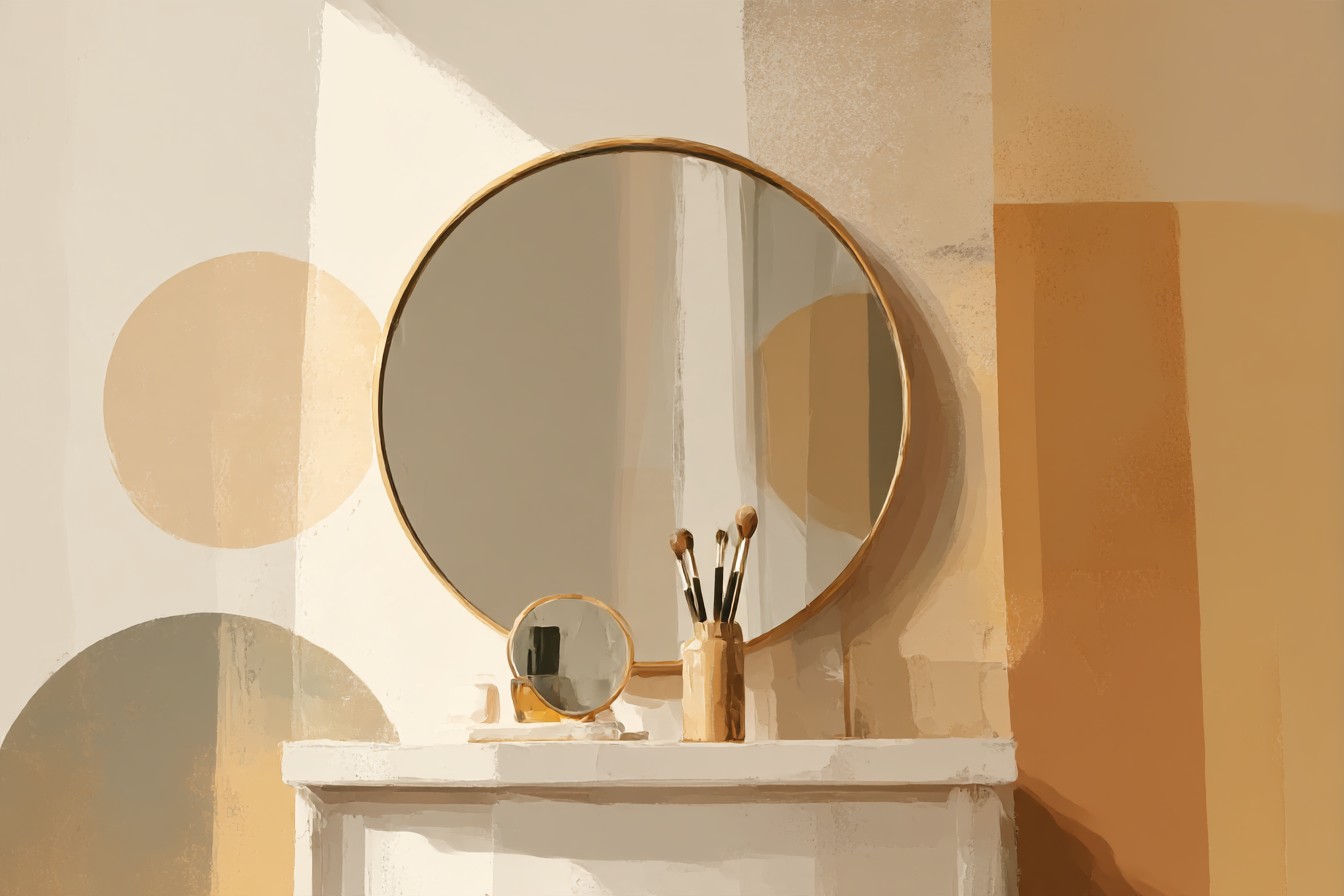
On paper, a round brass mirror over a white vanity is the safest, most photographed combination in the category, warm metal against cool white, soft shape against all those straight lines in the cabinetry. In reality I bought mine because I’d had a genuinely bad week at work and wanted one thing in my apartment to feel expensive without actually being that expensive, which, again, is not something a mirror can fix, and it did not fix it, it just looked nice while I sat with the feeling anyway.
The round shape earns its keep here in a way I didn’t expect. My vanity, my sink, my faucet, the cabinet pulls, every single line in that bathroom is straight or rectangular, and a round mirror is the one curve in the whole space. It stops the room from reading like a spreadsheet, which, coming from me, is a genuine compliment.
Where people go wrong, myself included on attempt one, is grabbing the cheapest gold finish available and being surprised when it looks more like costume jewelry than hardware. There’s a real difference between an actual brushed brass and a yellow gold electroplate over plastic, and you can usually tell from the price alone if you’re paying attention, mine that failed was under thirty dollars, the one I kept was closer to ninety, and the weight difference alone told me everything. The good one has actual heft when you lift it off the box. The bad one feels like a prop, because functionally, it was one.
[Brass and Gold Round Mirrors]
Frameless Beveled Edge Mirrors
I’ll be straightforward about this one: the frameless beveled mirror is the boring, sensible choice, and I say that with respect, because sensible has its place. This is the mirror equivalent of an index fund. Nobody’s ever going to compliment it specifically, but it’s also never going to actively work against anything else you do in that bathroom, and there’s real value in that kind of neutrality when you’re renting, or when you know you’ll repaint in two years and don’t want to have committed hard to a color decision you’ll regret.
You Might Also Like

I had one of these in my first apartment, the one before the condo, and honestly it did its job with zero drama for three years, survived a move, survived me hanging it slightly crooked for about a month before I noticed and fixed it, no chips on the beveled edge despite that whole ordeal. That’s the case for it. It disappears into the room in a useful way rather than a disappointing one.
Where it falls short on a white vanity specifically is exactly the flatness I just praised. Without a frame, you’re relying entirely on the bevel itself to create any visual interest, and if the room already has soft lighting and white on white surfaces, a frameless mirror can make the whole wall read a little unfinished, a little like a display home nobody’s actually moved into yet. I’d choose this one for a smaller powder room over a pedestal sink long before I’d choose it for a full vanity wall, where there’s more surface area for the mirror to actually do some visual work rather than just reflect the room back at you.
[Frameless Beveled Edge Mirrors]
Wood Framed Arched Mirrors
I resisted wood for longer than I should have, mostly because I had one bad experience years ago with a honey oak frame that clashed with absolutely everything I owned and put me off the material entirely, which in hindsight was a “the wood was wrong” problem, not a “wood is wrong” problem, and I conflated the two for an embarrassingly long time.
What changed my mind was a whitewashed oak arch, picked up mostly on impulse, that I put up temporarily while deciding on something more “considered,” in air quotes I’m putting here for a reason because it’s still up two years later. The arch shape softens the whole vanity in a way the black rectangle version doesn’t, and the pale wood tone reads as warm without introducing a second competing color the way brass sometimes can if your other hardware is already gold.
It works particularly well if your vanity has any wood elements at all, open shelving underneath, a stool, a small stack of towels on a wooden tray, because it gives the eye a second material to connect to rather than having the mirror sit there as the only non white, non metal thing in the room. Where I’d caution you is the actual wood quality; a lot of the budget arched mirrors are a thin veneer over MDF, and if your bathroom runs humid, and most bathrooms do, that veneer can start lifting at the edges within a year. Mine’s solid oak, cost noticeably more, and has had zero issues through two Charlotte summers of genuinely brutal humidity, which is the actual test, not the delivery day photo.
[Wood Framed Arched Mirrors]
Lighted Vanity Mirrors
This is the one category I approached almost entirely for function, then ended up caring about aesthetically anyway, which happens to me more than I’d like to admit.
I work from home two days a week, and my vanity bathroom is visible in the background of exactly one specific camera angle if I forget to close the door, and a lighted mirror with a genuinely accurate color temperature has fixed more video call disasters than any other single purchase in my apartment.
I bought a cheap ring light style vanity mirror first, the kind with a plug in dimmer, and the light it threw was so cool toned that my skin read faintly gray on camera, which nobody tells you until you watch a recording back and go, quietly, in horror, “who is that.” I returned it and bought one with an actual stated color temperature range, adjustable between warm and daylight settings, LED strip built properly into the frame rather than stuck on as an afterthought, and the difference on camera was immediate and, frankly, a little ridiculous given how small the change was.
On a white vanity specifically, a lighted mirror in a white or brushed nickel frame keeps the whole wall feeling cohesive rather than adding a competing dark frame on top of an already busy fixture. It’s not the mirror I’d choose for pure looks. It’s the one I’d choose if you actually use that vanity for anything beyond glancing in it on your way past, and if you’ve ever caught your own reflection under bad lighting and thought “that can’t be accurate,” it probably wasn’t.
[Lighted Vanity Mirrors]
Final Thoughts
If you take one thing from all of this, let it be that the color question has a real answer, black most often, brass close behind, and the rest depends on what your hardware and your patience can handle. I built a genuine case for each of these seven mirrors at the time, cost per year, resale, how it would photograph, all the language I use at work, and the honest version is that I kept buying because none of them quite fixed the low level dissatisfaction I couldn’t name until the right one showed up.
Two live on the wall now, one rotates depending on my mood, which I recognize is an unhinged sentence to type about a bathroom fixture. The other four are still in that closet, and at some point I’ll admit defeat and sell them, but not yet. What I’d actually tell you, cutting past all the spreadsheet language I clearly can’t help myself using, is to buy one good mirror rather than four adequate ones, check the frame finish against your actual hardware in your actual light, and stop trusting the product photo. Mine lied to me four separate times. Yours will too.