“Rule of three, big mirror above it, lamp on each end.” That’s the sentence every interiors article says about a hallway sideboard, and it gets repeated so often that people start treating it like building code. It isn’t. I’ve followed it, I’ve broken it, and my hallway looked better every single time I ignored it in favor of actually looking at the space I had instead of the space some stylist photographed in a house with better light than mine. There are two things that genuinely determine what goes on, over, and beside a sideboard, and neither of them is a decorating rule.
What Your Hallway Actually Does For A Living
The first thing that matters is function, real function, not aspirational function. My hallway is four feet wide and every single person who comes through my front door dumps something on the nearest flat surface within eleven seconds. That’s not a decorating choice, that’s physics, and the sideboard either accepts that job or it fights it and loses.
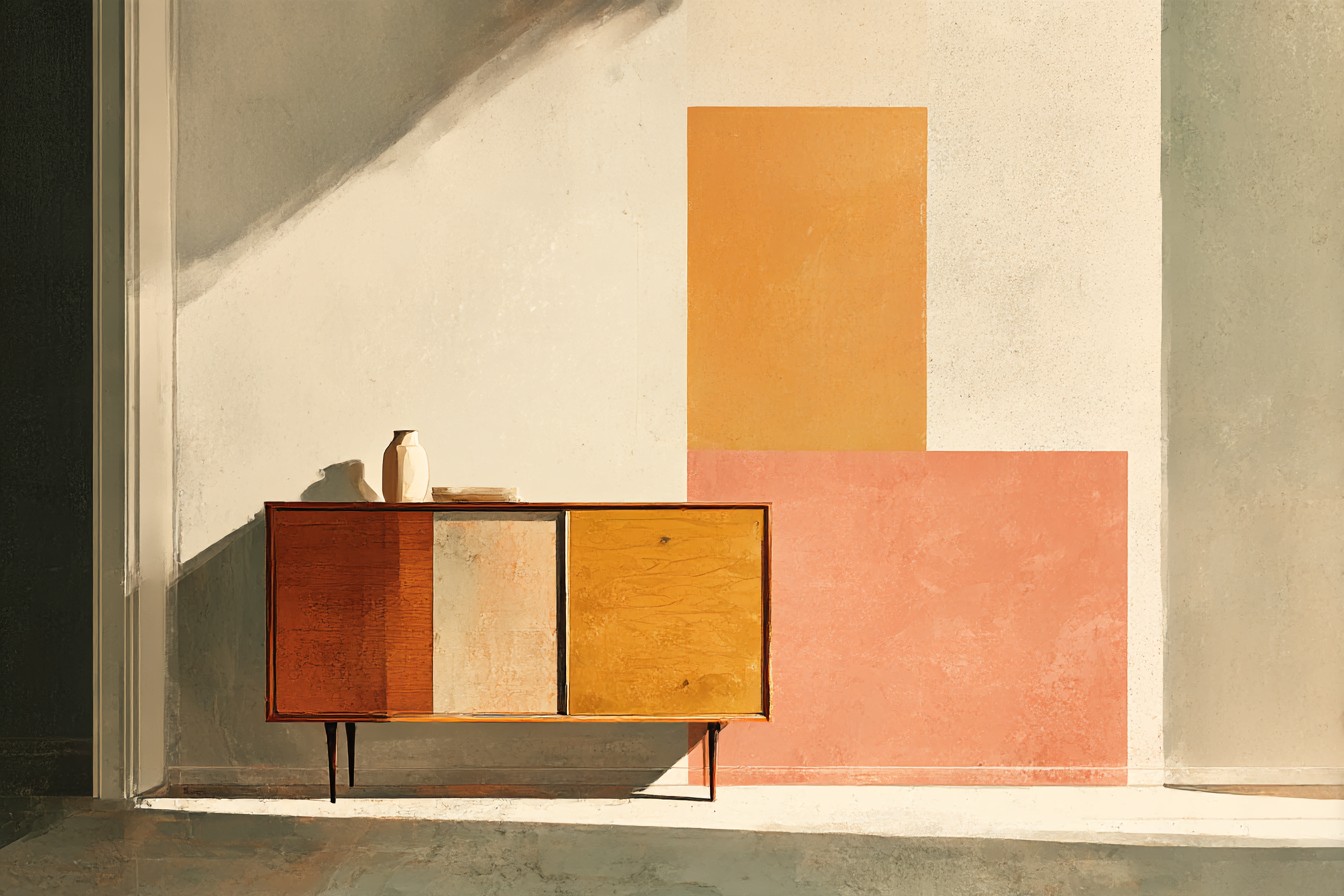
So the top of mine has a shallow tray for keys and post, because without the tray I was finding my keys under a stack of unopened mail from a company that’s been trying to sell me a mattress since March. That’s not styling advice, that’s surrender, and it’s the correct kind.
Above the sideboard, the mirror rule works for exactly one reason people never mention, which is that a narrow hallway needs the light bounced back at it or it reads like a corridor in a budget hotel. I bought a big round mirror for mine two years ago, and it does the job the rule promises, but I also nearly returned it because the frame cost more than the sideboard underneath it, which felt like a genuinely deranged way to spend money on a wall you walk past for four seconds a day. If your hallway already gets decent light, skip the mirror entirely and hang something you actually like looking at, a print, a row of small frames, one big weird painting your mother-in-law hates. The mirror is a fix for a lighting problem, not a mandatory hallway tax, and nobody selling you one is going to volunteer that distinction.
Beside the sideboard is where the real function argument lives, because that’s the bit nobody photographs and everybody needs. I’ve got an umbrella stand on one side that’s actually just a tall vase I bought for six dollars at a flea market, and it’s outlasted two actual designated umbrella stands that cost forty times as much and fell apart within a year. On the other side there’s a small stool, not for sitting, obviously, nobody sits down to put their shoes on in a four foot hallway, it’s there so my downstairs neighbor has somewhere to put her bag while she waits for me to find whatever I’m lending her that week. Function beside a sideboard means asking what actually happens in that specific three feet of floor, not what a catalog photograph implies should happen there.
What Your Hallway Actually Looks Like For A Living
The second thing that matters, and the one people get backwards, is scale, and hallways are the single worst room in any home for people misjudging it. A sideboard that reads as elegant in a wide entryway will make a narrow hallway feel like an obstacle course, and I learned this the expensive way with a console table I bought online that measured eighteen inches deep on the product page and somehow felt like a small boat once it arrived. I didn’t send it back, because returning furniture from a hallway that’s already too narrow to maneuver a box through is its own special kind of hell, so I lived with it for a year, apologizing to every guest who clipped their hip on the way to the bathroom.
You Might Also Like

What sits ON the sideboard needs to respect that same scale logic, and this is where the rule of three actually earns its keep, not because odd numbers are magically more pleasing, but because three smaller objects take up less visual depth than one large one, and depth is the one thing a narrow hallway cannot afford to lose.

A big lamp on a four inch deep console isn’t styling, it’s a hazard, and I say that as someone who knocked one off mine with a coat sleeve and watched the bulb detonate across the floor at eleven at night. Lower and flatter wins every time in a tight space, a shallow bowl, a couple of low framed photos leaned rather than hung, a single stem in a vase that isn’t going to become a projectile the first time someone walks through with a stroller.
Over the sideboard, scale cuts the other way, because a mirror or print that’s too small for the wall above a substantial piece of furniture just looks apologetic, like it’s not sure it’s allowed to be there. The proportion that actually works, and I did eventually measure mine properly instead of guessing, is roughly two thirds to three quarters of the sideboard’s width. Go smaller and it floats there looking accidental. Go bigger and it starts arguing with the ceiling height, which in most hallways is already working against you.
And beside it, scale is really about depth more than width, because a hallway sideboard eats floor space sideways in a way a living room one never has to answer for. Anything you put next to it needs to be narrow enough that two people can still pass each other without one of them turning sideways like they’re auditioning for a heist film. My umbrella vase is four inches across for exactly that reason, not because I’m precious about proportion, but because I measured the gap with a tape measure like an actual adult, once, after the third time a guest walked into it in the dark.
So no, there isn’t a universal formula here, whatever the rule of three would like you to believe. What goes on, over, and beside your sideboard should come from what your hallway does and how much of it you’ve actually got to work with, and any advice that skips straight past those two things is decorating for the photograph, not for the person who lives there.