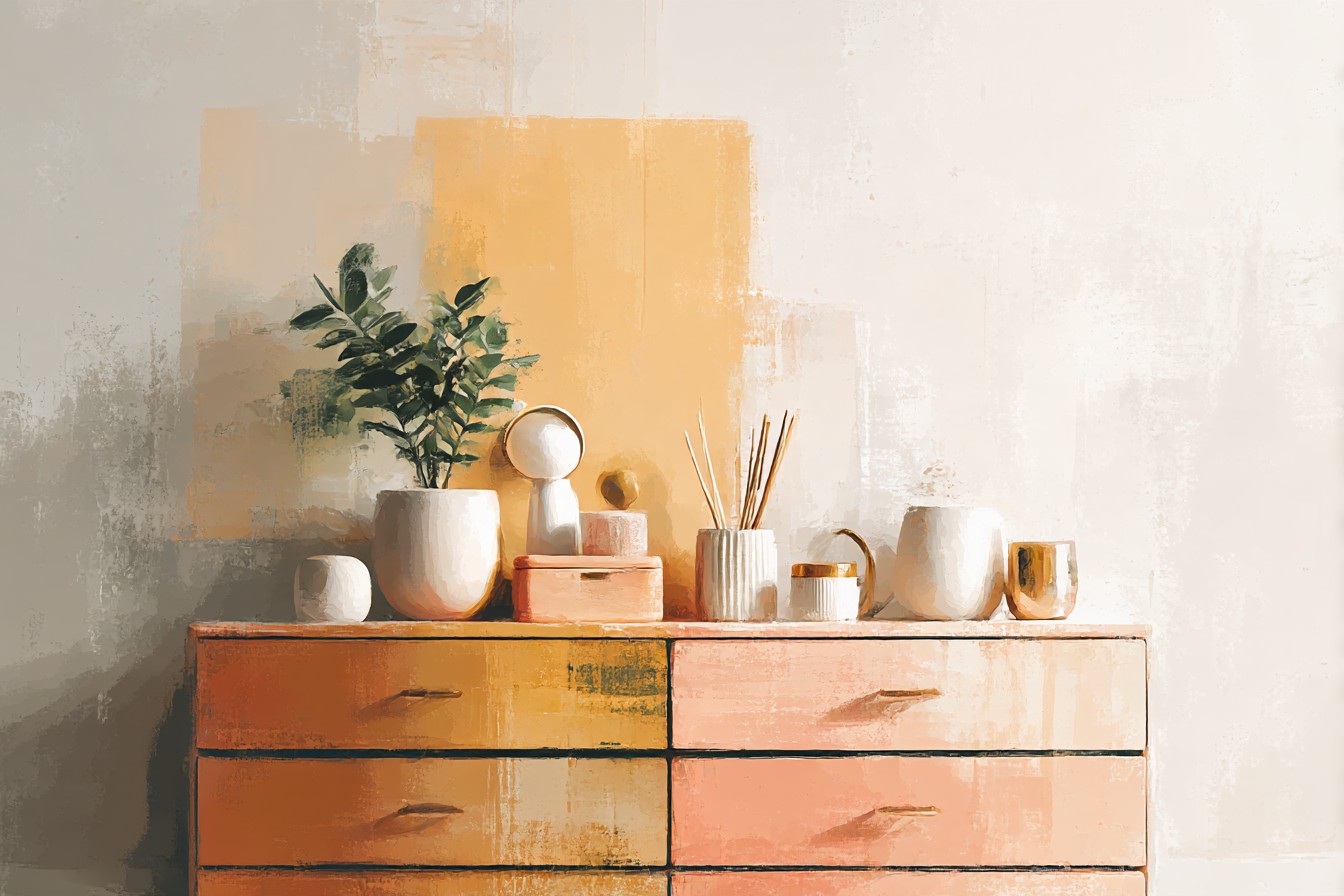
I realized what I’d been doing right about eighteen months ago, standing in my own bedroom, looking at a dresser top I’d rearranged without thinking about it for the tenth time that year. There was a tall brass candlestick on the left, a low dish of rings in the middle, and a stack of two books with a smaller frame propped against them on the right. I hadn’t planned any of it. My hands had just done it, the way they always do, and it looked right in a way I couldn’t have explained if you’d asked me to write it down. That’s when it hit me: I’ve been arranging dresser tops by instinct for years, and the instinct has a name, even if nobody ever taught it to me outright. It’s height and it’s texture, every single time, and once you see that you can’t stop seeing it.
I think most bad dresser tops aren’t bad because the objects are ugly.

They’re bad because everything on there is roughly the same size and roughly the same finish, so your eye has nowhere to land and nowhere to rest, and the whole thing reads as clutter even when it’s only four items. Fix those two things and you can put almost anything up there, salvage yard finds included, and it’ll look like it was always meant to be together.
Get the heights arguing with each other, on purpose
Here’s the thing nobody tells you: a flat dresser top with everything at the same eye level looks random even when it’s tidy, because your brain reads “same height” as “no relationship.” I learned this properly at an estate sale outside Pooler, going through a dead woman’s bedroom furniture with her grandson standing there looking like he’d rather be anywhere else. There was a squat little milk glass lamp, maybe eight inches tall, sitting next to a slim brass floor candlestick someone had clearly moved from the hearth at some point in that house’s life. Neither one impressive on its own. Together, on that dresser, with a low framed photo tucked in between them, it was the best styled surface I’d seen in months, and nobody had styled it. It had just accumulated that way over forty years of a life being lived around it.
That’s the trick though, the accumulation looks intentional because the heights vary enough to make a shape, a little skyline instead of a shelf. I try to get three rough levels going now whenever I set one up, something tall enough to draw the eye up, something low and grounded, and something in between that bridges the gap so it doesn’t look like two unrelated objects that happen to share a surface. A tall lamp, a shorter stack of books, a flat dish for the stuff that would otherwise end up loose on the wood, that’s a starting formula and it very rarely fails me. What fails is putting three things of near identical height in a row, which I did for about two years on my own dresser before I noticed, because I was so pleased with the matching brass finish that I never stepped back and looked at the actual silhouette.
You Might Also Like

The other half of this, and it’s the part people skip because it feels less like decorating and more like admin, is leaving enough negative space that the height variation can actually register. If you cram the surface edge to edge, the tall and short pieces just blur into one dense strip and the eye can’t do the up and down reading it needs to do. I leave at least a third of any dresser top properly empty now, more if the piece itself has good grain or an interesting top, because sometimes the best thing you can put on a surface is the surface.
Mix what things are made of, not just how tall they are
Height gets you the shape, but texture is what stops the whole arrangement looking like a showroom display nobody’s allowed to touch. I nearly walked past a yard out past Garden City entirely, it looked like nothing from the gate, just folding tables and a lot of flat pack shelving someone was clearly offloading after a move.
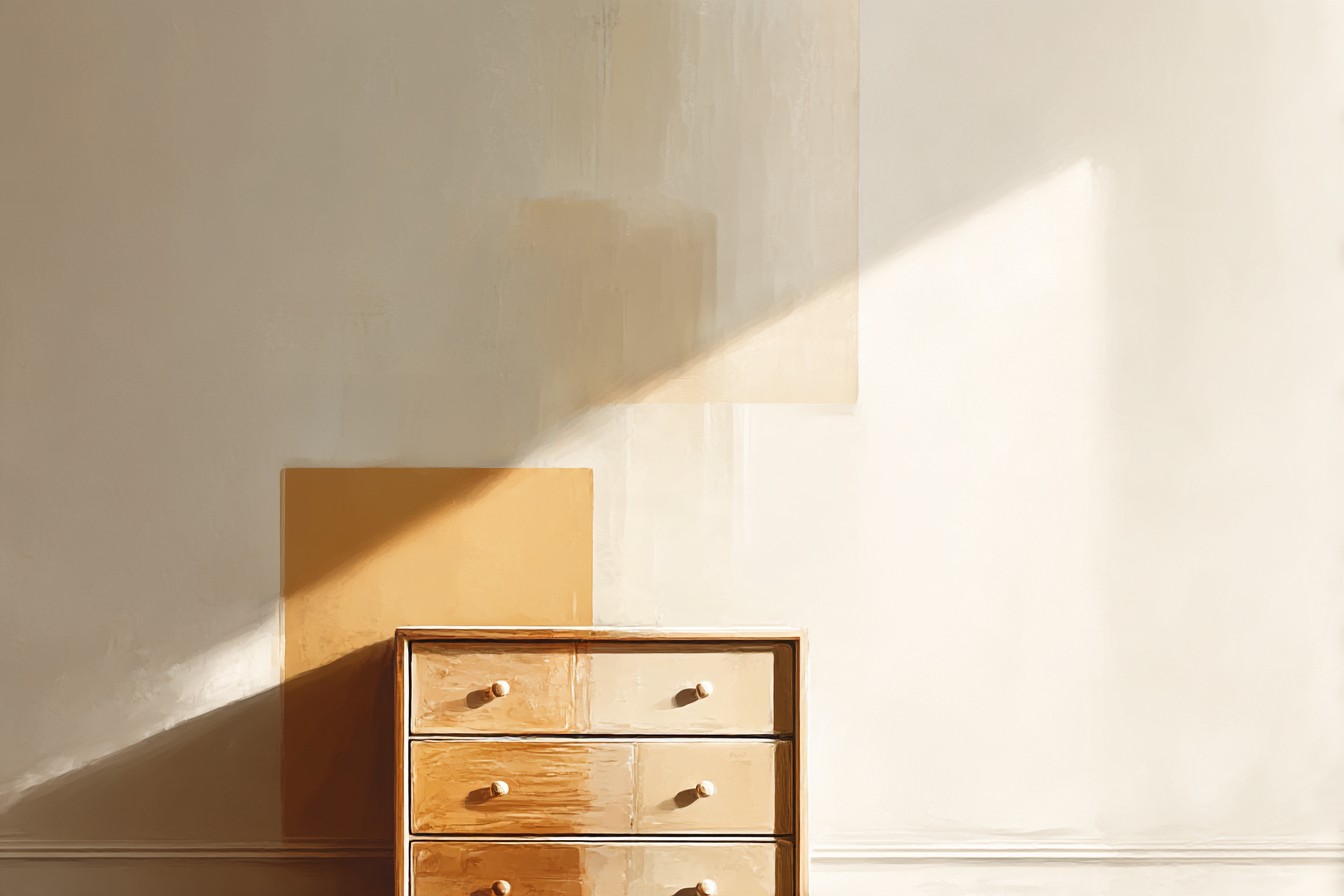
Tucked behind three identical particle board bookshelves, though, was a small ceramic bowl with a crackled glaze the color of weak tea, chipped on one edge in a way that told me it had been used, not just displayed. I paired it eventually with a smooth brass frame and a rough linen covered box I’d had knocking around for a year with nothing to do, and the three of them together on a dresser top do more work than any single “statement” object could manage alone.
That’s the bit I think most people miss when they’re staring at their own dresser feeling like something’s off. If everything on the surface is the same material, all glass, all brass, all whatever’s trending, it stops reading as a collection and starts reading as a matching set, which sounds nice in theory and looks flat and a bit soulless in person. You want the eye moving between surfaces the way your hand would if you actually picked each thing up, smooth brass, then rough ceramic, then the soft give of a small stack of linen bound books, then glass catching light differently from all of it. It’s the difference between a room that looks decorated and one that looks collected, and collected is the one that actually holds up to being looked at twice.
I’ll admit I get this wrong at the point of purchase more than I’d like to say. I fell properly in love with a small marble dish at a sale near Thunderbolt, bought it on the spot without turning it over, got it home and found a hairline crack running clean through the base that the seller’s table lighting had hidden completely. It still lives on my dresser, crack and all, because the fault doesn’t actually show once it’s holding a scatter of rings, and honestly it’s taught me that texture forgives more than a spec sheet would ever let on. What matters more than any single object being perfect is that the whole surface feels like it was gathered rather than bought in one trip, one focal piece the eye lands on first, whatever height and texture chaos you like around it, and enough bare wood showing through that the dresser still gets to look like a dresser.


[…] the construction reality behind why this drawer is usually shallow. Cheaper dressers cut corners at the top first, because it’s the smallest box to build and the one people scrutinize least. Flip one […]