I was standing on a beach in South County a few Octobers back, at the point in the evening where the sky goes that particular shade of purple that makes everyone forget they’re cold, holding a mesh bag of firewood I’d bought from a gas station because I hadn’t planned properly, and squinting at a laminated sign bolted to a fence post that I genuinely could not read without my phone flashlight. It listed fire hours. It listed a permit number. It mentioned, in smaller print, something about designated areas only, which I had not looked for, because I had assumed, the way you assume a lot of things about beaches, that the sand itself was the permission slip. It is not. I want to be extremely clear about that up front, because I think a lot of people arrive at a beach with a bag of firewood and the same assumption I had, which is that sand is basically nature’s way of saying go ahead, and sand does not say that.

Sand is just sand. It has no opinion on fire codes.
What actually governs whether you can build a fire on a beach is a patchwork of things that have nothing to do with the beach looking, to your eye, like an obviously fine place to burn something. It’s municipal ordinance. It’s whether the beach is town owned, state owned, or part of a conservation area with its own separate rules that don’t care what the town three miles up the coast allows. It’s fire danger ratings that change week to week depending on how dry the season’s been. None of this is fixed, none of it is the same from one town to the next, and none of it is something I can hand you a tidy universal answer for, because the honest answer is it depends on exactly where you’re standing, and that answer changes based on the year, the season, and sometimes the specific stretch of sand.
What I can talk about, from a fair amount of trial and error and one memorably windy night that ended with me shoveling actual sand onto actual embers with my actual hands because I hadn’t brought a proper tool, is what the general shape of doing this responsibly looks like, regardless of which coastline you’re on.
[Fire Pits on the Beach]
Permits Aren’t Optional Just Because Nobody’s Watching
The thing about beaches at dusk is that they feel unsupervised. No one’s standing there checking IDs. That feeling is doing a lot of dangerous persuading. Plenty of beaches that allow fires require a permit you get in advance, sometimes from the town clerk’s office, sometimes from a fire department, sometimes through an online form that takes five minutes and that almost nobody fills out because it involves admitting you’re planning something rather than just doing it. Other beaches don’t do permits at all and instead restrict fires to specific marked pits that the town itself installed, which means bringing your own fire pit and setting it up wherever you like is a completely different proposition even on a beach where fire is technically allowed. And plenty of beaches, particularly ones near dunes, near nesting areas, or near anything with a conservation designation, don’t allow fires at all, full stop, no permit fixes that.
I’ve made the mistake of treating “I saw other people doing it” as research. It isn’t. Other people are frequently also guessing, or they got a permit and you didn’t see the paperwork, or they’re locals who know something you don’t and are quietly gambling on a ticket. None of that is a system you can rely on. The only actual research is checking with whoever manages that specific beach, which is usually the town’s parks and recreation department or its fire department, and asking directly, because the rules genuinely do vary block to block along a single coastline in a way that surprised me the first time I looked into it properly.
[Permits and Local Rules]
Tides Don’t Care About Your Evening Plans
This is the one that gets people who’ve done everything else right. You’ve got your permit, you’ve picked a legal spot, you’ve got your firewood, and you build your fire at what looks like a perfectly reasonable distance from the water. Then the tide comes in while you’re not watching it, because you’re watching the fire, which is the whole point of a fire, and three hours later the water’s four feet closer than when you started and your fire pit is sitting in a very different relationship to the ocean than it was at sunset.
Tide tables exist for exactly this reason and I now check one before I leave the house, not when I arrive, because cell signal at some beaches is unreliable and I’d rather know before I’m standing there with a bag of charcoal and no plan. A rising tide at night, especially around a full moon when tides run higher than usual, can come in faster and further than people expect, and it’s not gentle about it. It doesn’t announce itself. It just arrives.
Building far enough back that a normal tide won’t reach your fire is the baseline. Building far enough back that a HIGHER than normal tide, the kind tied to a full moon or a storm system offshore, won’t reach it either, is the actual standard, because “should be fine” is not a phrase I want anywhere near open flame and rising water. I learned this the unglamorous way, retrieving half-burned logs from ankle deep water at eleven at night, which is a genuinely stupid way to end an evening that started with good intentions.
[Tides and Beach Fires]
You Might Also Like

What You’re Actually Burning It In Matters
There’s a real difference between a fire built directly in a pit dug into the sand and a raised, contained fire pit you bring with you, and it’s not just aesthetic. A fire dug straight into sand can scorch and fuse the sand around it in a way that doesn’t undo itself when you leave, and depending on the beach, digging a pit at all might be exactly the thing that’s not allowed even where fires generally are, because it disturbs a surface that’s doing more ecological work than it looks like it’s doing. A raised pit, something with legs and a solid base, keeps the heat off the sand entirely and is what a lot of the beaches that do permit fires actually specify, sometimes down to a maximum size.
I bought a cheap raised pit for forty dollars a few summers back, more of a metal bowl on legs than anything sturdy, and it survived exactly one trip before the legs bent under it in soft sand and it tipped sideways, which was a bad five minutes. The one I actually trust now is heavier, wide based, and doesn’t sink unevenly the way the flimsy one did. If you’re bringing your own, weight and a stable base aren’t nice to have, they’re the difference between a contained fire and a fire that’s now somewhere you didn’t intend it to be. Spark screens matter too, more than I gave them credit for before a gust sent embers further across dry sand than I’d have guessed possible.
[Choosing a Fire Pit Type]
Packing Out Means All Of It, Not Most Of It
Coals stay hot far longer than people expect, sometimes overnight, buried under a layer of sand that looks cool on top and isn’t underneath at all, which is how people end up with burned feet the next morning walking the same stretch barefoot. Dousing a fire properly means water, not sand, sand insulates heat rather than killing it, and stirring the coals while you douse them so nothing’s smoldering under the surface. I didn’t know that for longer than I’d like to admit and effectively buried a live fire under a foot of sand once, thinking I’d extinguished it, which is precisely backwards.
Packing out means the ash too, once it’s fully cool, along with every scrap of foil, every skewer, every bit of trash that arrived with you. Sand is unbelievably good at hiding things you’d notice instantly on a lawn. A crushed can looks like part of the landscape after dark in a way it never would on grass, which makes it easy to leave behind by accident rather than on purpose, and I’ve caught myself doing exactly that, patting my pockets in the parking lot and realizing I’d left a bottle cap sitting six feet from where the fire had been.
[Packing Out Properly]
Wind, Noise, and the Neighbors You Can’t See
Beaches at night feel private in a way they’re not. Sound travels flat across open sand and water further than it does anywhere else I’ve spent an evening, and a fire pit gathering means voices carrying to houses set back from the beach that you can’t even see from where you’re sitting, which is usually where noise complaints and unhappy encounters with someone in a bathrobe actually come from, not the fire itself.
Wind is the other piece nobody accounts for until it’s a problem.
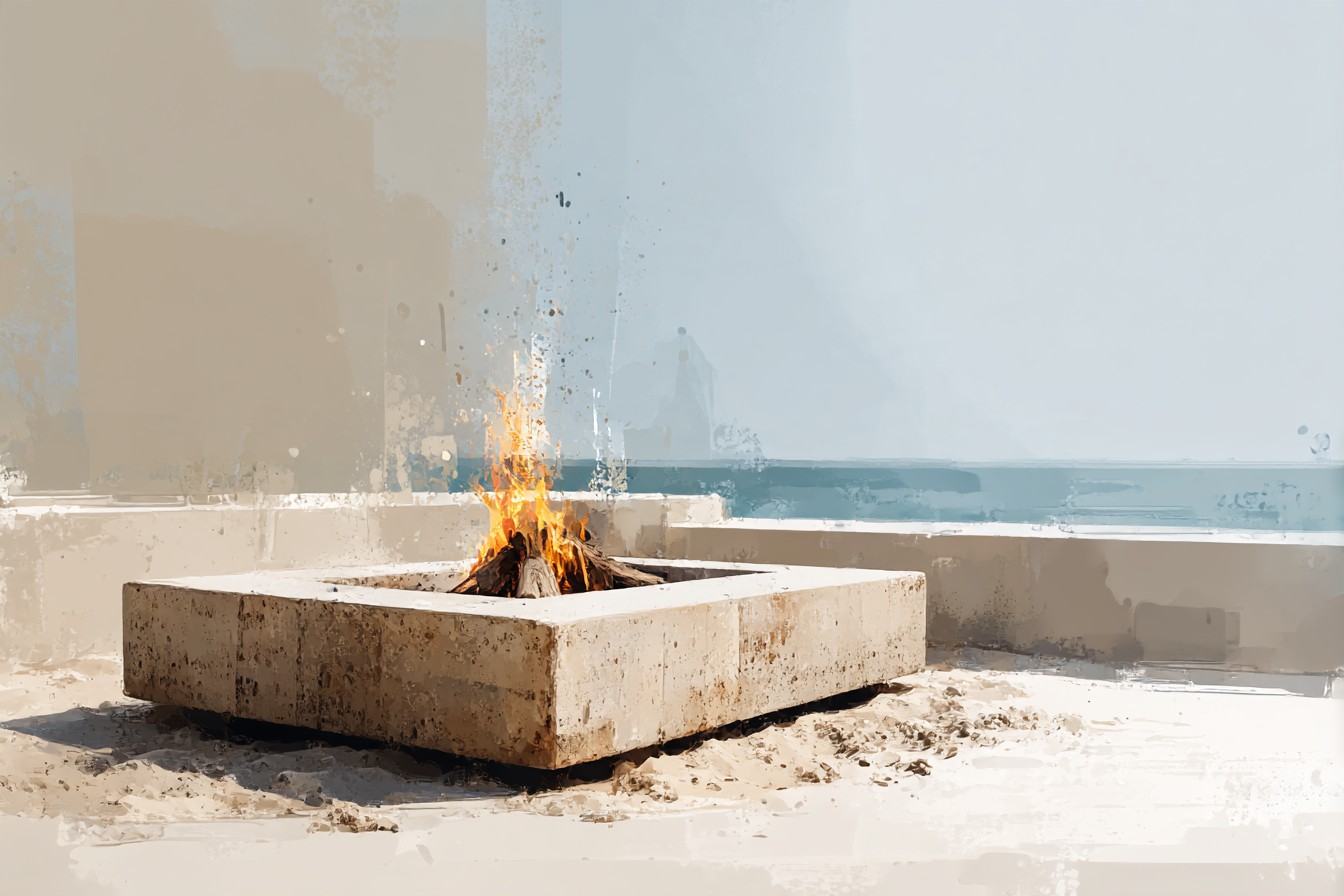
A steady onshore breeze can push sparks and smoke toward dune grass, toward nesting areas some beaches actively protect during specific months, or just toward the group forty feet away who did not sign up for your smoke. I’ve had a fire go from pleasant to genuinely concerning in about ninety seconds when the wind shifted, which is exactly the kind of thing sand pit or not, permit or not, you’re still responsible for managing.
[Wind and Neighbors]
Final Thoughts
None of this is meant to talk anyone out of a beach fire, I still think a fire on sand with the tide somewhere in the middle distance is one of the better ways to spend an evening I know of. But it’s not a lawless activity just because it happens somewhere without walls. It’s governed by rules that change from town to town and year to year, by water that doesn’t care what time you were planning on leaving, and by a strip of sand that hides both live coals and forgotten trash with equal efficiency. Check with whoever manages the specific beach, check the tide, bring a fire pit that won’t tip over the second the wind picks up, and leave with everything you brought plus the ash. Sand isn’t the loophole it looks like. It’s just the surface. Everything that actually matters happens above it, and it’s still entirely your job to manage.