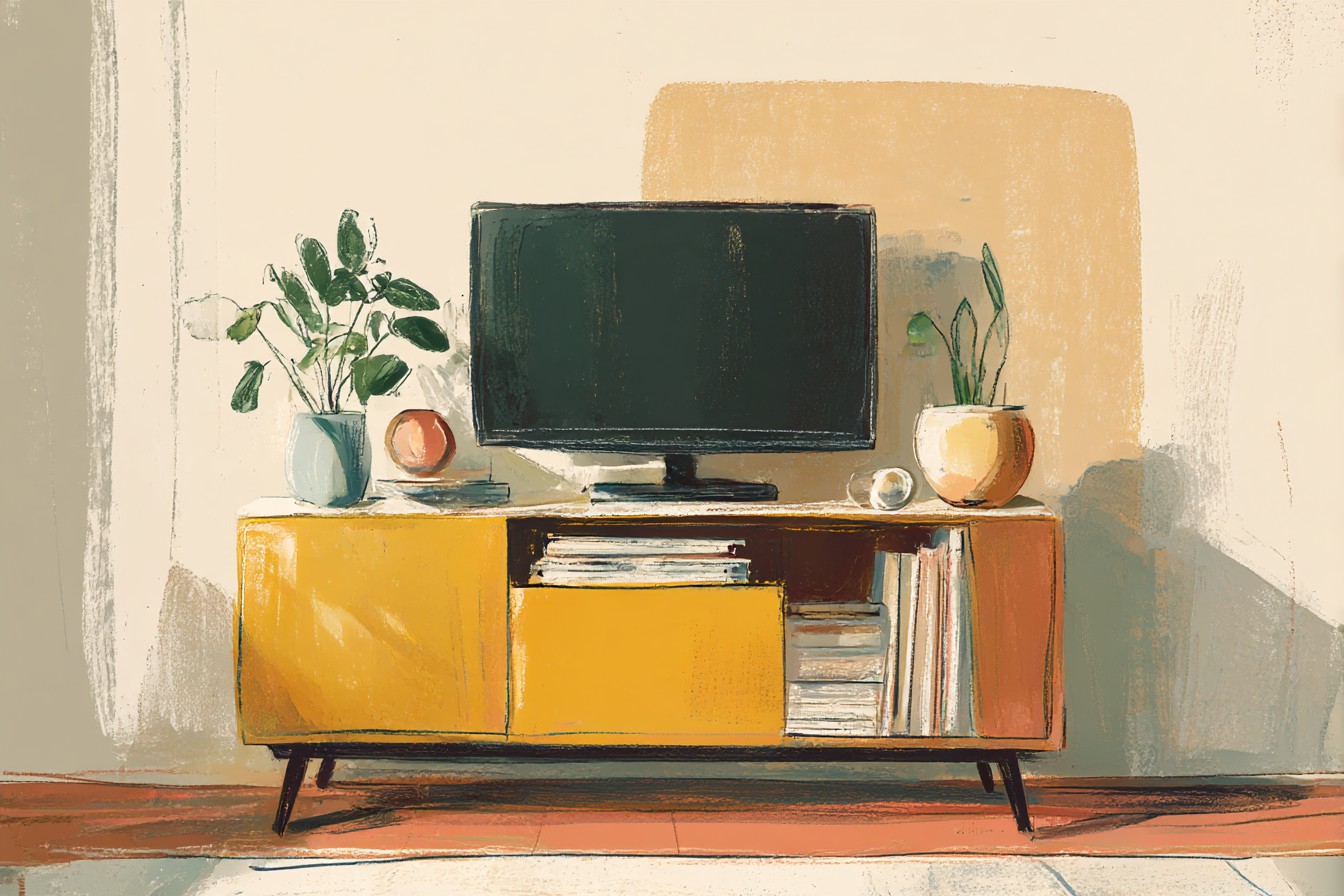
I currently have fourteen objects on top of my television stand. I counted them this morning, out of what I can only call morbid curiosity, and then I stood there for a moment doing the math on how a piece of furniture whose entire job is to hold up a television somehow became the busiest surface in my living room. Two ceramic candlesticks, a dish for nothing in particular, three framed photographs, a stack of five books I have not opened since the Clinton administration, a small brass rabbit my sister gave me in 1994 that I have never once liked and have also never once gotten rid of, and a remote control caddy holding four remotes for a television that technically only needs one of them. Fourteen. On a stand that is, at its core, a box for wires.
Here is the thing nobody tells you when you buy your first TV stand, back when the television itself was the whole event and you were just grateful to have something sturdy enough to hold a set that weighed as much as a small refrigerator. The top of that stand does not stay empty.

It cannot stay empty. It is at exactly the wrong height and exactly the wrong location, dead center of the room, eye level from the sofa, to remain a blank shelf for longer than about eleven days. Something will land there. A birthday card. A set of keys. A candle someone gave you that you’re saving for a special occasion that never arrives. And eventually you look at the whole arrangement and realize the television has become the least interesting thing on its own stand, which is either a design failure or a design opportunity depending entirely on whether you did it on purpose.
I did not do it on purpose the first two times. I did it on purpose the third time, which is the version of my living room I’m sitting in now, and it took me the better part of thirty years to learn the difference between a surface that’s accumulated and a surface that’s been arranged. They look nothing alike even when they contain almost identical objects. I’d like to have a word with the woman who, in roughly 1996, let a television remote basket become the visual centerpiece of an entire wall because she simply never thought to ask what else could go there. She had the space. She just hadn’t noticed it as space yet.
So this is what I’ve actually learned belongs up there, television included, obviously, but very much not television alone.
[Top of a TV Stand]
Candles and Ceramics
Start with the things that don’t do anything, because those are the pieces that make the rest of the arrangement look intentional instead of collected. I mean candles, mostly, and small ceramic objects that have no function beyond existing in a shape you like. My two candlesticks are a pair I bought at an estate sale in Webster Groves for eleven dollars, brass, slightly mismatched if you look closely, and I have never once lit the candles in them because they’re the wrong height for the room and I’m not rearranging my whole life around a fire hazard. They just sit there being brass. That’s their entire job and they do it well.
The mistake I made for a solid decade, and I mean this as an actual confession, not a stylistic flourish, was believing that anything on top of a TV stand needed to be either useful or meaningful. A remote holder, a coaster, a photo of someone you love. It took me an embarrassingly long time to accept that a ceramic dish with nothing in it is allowed to just be a good shape near a good color, full stop, no justification required. My sister looked at an empty dish I’d placed next to the television once and said, “what goes in that,” and I said “nothing,” and she said nothing back, which from her is its own kind of verdict.
What I’d steer you away from is the matched three piece candle set that shows up in every catalog looking identical to the one two seasons ago, always the same taper height, always the same “hand poured artisan” language on something clearly made by a machine in a warehouse. I fell for that exact pitch around 2015 and the set looked generic within about a year, because it was designed to look generic, designed for a photograph, not for a room with actual light hitting it at four in the afternoon. Buy odd numbers, buy things with a little weight and a little age to them if you can, and don’t be afraid to leave a candle unlit forever. Mine have been decorative for six years running and I regret nothing.
[Candles and Ceramics]
Framed Photographs and Small Art
Three frames on my stand right now, and all three are actual photographs, not the stock inserts they came with, which sounds obvious until you remember how many people buy a frame and simply never get around to swapping out the smiling stranger inside it. I did this myself for almost a year in the early two thousands, a frame with someone else’s honeymoon photo in it sitting on my furniture like I’d adopted a stranger’s memory out of sheer inertia. Nobody ever commented on it, which honestly is worse than if they had.
The photographs I actually keep there now are small on purpose, five by seven at the largest, because anything bigger starts competing with the television itself for visual attention, and a photograph should never have to fight a screen for a room’s focus, it will lose every time the television’s turned on and look strange every time it’s off. I lean them rather than hang them, propped against a low stack of books or against the wall behind, slightly angled, which gives the whole surface a kind of unfussed, gathered look rather than a showroom look. That’s the difference, by the way, between decor that reads as lived in and decor that reads as staged. Staged is symmetrical. Lived in leans.
I’ll admit I went through a period, roughly the George W. Bush years if I’m honest about dating myself, of framing black and white photography prints I’d bought specifically to look sophisticated, generic city skylines, none of them mine, none of them anyone’s. They photographed fine. They meant nothing. I’ve since replaced every one of them with pictures of actual people I actually know, including one deeply unflattering photo of my late husband asleep in a lawn chair that makes me laugh every single time I walk past it, which is a much better use of a frame than sophistication ever was.
[Framed Photographs and Small Art]
Books and Bookends
Five books sit on my stand right now, stacked flat, and they’ve been the same five books for probably four years, which tells you they’re doing a job that has nothing to do with reading. Height is the job. A television stand is a horizontal surface holding a rectangular object, and everything else on it is fighting the same flat plane unless something gives it vertical interest. A short stack of books, eight or nine inches high, does that better than almost anything else you could buy specifically for the purpose, and it costs you nothing because you already own books, presumably, unless you’ve gone fully digital, in which case I genuinely don’t know what to tell you.
You Might Also Like

I use hardcovers, always, paperbacks slump and look apologetic stacked on their own, and I choose them by spine color and size rather than by content, which might offend actual readers but I promise nobody browsing my living room has ever picked one up to check. A pair of bookends helps if your stack is doing any real work holding up a lamp or an object, mine are small brass elephants I’ve had since a garage sale sometime in the nineties, and I will say the trend of huge, sculptural bookends the size of doorstops that showed up a few years back baffled me completely, on a TV stand you have maybe six vertical inches to work with before you’re blocking the screen itself, nobody needs a bookend built for a library table.
The one true failure in this category was a set of “decorative books,” fabric covered, no pages inside, sold specifically for styling purposes, that I bought once out of curiosity and regretted within the week. They weighed nothing. They looked like nothing up close. My sister picked one up, felt how light it was, and put it back down without a word, which I’ve come to understand is the harshest review in her entire repertoire.
[Books and Bookends]
Plants, Real and Otherwise
A television stand needs something living on it, or at least something that looks like it could be, because everything else up there, the frames, the ceramics, the books, is static in the same way the screen itself is static when it’s off, and a room full of static objects starts to feel like a display case rather than a home. I keep a small pothos in a plain terracotta pot on the end of mine, and it has survived two moves, one bout of severe neglect during a kitchen renovation, and a cat who briefly found it fascinating in 2019. That’s the actual test for a plant in that spot, not whether it looks nice on day one, but whether it survives being near a heat source and mostly ignored for weeks at a stretch, which is precisely what television stand life involves.
I resisted fake plants for years on genuine principle, feeling they were a kind of decorating cheat, and then I put a very good faux fern on the shelf below my stand, out of direct light, and forgot it wasn’t real for approximately eight months until a guest touched it. I’m not proud of how smug that guest looked. But I’ll say this plainly: a GOOD fake plant, one with some weight to the leaves and a matte finish instead of that plastic shine, holds up in a spot where real light simply doesn’t reach, and pretending otherwise for the sake of purity is its own kind of vanity.
What I won’t do is put anything trailing and delicate directly beside the television, ivy dangling over the corner of a screen looks charming in a photograph and becomes a genuine nuisance the first time you need to dust behind it or the cat decides it’s a toy. Structure over drama, every time, in this particular spot.
[Plants for TV Stands]
Trays and Baskets for the Clutter You Can’t Hide
Now the part nobody enjoys discussing, which is that a television stand attracts remotes, chargers, coasters, and the occasional stray hair tie the way a porch light attracts moths, and no amount of nice ceramics changes that basic physical fact. The honest solution isn’t pretending the clutter doesn’t exist, it’s containing it in something that looks deliberate. I use a low, shallow woven tray, the kind sold for ottomans really, and every remote in the house lives in it, four of them, for a television, a soundbar, a streaming box, and one for a DVD player we have not owned the matching machine for since roughly 2017 and yet somehow still keep a remote for.
A basket does the same job with a bit more height if you’ve got cords to hide too, and I’d say get one with a solid enough weave that you can’t see straight through it, because a basket that shows every cable snaking around inside defeats its own purpose entirely. I bought an open wire basket once, very of the moment at the time, and it looked less like storage and more like an X ray of my clutter, which nobody needs on display.
The trick, and I mean this as the actual point of the whole section, is choosing something with enough visual weight that it reads as a decor object first and a solution second. If your eye goes straight to “that’s where the remotes live,” it’s doing its job wrong.

If your eye goes to “nice tray,” and only later do you register what’s inside it, that’s a tray earning its spot on the stand rather than merely tolerating one.
[Trays and Baskets]
Final Thoughts
Fourteen objects, and I stand by every one of them now, though it took three houses and roughly three decades to get from a bare box holding a heavy television to a surface I actually like looking at with the screen off. The pattern, if there is one, isn’t about buying more things. It’s about making sure whatever lands up there earns its spot rather than simply arriving there by accident and never leaving, the way that brass rabbit clearly has.
What I’d tell anyone starting this project, including the version of me who once thought a stranger’s honeymoon photo was acceptable frame filler for a year, is to treat the top of that stand the way you’d treat a mantel, because functionally that’s exactly what it’s become in most living rooms now. Height variation, a mix of things that do something and things that simply look good doing nothing, and at least one item nobody else would choose but you. That last part matters more than people think. A room furnished entirely from someone else’s list of what belongs on a television stand looks like a showroom, and I have lived in a showroom. It’s not comfortable, and worse, it’s not interesting. Give me the ugly brass rabbit and the unlit candles and the photo of a man asleep in a lawn chair, every single time.