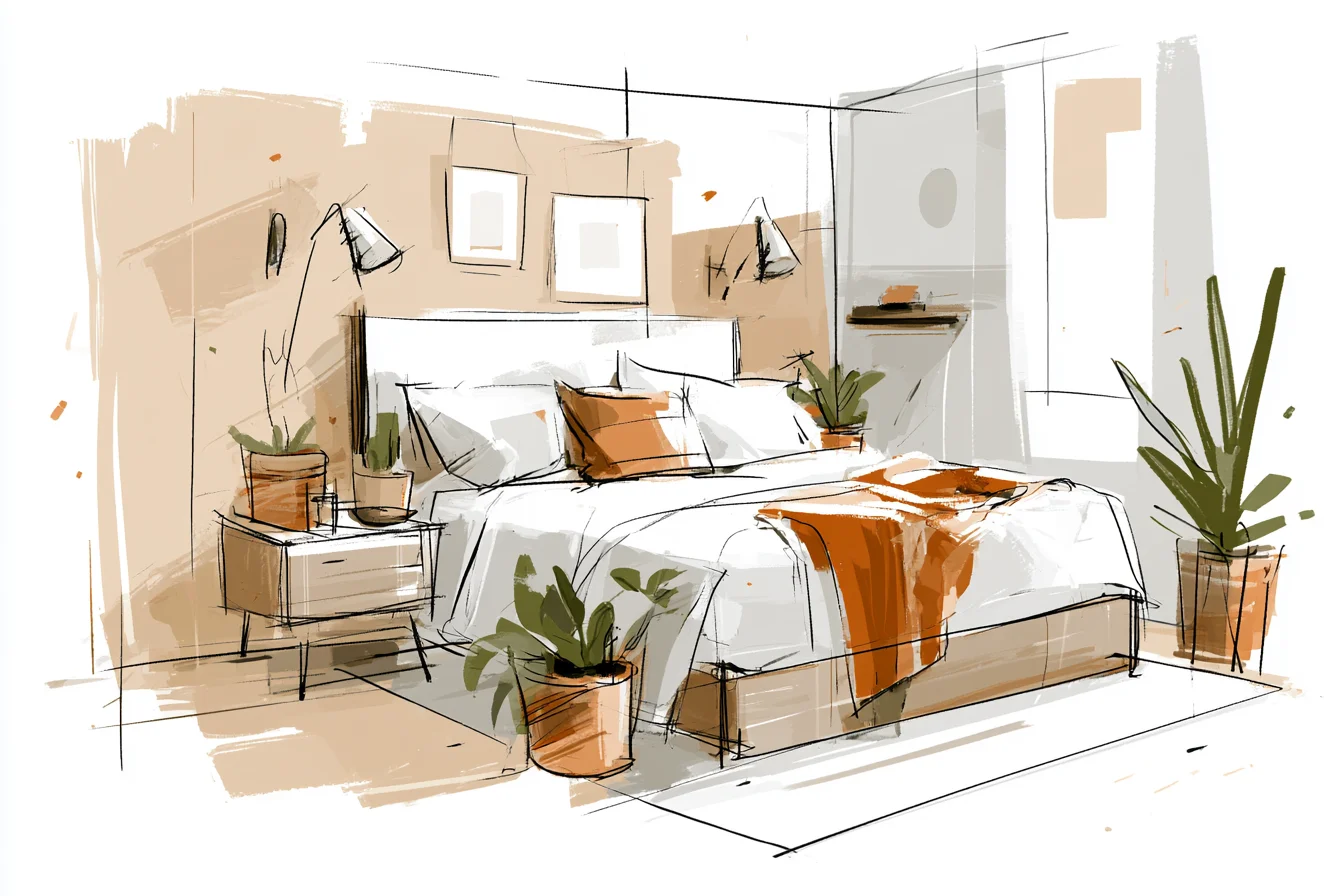
The first time someone walked into my ten- by -twelve bedroom and said “wow, this feels so much bigger than I expected” I knew I had it figured out. Because let’s be real – that bedroom was small. Ridiculously small.
I probably couldn’t even walk comfortably from my bed to my dresser without sidestepping. Instead – somehow – I’d designed a bedroom so that it appeared bigger than its actual dimensions would suggest. How did I do it?
Let me take you through all my tricks and tips. Honestly?

It started with the walls.
I’d been living with beige ones for way too long (we’re talking that depressing ‘builder’s beige’ that makes every stick of furniture and homeware accessory look grim) and knew I wanted something lighter. Everyone was telling me to go navy, to pick a deep, moody colour. Darkest den wallpaper, they promised. “Trust me, dark colours are so impactful,” my friend Helen would coo at me while swiping through photos of glossy Instagram bedrooms.
Except – and this was my gut speaking – it didn’t feel right for my room. Instead, I went to the DIY store and picked the lightest baby blue I could find. The sort of blue that verges on white.
Literally – when I got home I text my sister a photo of the paint pot next to my white walls, and she laughed at me. “Are you sure you want it to be THAT pale?” the store guy had asked me. Yes. Yes, I was sure.
The trick with small rooms is that you want your eye to skim over the walls, not stop and admire them. That ultra pale blue was just light enough that the walls visually receded – instead of throwing themselves forward like pure white would. White can look clinical and boxy when you’re working with limited square footage.
Next up? Don’t shrink down your furniture to match your room. It’s obvious, right?
Make sure your bed and dresser are appropriately scaled for your four-person sleeper sofa turned single bed and voila! Trouble is, most of us think about that logic piecemeal. We get a teeny bedside table because our bedroom is small.
Or buy a dresser so compact it looks like it belongs on hold of a dining chair set. Instead, think about your furniture as both individual elements and as one complete vision. In a small bedroom, you want fewer large items rather than lots of little ones.
One bulky dresser looks intentional. Three bedside tables thrown around the room look like you couldn’t find anywhere better to stash your junk. Speaking of bulky dressers.
When I say that I got mine from eBay, I mean it in the literal sense. I bought a full bedroom suite, took everything off of it except for the dresser, painted it that Same Shade Of White, and voila. It WAS big – wider and taller than I technically “should” have gotten – but because it was a single piece of furniture rather than a dresser, nightstand, and laundry bin all crammed into the same corner it helped to create one clean horizontal line.
See it? My bed was another challenge. Again, I couldn’t exactly replace my mattress with something smaller, but I COULD get rid of the bulky bed frame I’d been given as a wedding gift and replace it with something more minimalist.
You Might Also Like
So I did. I built myself a simple wooden platform bed base (literally just a low wooden rectangle) that allowed my bed to sit ‘floating’ above the ground. None of my mattress legs broke up the visual horizon line of the bed, and because I didn’t have an ornate headboard sucking up valuable wall space it helped create a sense of clean horizontal and vertical lines that didn’t fight with the rest of my furniture.
Mirrors are great for opening up small rooms – but only if you do it right. Hang the wrong mirror on the wrong wall and you just end up with creepy reflections of yourself when you thought you were creating elegant illusions. I found this gorgeous carved mirror at a car boot sale for five quid (mirrors always are) and hung it on the wall directly opposite my microscopic window.
Now I basically have two windows’ worth of light pouring into the room, AND the mirror gives the illusion of another window on the opposite side of the room. BONUS. The only thing?
I hung it so that it reflected something attractive. Sure, the bed bur Banksy print by my door were part of my bedroom – but by hanging the mirror opposite the nice bits (dresser + window reflection) I tricked the eye into focusing on that instead of my dirty laundry collection. Next up?
Clever storage. Let’s be real – most of us can’t afford custom-built wardrobes (I know I DEFINITELY can’t) and while standalone wardrobes CAN work in small spaces they always make the room feel more cramped than before. So what’s a homemade hoarder to do?
Get creative. I installed a clothing rail in my bedroom corner and hung just my seasonally-worn clothes on it. Everything else got packed away under the bed in THESE flat storage boxes.
The rail itself became less of an eyesore and more of a feature when I hung my clothes organised by colour gradient. Light whites at the top, darks in the corners. It’s SUCH a silly thing to do – but after living with my clothes filed that way, seeing anything less feels mildly stressful.
And since we’re on the subject – LIGHTING is everything. My original bedroom came equipped with one of those awful spotlights glued to the ceiling. While I could – technically – rewire the room to add more fixtures, I knew from experience that ANY light mounted on the ceiling was going to disappear.
Sure, it might light up my face when I sat at my dresser… but the rest of my room would be lost in shadows.

So I didn’t use it. Not once.
Instead I layered my lighting with three sources – a tall floor lamp in the corner, some string lights around my window frame (hi, I’m that person), and finally a little table lamp on my dresser. Layering your lighting creates depth because you’re highlighting different areas of the room from different angles. Instead of flat lighting and harsh shadows, your whole room is lit evenly.
Finally… curtains. Yes, even your curtains are important. Instead of buying ones that just covered my window, I mounted the rail nearer to ceiling height and had them extend several inches on either side of my window.
When closed, my curtains covered not just my window but a solid six inches of wall on either side of it. It tricks your eye into thinking that the window is wider – and therefore the room is bigger. And just like my walls, I went with a lightweight linen that matched the colour scheme of the rest of the room.
Literally disappearing into the background the instant anyone walked into my room.