I was on my knees Tuesday morning, vacuum attachment in one hand, phone flashlight in the other, trying to work out what exactly had colonized the space under my coffee table, when I found a single sock, three coasters that don’t match anything I own, a paperback I’d declared lost in 2019, and a candle that had melted itself into the shape of the shelf slightly warped from a summer with the air conditioning off. That’s the bottom shelf of a coffee table for you. Nobody plans what goes there. It just happens, the way lint happens, the way a junk drawer happens, except this particular junk drawer sits in the middle of your living room in full view of anyone who comes to sit down.
I’ve had four coffee tables in this house across three separate decades, and every single one of them had a lower shelf, and every single one of them ended up looking like the inside of a glove compartment within about six weeks of moving in. There’s something about a flat, open surface at knee height that invites chaos the way a clean countertop invites a stack of mail. It’s not a failing of character.

It’s just what happens when a piece of furniture offers you storage without offering you any rules about how to use it.
But here’s the thing I’ve come around to, slowly, the way I come around to most things: that shelf is actually one of the more useful pieces of real estate in the whole room, if you treat it like storage instead of a landing strip. There’s a real difference between a bottom shelf that reads as “this person has thought about what lives here” and one that reads as “this person gave up sometime in March.” The furniture hasn’t changed. What’s sitting on it has.
I’d like to have a word with the woman who, sometime in the early 2000s, decided the solution to a messy lower shelf was simply more baskets, stacked, no system, just baskets containing other baskets like some sort of storage nesting doll. It didn’t work. It just moved the chaos one layer deeper and made it heavier to lift. What actually works is narrower than that, and more deliberate, and I’ve spent long enough rearranging this particular six square feet of my house to have opinions about what earns a spot down there and what doesn’t.
[Using the Lower Shelf of a Coffee Table]
Baskets and Bins, Chosen for What They Hide
The instinct is always to grab whatever basket’s cheapest and biggest, and I understand the instinct, because a bigger basket feels like it solves more problems. It doesn’t. A basket that’s too deep just becomes a pit where things go to be forgotten, remote control batteries at the bottom, a phone charger nobody can locate, the television remote itself buried under a throw blanket someone shoved in there in a hurry before guests arrived. What I’ve landed on, after going through at least six different systems over the years, is a low, wide basket, something you can see into without digging, seagrass or a tightly woven rattan that holds its shape rather than slumping sideways the second it’s half empty.
I keep exactly two down there now. One holds the actual clutter of daily life, remotes, a deck of cards, the reading glasses I lose eleven times a day. The other holds nothing practical at all, just a folded throw, because an empty looking basket with texture in it does more for a room than a full one crammed with cables. My sister came over in the fall, looked at the shelf, and didn’t say anything, which from her is genuinely a compliment, she only comments when something’s gone wrong. The trick isn’t the basket itself, it’s restraint about what goes inside it. The day a basket needs a second basket inside it to stay organized is the day you have too much stuff living under your coffee table, full stop.
[Storage Baskets]
Books, Stacked Like You Mean It
I went through a period, and I’ll own this fully, where I thought a lower shelf existed to hold every book I owned that didn’t fit on the actual bookshelf. It looked like a library that had given up on itself, spines every direction, a paperback wedged sideways to keep the stack from toppling. That’s not styling, that’s overflow, and there’s a real difference between the two.
What works now is far more limited, and honestly more satisfying to look at. Three or four books, stacked flat rather than upright, chosen for how they look as much as what’s inside them. I’ve got an old, oversized art book from a trip to Chicago decades ago sitting on the bottom of my current stack because the cover’s a color I like and the size anchors the pile. On top of that, something slimmer, and then whatever I’m actually reading, which changes but never grows the pile past four books deep because past four it starts to lean, and a leaning stack of books under a coffee table looks less like a home and more like something about to fall over onto someone’s foot. If you’ve got more books than that needing a home, that’s a bookshelf problem, not a coffee table problem, and no amount of clever stacking down here is going to fix a bookshelf you’ve outgrown.
[Book Storage]
You Might Also Like

Trays, for the Things That Actually Need Reaching
This is probably the shelf’s best use, and it took me the longest to figure out, mostly because a tray feels like an unnecessary extra step when you could just set things down directly. But a tray does something a bare shelf doesn’t, it draws a boundary. Everything inside the tray belongs there, on purpose, and everything outside it is clutter that snuck in when nobody was watching.
I use a low wooden tray for the stuff that gets touched daily, coasters, a small stack of napkins, the TV remote again because apparently that thing needs to live in three places at once. The edges of the tray keep it from sliding around every time someone kicks the shelf reaching for something, which happens more than I’d like to admit in a house with a dog that treats the coffee table as a personal obstacle course. What I got wrong for years was choosing trays that matched the coffee table’s wood tone so closely that the whole thing disappeared into one beige blur. A tray works better when it reads as its own object, a different material, a bit of contrast, so your eye actually registers “ah, that’s where the coasters live” instead of scanning past a flat expanse of sameness. It sounds like a small thing. It changes how tidy the whole shelf reads from across the room.
[Coffee Table Trays]
Games, Kept Out and Actually Used
My grandkids come over most Sundays, and for a while I kept every game we owned in a hall closet, which meant nobody ever asked to play any of them because nobody remembered they existed. Moving two or three onto the lower shelf changed that completely, not because the games got better, but because visibility does something a closet never will. A stack of card games in a shallow box, a wooden set of dominoes in a tin that looks decent enough to be seen, that’s the difference between “we should play something sometime” and someone actually pulling a deck out mid conversation.
This only works if you’re honest about which games you actually play. I kept a Scrabble box down there for two years out of a vague sense that I should be the kind of person who plays Scrabble, and nobody touched it once. It came off the shelf eventually, replaced by a set of playing cards and a small box of dominoes that get used weekly, and the shelf looks better for holding things with actual fingerprints on them rather than things holding a place for an imagined version of my Sundays. If nothing gets played, it’s decoration pretending to be function, and decoration pretending to be function is exactly the kind of thing that ends up gathering dust in a spot where dust is extremely visible.
[Games Storage]
A Little Room for Nothing at All
Here’s the one that took me the longest to accept, because it runs against every instinct I have about a shelf that’s sitting there empty feeling like wasted space. Sometimes the correct answer is to leave part of it alone. Not the whole thing, I’m not suggesting you turn a functional shelf into a design magazine’s idea of minimalism where nothing lives anywhere and everyone’s afraid to set a mug down. Just a portion of it, a clear stretch of surface with nothing occupying it, so the eye has somewhere to land between the basket and the stack of books.
I resisted this for years because empty space felt like an opportunity I was failing to use.
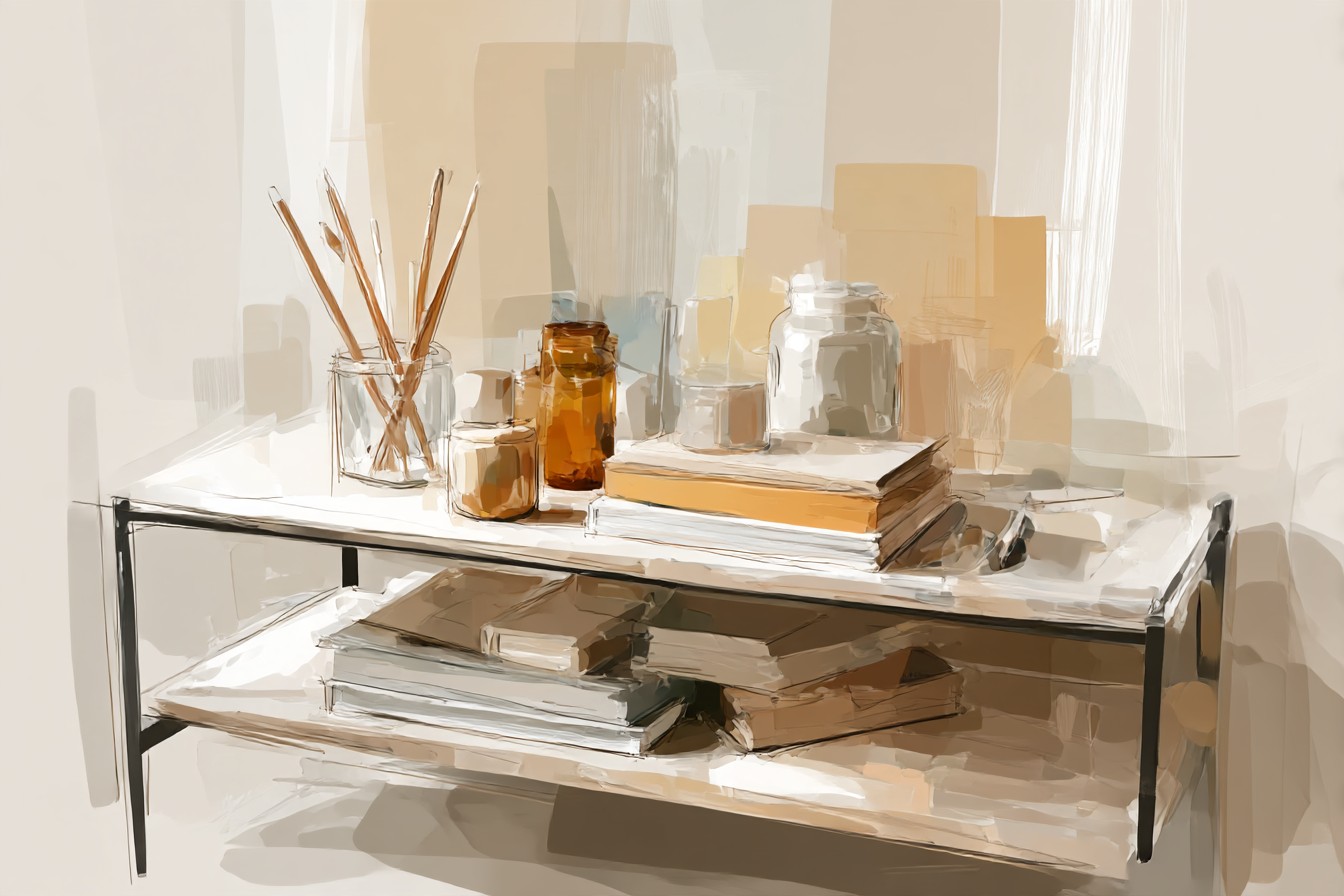
Then I actually left about a third of the shelf clear on purpose, just wood, nothing on it, and the whole table suddenly read as considered instead of crammed. It’s the same principle as leaving a blank wall instead of hanging something on every square inch of it. A shelf that’s completely full, no matter how nicely organized, still reads as full. A shelf with breathing room reads as chosen. That’s really the whole difference between tidy and piled up, and it’s not about better containers, it’s about having the nerve to leave a gap.
[Empty Shelf Space]
Final Thoughts
If there’s one thing I’d tell the version of myself who kept cramming that lower shelf full of whatever didn’t have another home, it’s that the shelf isn’t a problem to solve once and forget about, it’s more like a houseplant, it needs the occasional look and a bit of editing or it drifts right back into chaos within a season. Mine’s currently holding two baskets, four books, a tray with the remotes in it, a tin of dominoes, and a stretch of bare wood I had to talk myself into leaving alone. It took me three coffee tables and about twenty years to land on that particular mix, which either means I’m slow or means it genuinely takes that long to figure out what a household actually uses versus what it just tolerates having around.
Either way, the lower shelf of a coffee table isn’t asking for much. It wants boundaries, a few things chosen on purpose, and somebody willing to occasionally get down on their knees with a flashlight and admit that the melted candle has got to go.